
Heated extensions on Briar Hill, Camp Hill and Hunsbury homes
Semi-detached houses are 30% of Northampton's homes, and the development corporation estates in the south generate a large volume of extensions. Heating is simplest to add where a single-storey extension is going on. Nothing is there yet, so the designer can allow enough depth for the insulation, the pipework and the screed, and set the finished level to line up with the old house.
The difficulty comes when the owners want the heating to run on into the original rooms. There, the old floor has to be taken up far enough to fit the whole build-up under thresholds and the bottom stair. Every millimetre counts, and the screed choice often decides whether it fits.
Pumped screed has to cover the pipes by 25mm or more, for a screed of around 45 to 50mm. Hand-laid sand and cement wants roughly 45mm on top of them, so the floor grows noticeably deeper. Liquid also flows fully round the pipes with no voids and warms up faster, because there is less mass to heat, which is why it is usually the first choice for a retrofit. Around 20mm saved can mean the original doors stay as they are. Sand and cement stays useful in rooms that may get wet.
We can supply the insulation, the membrane and the perimeter strip, or we will look over what is already down, and our guide to how thick screed should be shows typical build-ups. For the pumping side of a heated floor, see liquid screed in Northampton.
Commissioning heated floors at Grange Park and beyond
Newer homes at Grange Park suit liquid screed over underfloor heating, and on a new plot the system is usually designed with the floor from the outset. The pour itself is quick. The weeks after it are where heated floors succeed or fail.
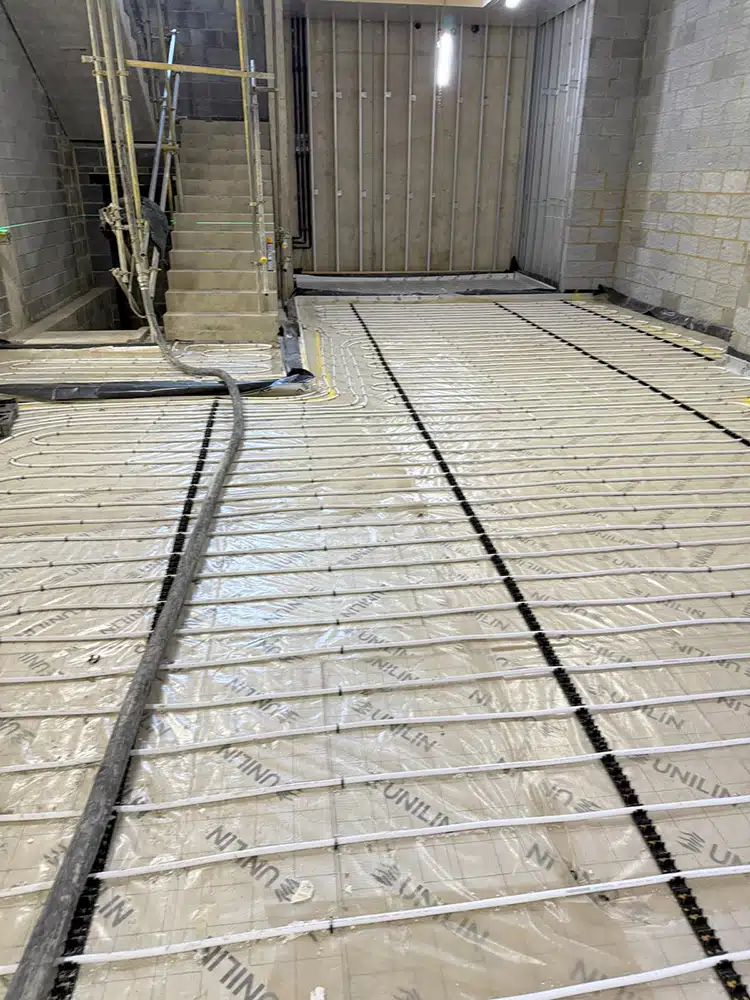
Before we arrive, the pipes must be clipped down, filled and pressure tested by the installer, with the edge strip fixed and the membrane taped. After the pour, the heating stays off at first. Heat can normally go into calcium sulphate after around 7 days. On sand and cement, the system stays off for 21 days or more.
Commissioning should then be gradual. Begin with the flow temperature turned low and lift it a notch at a time across several days, working to the heat-up schedule we hand over. Full heat on a young screed can crack it or break its contact with the pipes.
When the moisture test passes, the heated floor gives a level surface ready for engineered wood, LVT or tiles. The same rules apply to a garden room with its own insulated base anywhere in the town, whether in Boughton Green or Lodge Farm. Heated floors in Towcester and Wellingborough are planned the same way.
Underfloor Heating Screed prices in Northampton
Liquid screed over underfloor heating: £20 to £35 per m² supplied and laid (trade2base, June 2026), so £700 to £1,230 for 35 m². trade2base gives these figures excluding VAT. See our floor screeding cost guide or screed calculator.
Who lays your underfloor heating screed in Northampton
K & B Screeding’s own team, led by director Donatas Bardisevicius. Founded 2019, company 12298780.
See what customers say in our Google reviews and on our testimonials page.
Underfloor Heating Screed from Slough to Northampton
Northampton is about 49.9 miles north-north-west of our Slough base as the crow flies, with postcodes including NN1, NN3, NN4 and NN2. The nearest towns to it are Towcester (8.3 miles), Wellingborough (9.7 miles), Daventry (11.3 miles) and Burton Latimer (12.6 miles).
More on underfloor heating screed, part of our screeding services.
