
New heated floors at Hanwood Park and Barton Point
New homes at Hanwood Park are mostly specified with flowing screed and underfloor heating, and that combination is well understood. The insulation, pipes and screed depth are drawn by the designer, the heating installer lays and tests the pipes, and the screed follows.
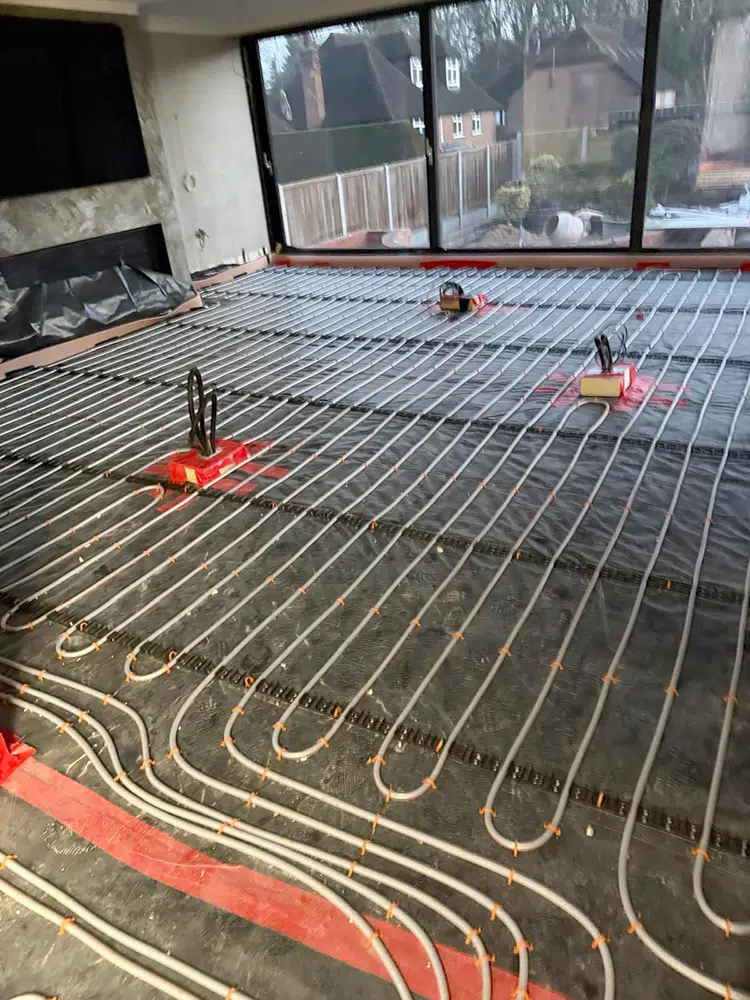
The numbers still need checking on the day. There must be 25mm or more of liquid screed over every pipe, so the whole floor usually comes to 45 to 50mm. Pipes must be clipped down firmly, because a flowing screed will lift any loose loop. The system has to be filled and pressure tested, the edge strip fixed round every wall and the membrane taped at the joints before the pour starts.
Liquid screed suits heated floors for simple physical reasons. It flows fully round the pipes and leaves no air pockets, so heat passes evenly into the floor, and its thinner section warms up faster than a thick sand and cement floor, so the rooms respond sooner when the thermostat changes.
Where a new plot calls for calcium sulphate, the grade and the laitance treatment matter as much as the depth, and those are covered on our anhydrite flow screed page for Kettering. Self-builders and small developers elsewhere in Kettering face the same checks, and the screed thickness guide sets out typical build-ups for heated and unheated floors.
Heated extensions on Kettering's post-war semis
A rear extension or garage conversion on one of Kettering's post-war or later semis is a natural place to add underfloor heating. The new floor can be designed to meet the house, with room for insulation, pipes and screed.
Bringing the heating into the original rooms is harder. The old floor has to come up far enough to take the whole build-up, and the new floor must still meet thresholds and the stairs. A liquid screed totalling 45 to 50mm is normally the easier fit, because sand and cement wants roughly 45mm over the pipes before you count anything else. Sand and cement is still chosen where a room may get wet.
Then comes patience. Heat can normally go into calcium sulphate after around 7 days, but a sand and cement floor has to wait 21 days or more. Keep the first flow temperature low and lift it a step at a time across several days, as the heat-up schedule sets out. Heating a young screed hard and fast can crack it.
Homes built since 2000 make up 19% of the town, and houses of that age are more likely to have insulated ground floors, which makes a retrofit easier to plan. The insulation and membranes can be checked or supplied as part of the job, and screed over heating in Wellingborough follows the same approach.
Underfloor Heating Screed prices in Kettering
Liquid screed over underfloor heating: £20 to £35 per m² supplied and laid (trade2base, June 2026), so £700 to £1,230 for 35 m². trade2base gives these figures excluding VAT. See our floor screeding cost guide or screed calculator.
Who lays your underfloor heating screed in Kettering
K & B Screeding’s own team, led by director Donatas Bardisevicius. Founded 2019, company 12298780.
See what customers say in our Google reviews and on our testimonials page.
Underfloor Heating Screed from Slough to Kettering
As the crow flies, our yard in Slough is about 60.1 miles from Kettering, which lies to the north. Postcodes here include NN16, NN15 and NN14, and Burton Latimer (3.3 miles), Desborough (4.9 miles), Corby (6.2 miles) and Wellingborough (6.9 miles) are close by.
More on underfloor heating screed, part of our screeding services.