
From Hanwood Park plots to Headlands kitchen extensions
Liquid screed pays off where the floor is large, open or heated. Three kinds of Kettering building fit that description.
New homes come first. At Hanwood Park, the neighbourhood growing at Barton Point, houses are mostly designed for flowing screed over underfloor heating. The screed flows round every pipe with no voids, finishes to SR1 or SR2 flatness readily and needs few joints because it shrinks so little.
Next are the larger period houses around the Headlands, which bring bigger extensions and kitchen projects. Knocking a back room into a new extension creates one wide floor, and a pumped screed covers it in a day once the levels are set to meet the old house.
Third are flats. Flats of every kind make up 16% of Kettering's homes, and a pumped screed can reach an upper floor by running the hose up the stairs, avoiding barrowing sand and cement through a communal hallway. The building owner needs to agree the route and any acoustic requirements first.
Depth follows the build-up. Floated on insulation, it can be as shallow as roughly 35mm in a house, or roughly 40mm on a commercial job. Pipes underneath need 25mm or more on top of them, which is why heated Hanwood Park style floors tend to finish at 45 to 50mm. You can have a liquid screed with either a calcium sulphate or a cement binder, and the grades and specification for the first are set out on our Kettering anhydrite screed page.
Parking the pump on Kettering streets
Our mixer and pump stay out on the street or driveway while a hose carries the screed indoors. That makes access the first practical question on any Kettering pour.
Where there is off-road space in front of the house, that part is easy. The Victorian and Edwardian terraces off the town centre are tighter, and the vehicles may need to stand on the carriageway, so mention yellow lines, permit bays and narrow junctions when you ask for a price. The hose can run through a hallway, but the route must be clear, sheeted and free of anything that could snag it. On a new-build plot, the site manager usually sets the delivery time and the standing area.
Before we arrive, every wall in the room wants its perimeter strip, every membrane seam needs tape, and each doorway needs a dam. Liquid screed finds any gap, and a missed seam can let it run under a wall or lift the insulation.
After the pour, the floor is walkable in a day or two but far from dry. As a rough guide it loses moisture at a day for each millimetre up to 40mm, then more slowly. Using the heating to help is covered on our underfloor heating screed page for Kettering, and liquid screed in Burton Latimer follows the same approach next door.
Liquid Screed prices in Kettering
Liquid screed: £24 to £31 per m² supplied and laid (MyJobQuote, August 2026), so £960 to £1,240 for 40 m². MyJobQuote does not say whether these figures include VAT. See our floor screeding cost guide or screed calculator.
Who lays your liquid screed in Kettering
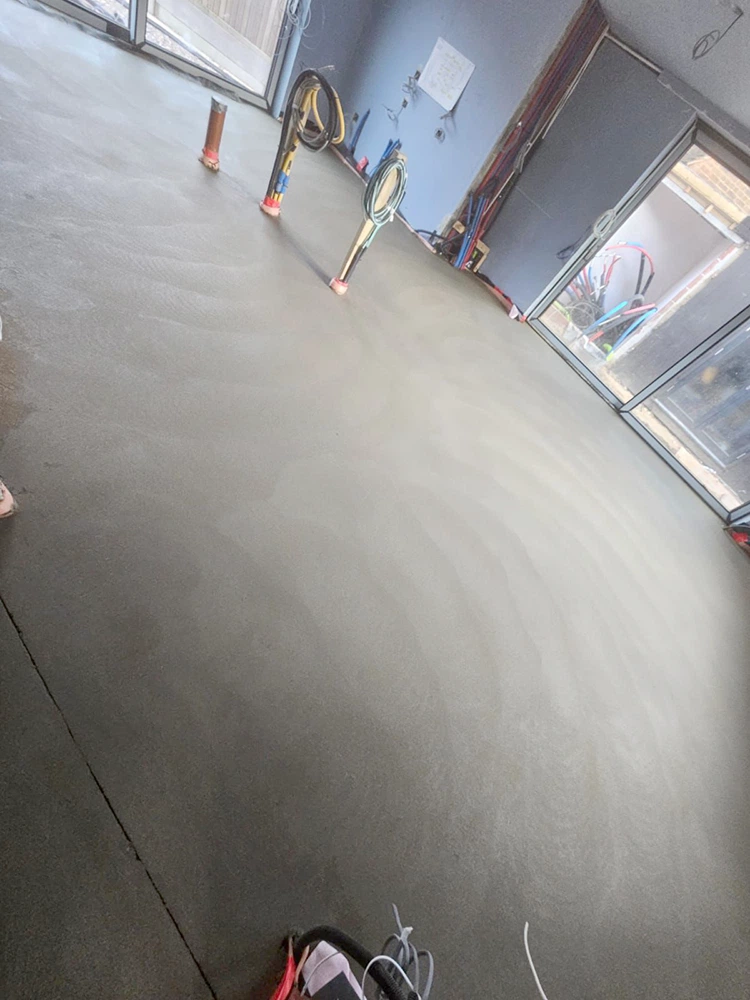
K & B Screeding’s own team, led by director Donatas Bardisevicius. Founded 2019, company 12298780.
See what customers say in our Google reviews and on our testimonials page.
Liquid Screed from Slough to Kettering
As the crow flies, our yard in Slough is about 60.1 miles from Kettering, which lies to the north. Postcodes here include NN16, NN15 and NN14, and Burton Latimer (3.3 miles), Desborough (4.9 miles), Corby (6.2 miles) and Wellingborough (6.9 miles) are close by.
More on liquid screed, part of our screeding services.