
Anhydrite specifications on Hanwood Park and apartment floors
Anhydrite grades follow a code laid down in the European screed standard. CA names the binder; after that, C gives the crushing (compressive) strength and F the bending (flexural) strength, each in N/mm2.
CA-C20-F4 is for lightly used rooms in a house.
CA-C25-F5 is what the majority of houses, flats and offices are poured in.
CA-C30-F6 is for floors in heavier use.
Where a new home at Hanwood Park is specified with a calcium sulphate flowing screed, the grade comes from the developer's engineer, and that is the grade we pour. On an apartment block, the grade may change between areas, for example between the flats and a communal corridor, and each zone needs to be clear on the drawings before we price.
Alongside those grades are the alpha hemihydrate products. Specifiers turn to them when a floor must dry sooner or be laid thinner, for instance in a refurbishment with little height to spare, and each one is laid and dried to its own data sheet instead of general rules.
Because calcium sulphate barely shrinks, a Kettering apartment floor can be poured in big bays with only a handful of joints. Bay and joint positions are still planned before the pour: at doorways, where rooms change shape and where heating zones meet. In a block of flats, those joints also need to respect any acoustic details the designer has set, since the screed floats on its layer and must not touch the walls.
Sanding, priming and testing a Kettering anhydrite floor
Drying calcium sulphate leaves laitance behind, a fragile film across the top. When the floor has dried far enough, we sand that film away to firm screed underneath and then apply a primer designed for calcium sulphate. Leave the laitance in place, or use the wrong primer, and the tiles, LVT or wood end up fixed to a layer that can break away.
The moisture test catches people out. Flooring makers often accept less moisture in anhydrite than in a cement screed. Our hygrometer result is held up against the figure for whatever flooring you have chosen. Where heating is fitted, running it gently from around day 7 on a step-by-step schedule usually speeds drying.
The material has one clear weakness. Long spells of wet weaken it, so a shower room, a wet room or a utility floor where leaks are likely should get a cement based flowing screed or a hand-laid Kettering sand and cement floor. If the dried floor still needs a skim before thin sheet flooring, floor levelling in Kettering uses primers matched to calcium sulphate. For the chemistry behind it, read our anhydrite screed explainer.
Anhydrite & Flow Screed prices in Kettering
Liquid flowing screed (which includes anhydrite): £24 to £31 per m² supplied and laid (MyJobQuote, August 2026), so £960 to £1,240 for 40 m². MyJobQuote does not say whether these figures include VAT. See our floor screeding cost guide or screed calculator.
Who lays your anhydrite and flow screed in Kettering
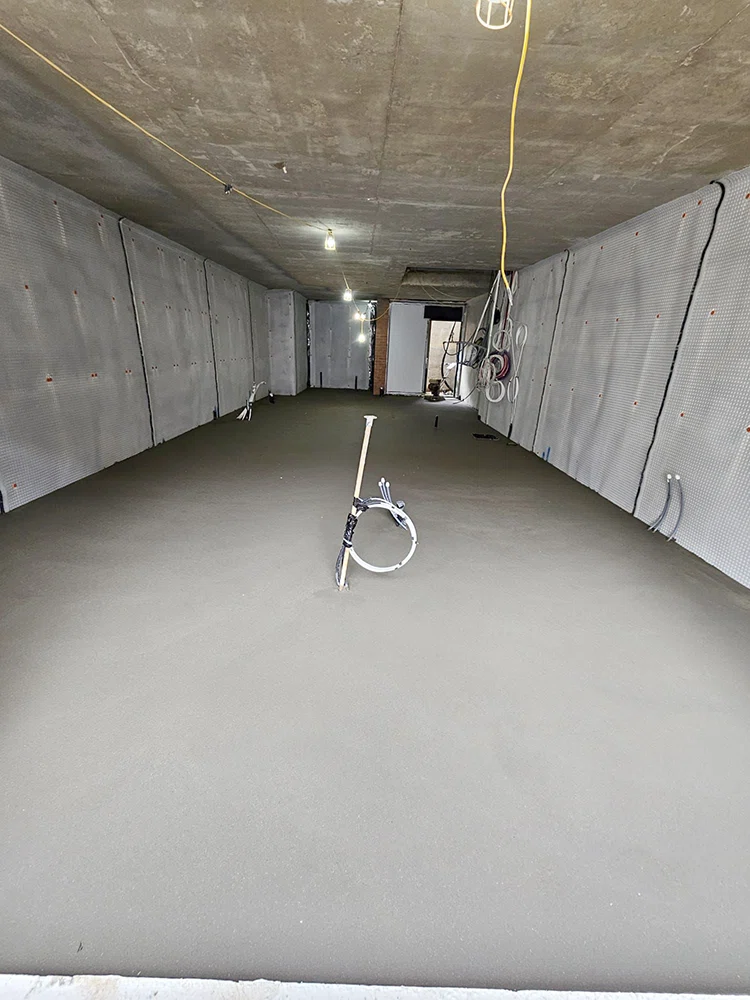
K & B Screeding’s own team, led by director Donatas Bardisevicius. Founded 2019, company 12298780.
See what customers say in our Google reviews and on our testimonials page.
Anhydrite & Flow Screed from Slough to Kettering
As the crow flies, our yard in Slough is about 60.1 miles from Kettering, which lies to the north. Postcodes here include NN16, NN15 and NN14, and Burton Latimer (3.3 miles), Desborough (4.9 miles), Corby (6.2 miles) and Wellingborough (6.9 miles) are close by.
More on anhydrite screed, part of our screeding services.