
Anhydrite grades on Corby apartment and plot drawings
Specifications rarely just say anhydrite. They give a code, for example CA-C25-F5: CA tells you it is calcium sulphate, the number after C is the crushing strength and the number after F the bending strength, both in N/mm2.
In practice three grades cover most buildings. For a bedroom or living room with only light wear, CA-C20-F4 does the job. Apartments, most houses and offices are normally drawn as CA-C25-F5, while floors that take more of a beating are given CA-C30-F6. Where a developer wants faster drying or a thinner section, an alpha hemihydrate product may be specified, and those are laid to their own product sheet rather than general rules.
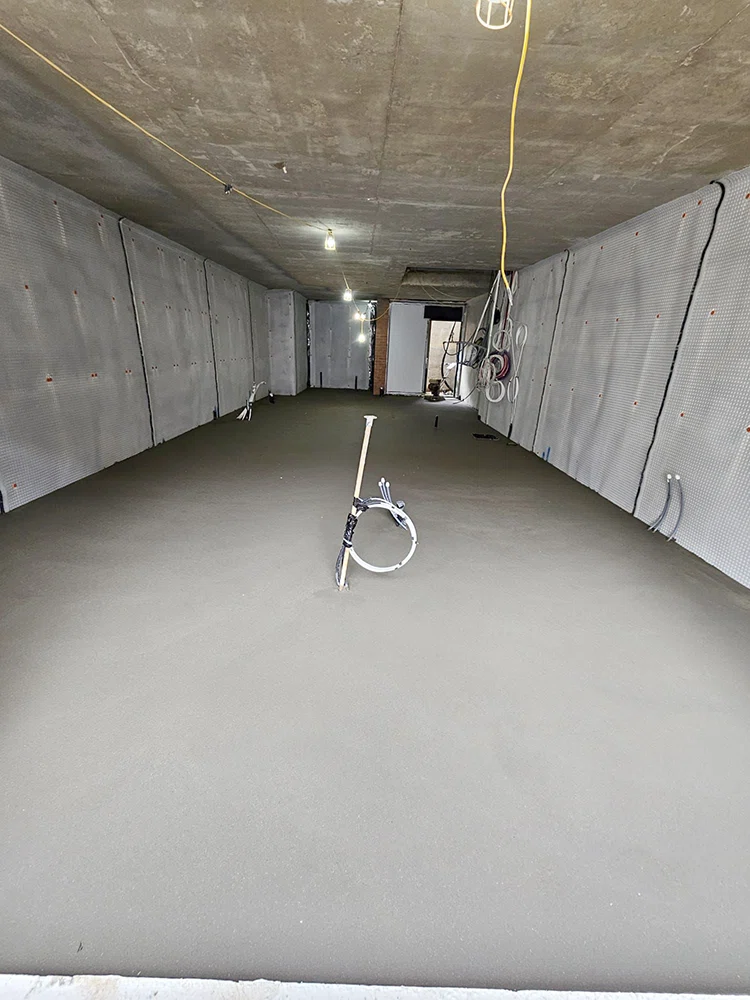
The material hardly shrinks as it sets, so a whole apartment level can go down in wide bays with hardly a joint. That suits apartment floors, where each level is a big, open area over insulation, and new houses where the ground floor runs open plan. On plots with heating pipes it has a further advantage: the heating can be used to force dry it from about 7 days.
Doorways and the line between two heating zones still want a joint, and we mark every one on the plan ahead of pour day. The build-up beneath, whether insulation, underfloor heating or a concrete base, is prepared by our own team. For more on the material itself, how anhydrite screed works is a good starting point.
Before flooring goes down on a Corby anhydrite screed
Calcium sulphate screed needs finishing work that cement screeds often do not. While it cures, a soft, chalky skin, laitance, rises to the surface. Flooring adhesive will grip the laitance rather than the screed, and that layer can fail under tiles or LVT. When the moisture allows, we sand that skin away and seal the floor with a primer approved for calcium sulphate.
Moisture testing comes next. Flooring suppliers usually set a stricter moisture limit for this material than for cement, so we take a hygrometer reading and compare it with the limit the floor supplier gives. We hand over drying and laitance advice in writing, which helps when the flooring contractor is a separate firm.
Anywhere water may sit, such as a wet room or shower area, should get a flowing mix made with cement, or a floor laid by hand. The Corby sand and cement screed page covers those. For factory and warehouse floors on the northern industrial estates, calcium sulphate is not the usual answer, and heavier duty high strength screed is.
Anhydrite & Flow Screed prices in Corby
Liquid flowing screed (which includes anhydrite): £24 to £31 per m² supplied and laid (MyJobQuote, August 2026), so £960 to £1,240 for 40 m². MyJobQuote does not say whether these figures include VAT. See our floor screeding cost guide or screed calculator.
Who lays your anhydrite and flow screed in Corby
K & B Screeding’s own team, led by director Donatas Bardisevicius. Founded 2019, company 12298780.
See what customers say in our Google reviews and on our testimonials page.
Anhydrite & Flow Screed from Slough to Corby
As the crow flies, our yard in Slough is about 66.1 miles from Corby, which lies to the north. Postcodes here include NN17 and NN18, and Desborough (6 miles), Kettering (6.2 miles), Burton Latimer (8.7 miles) and Market Harborough (9.4 miles) are close by.
More on anhydrite screed, part of our screeding services.
