
CA grades for Peterborough apartments and new homes
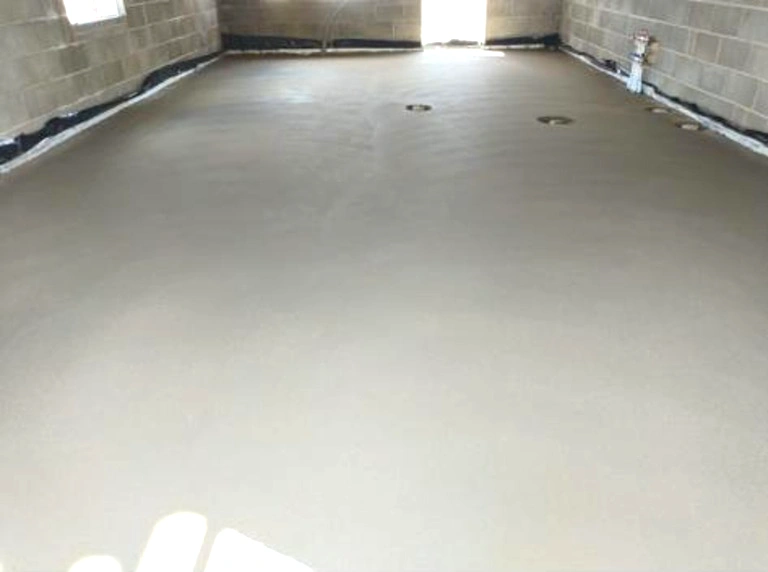
Calcium sulphate is the binder in anhydrite. Very little shrinkage happens while it cures, so bays can be big and joints few, and as it flows it seals itself round heating pipes. Developers specify it for exactly those reasons.
Specifications write it as a CA code. After C comes compressive strength, after F flexural, and the unit for both is N/mm2.
For a domestic floor with little traffic, CA-C20-F4 is adequate. The workhorse across homes, apartments and offices is CA-C25-F5, while busier commercial space with heavier use steps to CA-C30-F6.
Then there is alpha hemihydrate. Specifiers reach for it if speed of drying or a slimmer section counts, a refurbishment squeezed for floor height being one case. Each brand publishes its own product sheet, which we pour to.
On an apartment floor the screed usually sits over acoustic insulation, and the bay and joint layout has to be planned around doorways, corridors and changes of room before the pour. That layout is drawn up by K & B, and the layers underneath are put in by the same crew.
New houses are the other main use in the city, where the drawings for a heated ground floor may call for a flowing calcium sulphate floor. If you want the general case for pumped screed instead, see the Peterborough liquid screed page.
Before flooring goes on a Peterborough anhydrite floor
Pouring is only part one on calcium sulphate. Three jobs follow before a covering goes down.
First, laitance. Curing throws up a weak, thin crust on top. After drying, sanding takes that crust off and the dust gets cleaned up. Leave it on, and adhesive or compound can fail.
Second, moisture. Flooring makers frequently ask for a drier calcium sulphate base than they would accept on cement, which makes the hygrometer reading count for more. Where the floor is heated, its own pipes can force dry it, normally from around day 7.
Third, priming. The primer must be compatible with calcium sulphate, and the flooring contractor needs to know what base they are working on. Sanding and priming are both part of preparing floors for covering.
Where the floor may get wet, anhydrite is the wrong choice. Bin stores, plant rooms and wet rooms in an apartment block are typical examples. A cement based flowing screed is used there instead, and we can offer one alongside the calcium sulphate pour on the same project.
We put all of this in writing when the pour is finished, so the flooring contractor on a Peterborough scheme knows the grade, the date and what must happen before they lay. For the reasoning behind each step, read about anhydrite screed.
Anhydrite & Flow Screed prices in Peterborough
Liquid flowing screed (which includes anhydrite): £24 to £31 per m² supplied and laid (MyJobQuote, August 2026), so £960 to £1,240 for 40 m². MyJobQuote does not say whether these figures include VAT. See our floor screeding cost guide or screed calculator.
Who lays your anhydrite and flow screed in Peterborough
K & B Screeding’s own team, led by director Donatas Bardisevicius. Founded 2019, company 12298780.
See what customers say in our Google reviews and on our testimonials page.
Anhydrite & Flow Screed from Slough to Peterborough
On the map, Peterborough sits north-north-east of Slough, about 73.9 miles from our base in a straight line (postcodes including PE1, PE7, PE3 and PE4), next to Whittlesey (5 miles), Stamford (11.4 miles), March (14 miles) and Chatteris (14.6 miles).
More on anhydrite screed, part of our screeding services.
