
What latex screed does in Peterborough houses
Latex screed is a trade name rather than a separate material. It arrives as two parts: a cement based powder and a container of latex liquid, which is stirred in where water would normally go. The latex gives the cured layer a little give and a firmer grip, so it holds on surfaces that move slightly or soak up very little.
It goes down thin. A few millimetres is typical, enough to bury board joints, grout lines and old trowel marks, but nowhere near enough to correct a floor that falls across the room. That choice, between compound and a proper screed, is explained on our Peterborough floor levelling page.
So where does it earn its keep in this city? Kitchen and bathroom refits are the obvious case. About 7% of Peterborough homes were built between 1919 and 1944, and wherever a refit uncovers a timber floor, one rule applies. Bare floorboards are never a base for latex: they shrink, cup and flex underfoot. First they are covered with flooring grade plywood, screwed down at close centres, and the latex goes over that.
Old tiles are another common base. Quarry or ceramic tiles that are still firmly stuck can stay once they are degreased and primed, which spares the floor beneath from being broken up. Loose or hollow ones are lifted and the holes filled first.
Thin, hard and well bonded adhesive left from an old covering can sometimes stay too. Soft or thick residue cannot, and has to be stripped as part of preparing the floor before anything is laid over it.
Damp, primers and finishes in Peterborough refits
Latex does not hold back moisture. If a solid floor is still damp, a smoothing coat only seals the problem under the new vinyl, and sooner or later the adhesive lets go. That makes a damp check the first job on any older ground floor. Where the reading is high, the floor needs a membrane or, in worse cases, breaking out and relaying in a hand-laid sand and cement floor.
The primer follows the base. Plywood, tiles, concrete and cement screed each take their own, and a calcium sulphate screed always has its laitance sanded off and a compatible primer applied before latex goes near it.
The finishes that benefit are the thin and soft ones: sheet vinyl, LVT, lino, rubber, safety flooring in a cloakroom or utility, and carpet, where a smooth base stops seams and board lines showing through over time.
We cover the whole city. Postcodes here include PE1, PE2, PE3, PE4 and PE7, from Millfield and New England to Gunthorpe, Orton Wistow and Alwalton. For a house just outside the city, the same service is offered as latex screed in Whittlesey.
One smooth run from extension to hall in Bretton
Homes from 1973 to 1999 make up 38% of Peterborough's housing, and owners in the Ortons, Bretton and Werrington are mostly working with 1970s and 1980s houses, where extensions and garage conversions need new insulated floors. Once that new floor is in, an owner may want one continuous run of LVT or sheet vinyl from the new room through to the original hall or kitchen. Latex is often the layer that makes the two floors read as one.
The two sides rarely match. The new floor is a fresh screed, sand and cement or calcium sulphate, while the old one may be a concrete floor with adhesive, a few patched holes and slight wear. Each side is prepared for what it is: the new screed must be dry enough for the finish, and the old floor is scraped, cleaned and repaired. Then each surface gets its own correct primer before a single latex skim crosses both.
The join itself needs thought. If the floors meet within a millimetre or two, latex feathers across the line easily. A bigger step is first closed with a deeper levelling compound, with the latex going on top. Where a movement joint has been formed between the old and new floors, it should be carried up through the latex and the finish, or a threshold placed on it, rather than buried, because a joint covered over can crack through the vinyl later.
How we price latex screed in Peterborough
A fixed written price within 24 hours, once we know the area and the base. See our floor levelling cost guide.
Who lays your latex screed in Peterborough
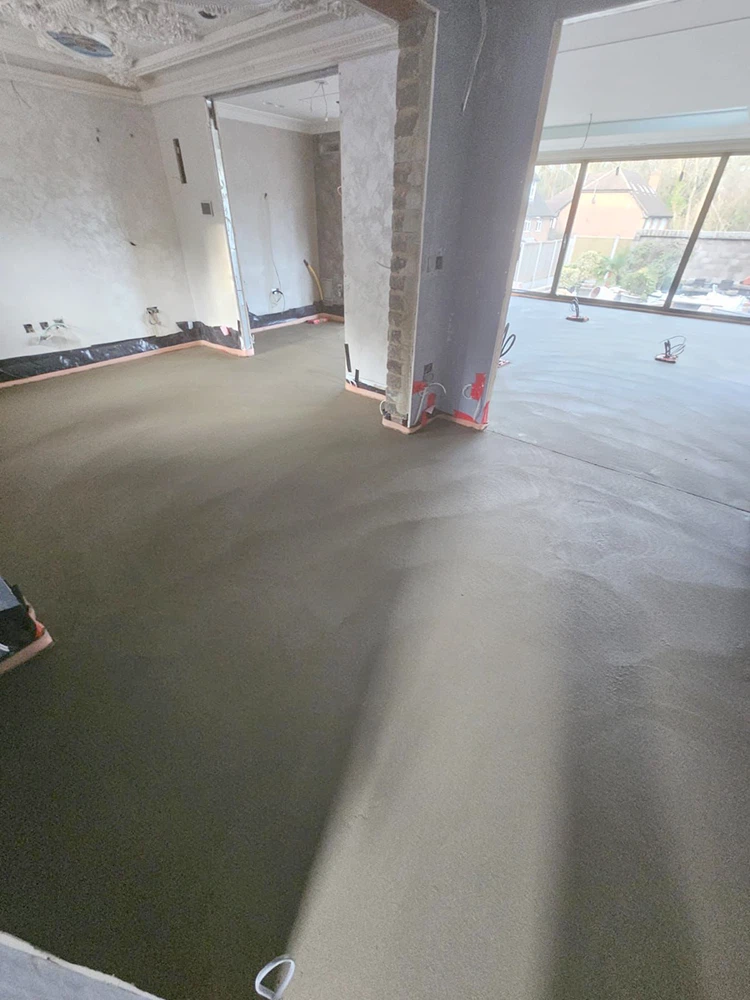
K & B Screeding’s own team, led by director Donatas Bardisevicius. Founded 2019, company 12298780.
See what customers say in our Google reviews and on our testimonials page.
Latex screed from Slough to Peterborough
On the map, Peterborough sits north-north-east of Slough, about 73.9 miles from our base in a straight line (postcodes including PE1, PE7, PE3 and PE4), next to Whittlesey (5 miles), Stamford (11.4 miles), March (14 miles) and Chatteris (14.6 miles).
More on latex screed, part of our screeding services. For every screed we lay locally, see floor screeding in Peterborough.
Further reading: latex, self levelling compound or screed.
