
Latex over mixed floors in Stamford semis and terraces
Pull up the units and old lino in a kitchen fitted decades ago and the floor underneath is seldom one material. There may be ceramic tiles near the sink, a concrete patch where a chimney breast or wall came out, and a strip of hardboard by the door. Thin modern finishes follow every edge and seam, so the floor has to become one smooth surface first.
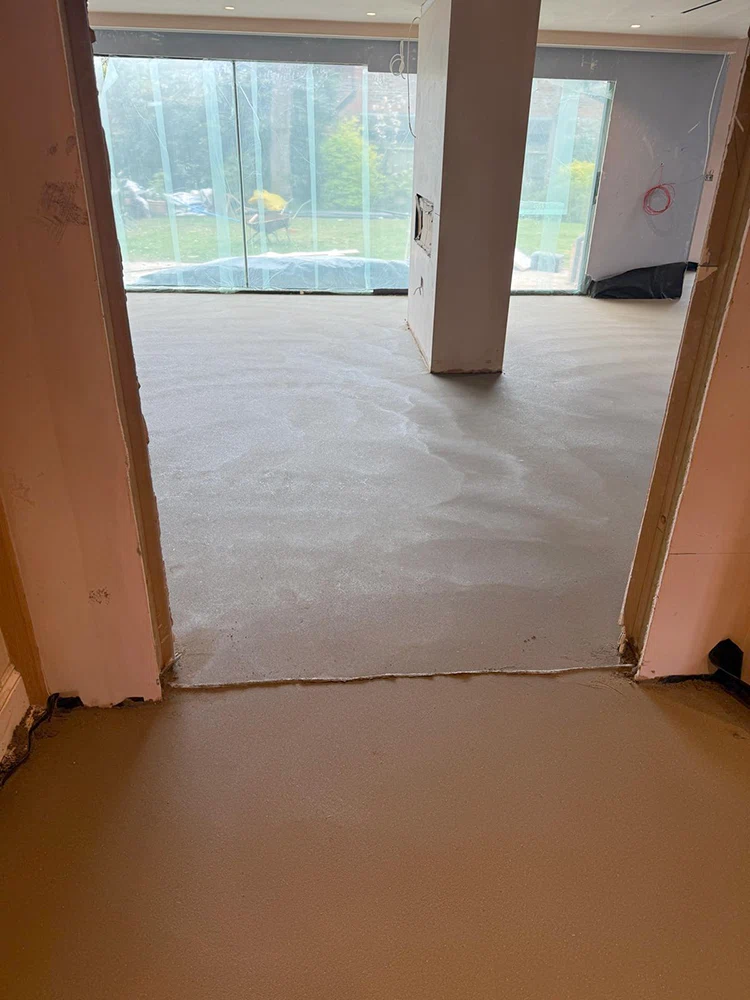
Latex screed does that job. The powder is cement based, but it is mixed with a latex liquid rather than water, which leaves a slightly flexible layer with a strong grip. It flows out a few millimetres thick and fills joints, grout lines and shallow hollows.
Preparation decides whether it lasts. We tap every old tile, because one loose tile under latex becomes a crack in the new floor, and hollow ones are lifted and the gap filled. Glazed surfaces are cleaned and keyed. Hard, thin adhesive left from earlier flooring can often stay, while soft or thick residue is scraped or ground off. Every base then gets a primer suited to it.
Upstairs, bathroom floors in houses of this kind are usually timber boards. Those are screwed down, then overboarded with flooring grade plywood, and the latex goes on the plywood, never on the boards themselves. The result takes sheet vinyl or safety flooring without the outline of each board showing through.
For a wider look at self levelling compound and flatness tolerances, see floor levelling in Stamford.
Listed Stamford buildings and floors latex cannot fix
Stamford's centre is a separate case. Many of its limestone buildings were put up with lime, and their old stone flags or solid floors were made to let moisture pass through. A cement based latex layer sealed under vinyl can trap that moisture and push damp into the walls, and in a listed building the floor itself may be protected. Any finish over a historic floor has to be settled with the owner and the conservation officer before we price it, and sometimes the right answer is to leave the floor as it is.
Elsewhere, three conditions rule latex out until they are dealt with. A springy timber floor needs refixing and proper overboarding, since no thin layer can stiffen it. A damp slab will break the bond, so we check moisture first and recommend a membrane or a rebuilt floor where needed. A floor that is badly out of level, with dips well beyond a few millimetres, needs a deeper product or a new screed, and hand-laid sand and cement in Stamford is the usual route for a failed solid floor.
Newer extensions finished in calcium sulphate screed need the laitance sanded away and a matched primer before latex. Skip that and the latex ends up stuck to a weak skin instead of the screed.
How we price latex screed in Stamford
A fixed written price within 24 hours, once we know the area and the base. See our floor screeding cost guide.
Who lays your latex screed in Stamford
K & B Screeding’s own team, led by director Donatas Bardisevicius. Founded 2019, company 12298780.
See what customers say in our Google reviews and on our testimonials page.
Latex Screed from Slough to Stamford
Stamford is about 77.7 miles north of our Slough base as the crow flies, with postcodes including PE9. The nearest towns to it are Oakham (10.5 miles), Peterborough (11.4 miles), Corby (14.7 miles) and Whittlesey (16.3 miles).
More on latex screed, part of our screeding services.
