
What latex screed does in a Desborough refit
Builders and fitters call it latex screed, but it is really a compound sold in two parts. The powder is cement based, the liquid it is stirred into is latex rather than tap water, and that latex gives the cured layer a little flexibility and a firm grip on the surface below. It goes down thin, usually a few millimetres, so it is a finishing coat rather than a floor in its own right.
That makes it useful on surfaces an ordinary skim would struggle with. In a Desborough house that has been through a few owners, lifting the old covering during a refit often uncovers one of four bases.
Timber floors covered with sheets of flooring grade plywood, screwed down tight. Latex goes over the plywood, never straight onto bare boards, which move and split it.
Old quarry or ceramic tiles that are still firmly stuck. Tapped and found sound, they can stay, cleaned and primed, with the latex bridging the grout lines.
Older concrete that is solid but rippled, patched or pitted.
Traces of old adhesive that are thin, hard and well bonded. Soft or loose residue comes off first.
Each of those needs its own primer, and a calcium sulphate screed is always sanded free of laitance and primed before latex touches it. We also test for damp, because latex sits on the surface and does nothing to stop moisture coming up from below.
The finished surface suits the thin, flexible coverings that show every flaw: sheet vinyl, LVT, lino, rubber and safety flooring, as well as carpet. For flatness classes and when a standard compound is enough on its own, see our Desborough floor levelling page.
When a Desborough floor needs more than latex
Latex is not a repair material, and laying it over the wrong base wastes the money spent on the flooring above it. Three conditions mean something else has to happen first.
Springy boards head the list. If a timber floor flexes underfoot, the latex will crack along the board joints however carefully it is mixed. The boards need refixing, any weak joists need a carpenter, and then flooring grade plywood is screwed down before we come back.
Damp is the second. A solid floor that reads wet on the hygrometer, or shows a tide mark along the skirting, has a moisture problem that latex cannot cure. The old floor may need lifting and rebuilding over a membrane, which is work for a hand-laid sand and cement screed.
The third is level. Latex smooths a surface a few millimetres at a time. Where a room falls away by more than that, perhaps where a garage conversion meets the hall or an old floor has sunk at one side, a screed repair or a new screed sets the level and the latex then finishes it.
A short visit tells us which of these applies before we price the job. Homes up the road are judged the same way, and our page on latex screed in Market Harborough runs through those checks for that town.
How we price latex screed in Desborough
A fixed written price within 24 hours, once we know the area and the base. See our floor screeding cost guide.
Who lays your latex screed in Desborough
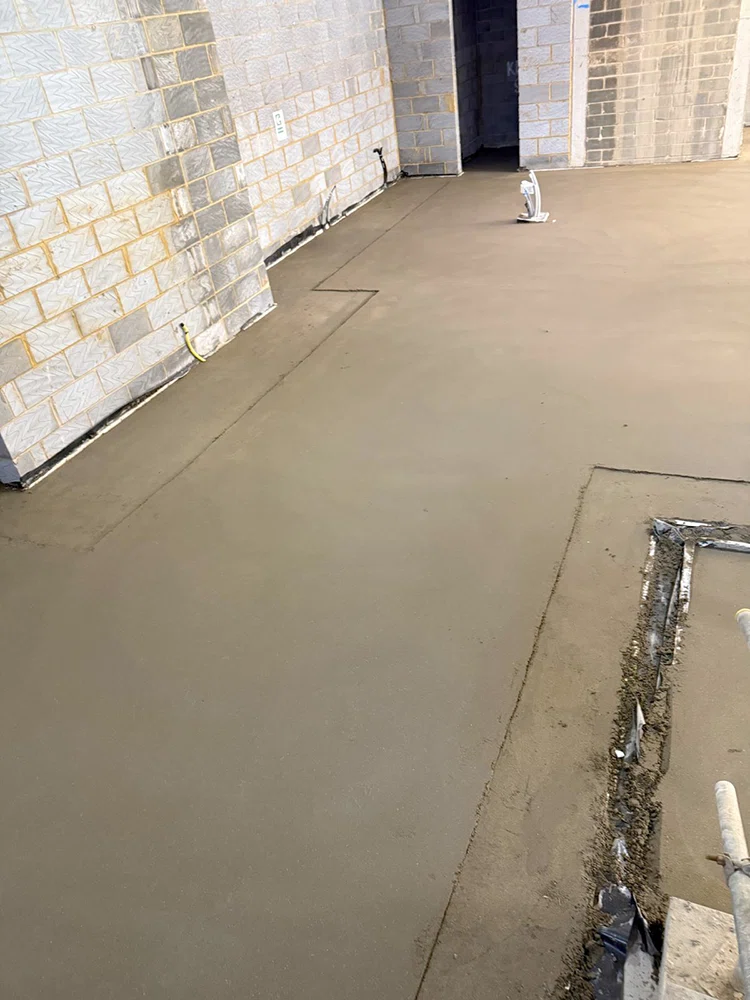
K & B Screeding’s own team, led by director Donatas Bardisevicius. Founded 2019, company 12298780.
See what customers say in our Google reviews and on our testimonials page.
Latex Screed from Slough to Desborough
Desborough is about 63.3 miles north of our Slough base as the crow flies, with postcodes including NN14. The nearest towns to it are Kettering (4.9 miles), Market Harborough (5 miles), Corby (6 miles) and Burton Latimer (8.1 miles).
More on latex screed, part of our screeding services.