
Latex over old tiles and boards in Wellingborough's terraces
Latex screed is the name the trade gives to a two part levelling compound. One part is a cement based powder; the other is a latex liquid that goes into the bucket in place of water. Mixed together they make a thin, slightly flexible coat that grips awkward surfaces and trowels out to a smooth finish only a few millimetres deep.
That grip is why it suits the older terraces nearer Wellingborough's centre when a kitchen or bathroom is being refitted. Lift the old covering in a room like that and you might find red quarry tiles, a ceramic floor from a previous refit, or a concrete surface pocked with old repairs. If the tiles are bonded fast, latex can go straight over them after cleaning, degreasing and priming, which saves breaking them out. Any tile that rocks or sounds hollow when tapped comes up first and the hole is filled.
Timber is handled differently. Latex never goes directly onto bare floorboards, because boards flex and the thin layer would crack along every joint. Instead, loose boards are screwed down and the room is overboarded with flooring grade plywood, fixed at close centres. The latex then goes over the ply, burying screw heads and sheet joins so they do not print through the vinyl.
Where an old solid floor has lost its damp protection, latex is no cure. Those terraces may need the floor dug out and rebuilt on a membrane, which is set out on our sand and cement screed page for Wellingborough.
Latex over flowing screed at Stanton Cross and Glenvale Park
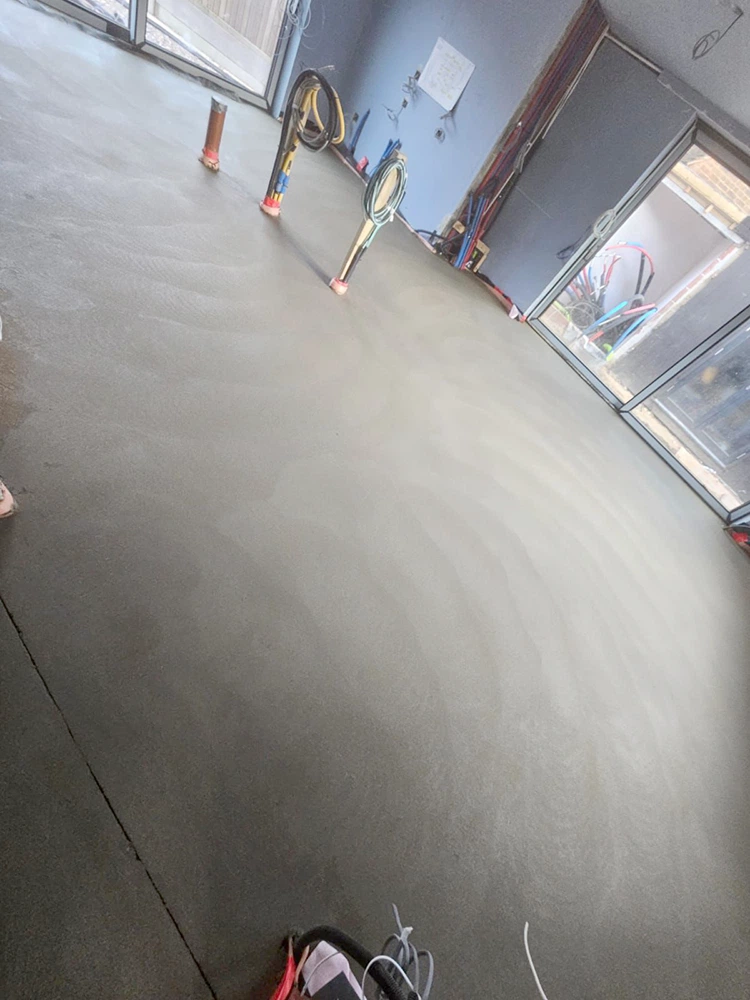
New homes at Stanton Cross and Glenvale Park are generally built with flowing screed over underfloor heating. That gives a flat start, but when an owner later wants sheet vinyl, rubber or LVT in a kitchen or utility room, a thin latex coat can still be worth adding to take out fine trowel marks, a ridge at a doorway or a patch where a fitting was removed.
Priming comes first, and the product depends on the base. If the flowing screed is calcium sulphate, its laitance has to be sanded off and the floor primed with a compatible product, because latex will not bond reliably to that weak surface skin. Cement based screed, concrete, ceramic tile and plywood each take their own primer too.
Elsewhere in the town, a concrete floor that has gone rough, or one carrying a thin film of old adhesive that is still hard and well stuck, can take latex as well. Soft or patchy glue is ground off beforehand, a step covered on our Wellingborough concrete floor grinding page.
Three warning signs mean latex should wait. Springy boards need fixing or overboarding. A damp reading needs the moisture problem solved at its source. And a floor that is badly out of level needs a screed or a deeper repair, because a few millimetres of latex cannot correct a slope. For a floor that is sound but uneven over a wider area, compare floor levelling in Wellingborough.
How we price latex screed in Wellingborough
A fixed written price within 24 hours, once we know the area and the base. See our floor screeding cost guide.
Who lays your latex screed in Wellingborough
K & B Screeding’s own team, led by director Donatas Bardisevicius. Founded 2019, company 12298780.
See what customers say in our Google reviews and on our testimonials page.
Latex Screed from Slough to Wellingborough
As the crow flies, our yard in Slough is about 53.3 miles from Wellingborough, which lies to the north. Postcodes here include NN8, and Rushden (4.1 miles), Burton Latimer (4.2 miles), Kettering (6.9 miles) and Raunds (7.3 miles) are close by.
More on latex screed, part of our screeding services.