
What latex screed is and where Bedford floors need it
Latex screed is the trade name for a two part compound. A bag of cement based powder is mixed with a drum of latex liquid in place of water, and the result is a smoothing layer that grips awkward surfaces well once they are primed. It goes down thin, usually a few millimetres, and its one job is to give the final covering an even face.
In Bedford it earns its place in refits. When a kitchen or bathroom is stripped out of an older house, the floor underneath is rarely one clean material. There may be quarry tiles still stuck fast, a patch of concrete where a wall came out, lines of glue where vinyl was laid, and a doorway where a newer floor meets the original. Rather than dig all of that out, a latex layer can bridge it, provided every part of it is sound.
Converted flats make up 6% of Bedford's homes, and a flat carved out of an older house often has timber floors. Latex never goes straight onto bare floorboards, because boards move with the seasons and the compound would crack along every joint. They are screwed down first and overboarded with flooring grade plywood, and the latex goes over the plywood.
The finishes that call for it are the thin, flexible ones: sheet vinyl, LVT, lino, rubber, safety flooring in a utility or cloakroom, and carpet, which wears more evenly on a smooth base. If you are unsure whether you need latex or a general smoothing compound, our Bedford floor levelling page covers that wider choice.
When a Bedford floor is not ready for latex
Latex is a finishing layer, not a repair. Before any is mixed, the base is checked for four things, and if one fails, the latex waits.
Movement comes first. A board floor that bounces underfoot will crack a thin compound however good the plywood on top, so loose boards are fixed and the joists looked at before overboarding.
Damp is next. A solid floor in an older house may have no working membrane, and latex does nothing to stop moisture rising through it. A high reading at this stage points to preparing the base properly or, where the floor has failed, digging it out and rebuilding it with a membrane and fresh screed.
Then level. Latex smooths; it does not lift a floor that falls badly from one wall to another. If a straightedge shows a deep hollow, the floor may need patching the old screed or a new screed first, with latex as the last thin coat.
Priming ties it together. Concrete, old tile, plywood and old adhesive each take a different primer, and a calcium sulphate screed must have its laitance sanded off and be primed before latex goes near it. A refit in Kempston, about two miles away, is handled the same way; see latex screed in Kempston.
How we price latex screed in Bedford
A fixed written price within 24 hours, once we know the area and the base. See our floor screeding cost guide.
Who lays your latex screed in Bedford
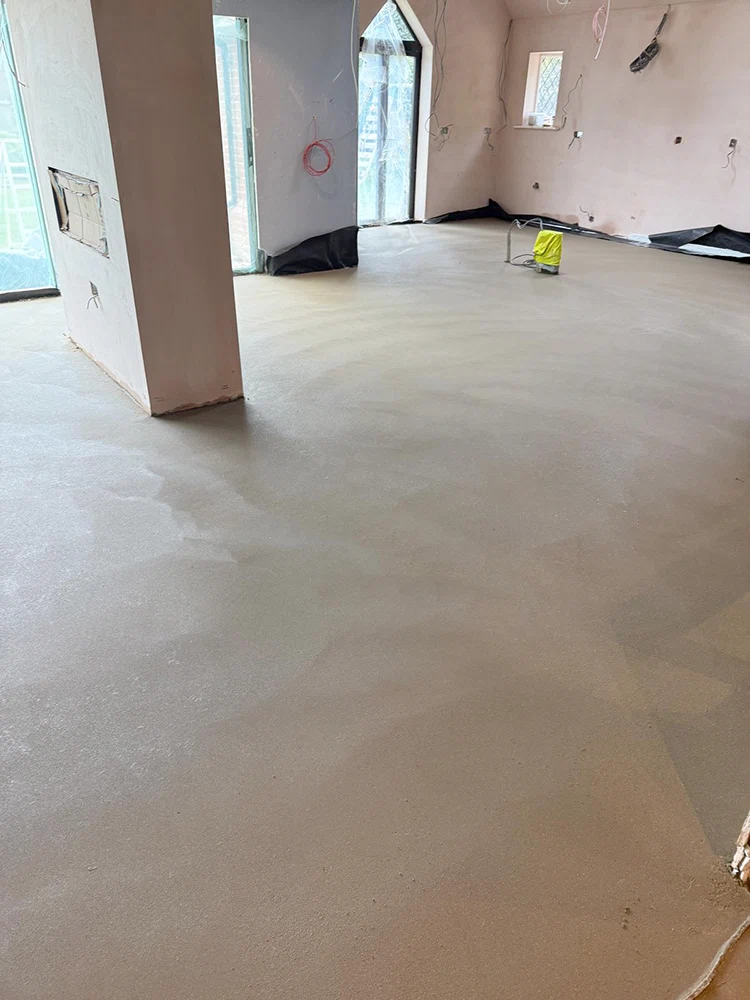
K & B Screeding’s own team, led by director Donatas Bardisevicius. Founded 2019, company 12298780.
See what customers say in our Google reviews and on our testimonials page.
Latex Screed from Slough to Bedford
Bedford is about 42.5 miles north of our Slough base as the crow flies, with postcodes including MK40, MK41 and MK42. The nearest towns to it are Kempston (2 miles), Sandy (7.7 miles), Flitwick (9.3 miles) and Biggleswade (9.4 miles).
More on latex screed, part of our screeding services.
