
Relaying failed solid floors in central Bedford houses
A failed solid floor in an older Bedford house usually shows itself as cracked tiles, a hollow sound underfoot, damp along the skirting or a dip in the middle of the room. Patching the surface rarely lasts. What lasts is lifting the old floor, digging to the depth the new build-up needs, and putting it back as a damp-proof membrane, insulation and fresh screed.
That build-up is where sand and cement earns its keep in Bedford's pre-war houses. Rooms are often small and broken up by chimney breasts and alcoves, and the floor has to finish level with existing thresholds and hearths. A hand-laid screed can be run to exact levels room by room, mixed in small batches, with no pump waiting outside.
Depth matters. Laid on insulation in a home, the screed goes in at around 65mm; a commercial floor gets 75mm. Going thinner over insulation risks cracking. If the concrete underneath is sound, a bonded screed fixed straight to it can be as little as 25 to 40mm. The reasoning behind each figure is set out under choosing a screed thickness.
Houses from between the wars, 11% of the town's homes, sometimes have suspended timber ground floors rather than solid ones. Converting one of those to a solid screeded floor is a bigger decision, and it is worth talking through ventilation and levels before anyone starts digging.
Wet rooms, garages and heavy use in Bedford homes
Because its binder is cement, this screed puts up with water that would weaken a calcium sulphate floor. So when a bathroom becomes a wet room or gets a walk-in shower, with the floor sloping to a drain, this is what goes underneath. The slope is built into the screed as we lay it, giving the tiler an accurate fall to work to.
Garages are another natural use. Turning an attached garage on a suburban Bedford semi into a room usually means raising the floor to match the house, adding insulation and a membrane, and screeding to a level. We have set out the whole process in a garage conversion floor guide. A floor that has to bear weight early, or take a hammering, can be specified in screed with fibre reinforcement or a stronger mix.
What you give up is drying time. At 65mm deep it stays damp much longer than a thinner pumped floor: the first 40 millimetres take around a day apiece, the rest longer. A faster drying mix can rescue a tight schedule. On price, 2026 published rates are £18 to £25 per m², and adding fibres costs a further £1 to £3 per m².
Sand and Cement Screed prices in Bedford
Sand and cement screed: £18 to £25 per m² supplied and laid (MyJobQuote, August 2026), so £450 to £630 for 25 m². MyJobQuote does not say whether these figures include VAT. See our floor screeding cost guide or screed calculator.
Who lays your sand and cement screed in Bedford
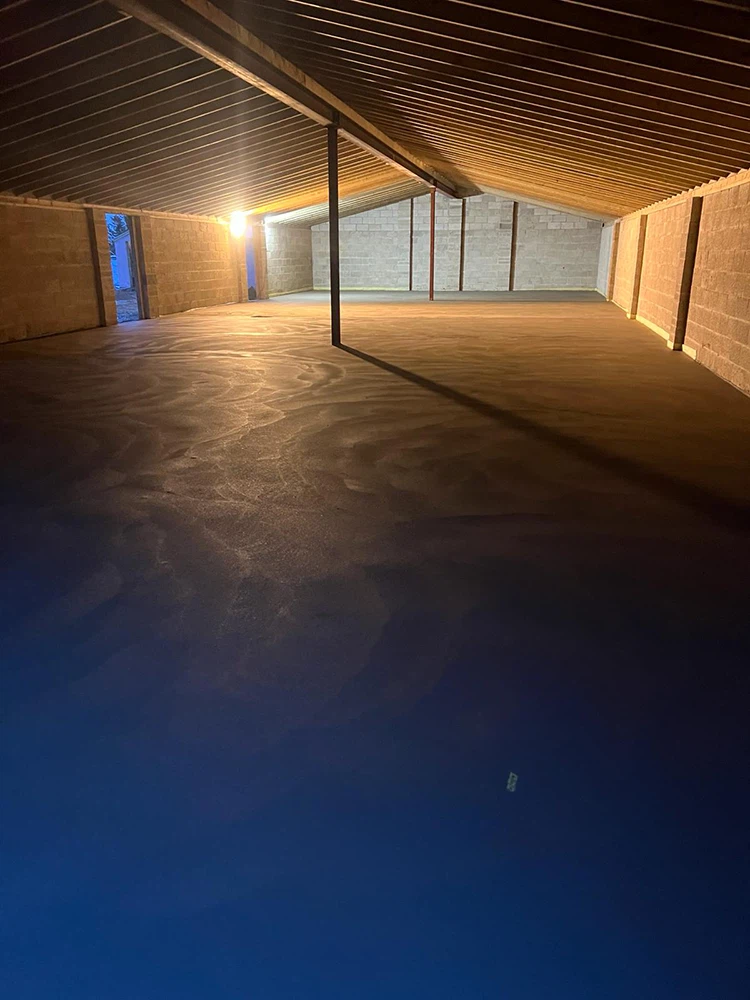
K & B Screeding’s own team, led by director Donatas Bardisevicius. Founded 2019, company 12298780.
See what customers say in our Google reviews and on our testimonials page.
Sand and Cement Screed from Slough to Bedford
Bedford is about 42.5 miles north of our Slough base as the crow flies, with postcodes including MK40, MK41 and MK42. The nearest towns to it are Kempston (2 miles), Sandy (7.7 miles), Flitwick (9.3 miles) and Biggleswade (9.4 miles).
More on sand & cement screed, part of our screeding services.
