
Replacing floors in Rushden's shoe industry terraces
Rushden grew on boot and shoe making, and the terraced streets built in that era are still a large part of the town. Their ground floors cause two familiar problems. Some are solid floors laid with no damp proof membrane, which feel cold and let damp through. Others are timber floors that have decayed where air or damp has got to them.
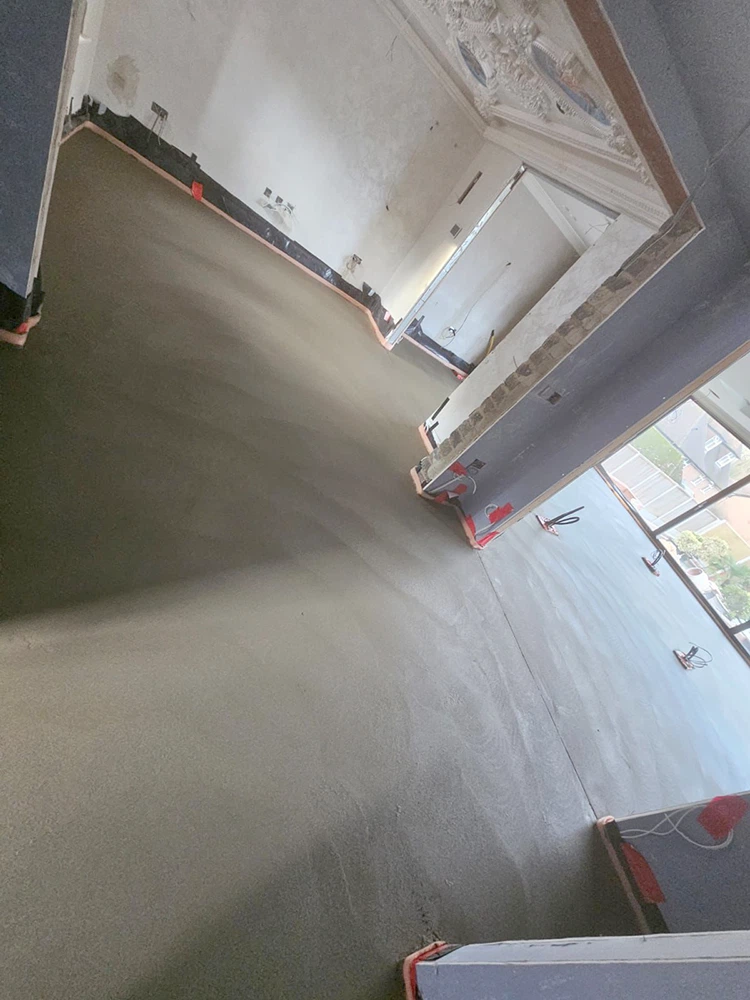
In both cases the lasting fix is a new floor from the ground up. We break out the old floor as deep as needed, put down a membrane and insulation, then lay 65mm of sand and cement over them as a floating domestic floor. If sound concrete is there to bond to, a 25 to 40mm bonded screed is an option instead.
Hand-laid screed suits terraced houses well. Rooms are narrow, the back of the house may only be reachable through the front, and areas are often small enough that a pump would not pay. Sand and cement can be barrowed in, mixed to suit each area and shaped around hearths, steps and thresholds.
Cement underneath also suits wet areas, and the floor can be loaded sooner than calcium sulphate would allow. Where a floor needs extra resistance to cracking, the mix can include fibres; see our fibre reinforced screed page. The layers below are covered in our insulation and membrane work.
Garages, wet rooms and drying in Rushden
Terraces are not the only use. Small bathrooms, utility rooms and outbuildings in houses of any age are often simpler to screed by hand than by pump.
A wet room floor has to drop towards its drain, and that drop is formed by hand in sand and cement. Utility rooms and anywhere a leak is possible are safer in a cement screed than a calcium sulphate one. Garage floors converted into rooms usually start below the house level, and insulation plus screed lifts them to meet the hallway. The depth is set by that height difference, which we measure before pricing.
Drying is where you lose time. A sand and cement floor dries roughly one millimetre a day for its first 40mm and more slowly after that, leaving a 65mm floor weeks short of being ready for tiles or wood. A fast drying additive helps when the programme is tight. What moves a price up or down is covered in our screed cost guide. If the existing floor turns out to be sound, levelling it instead may save the cost of digging out.
Sand and Cement Screed prices in Rushden
Sand and cement screed: £18 to £25 per m² supplied and laid (MyJobQuote, August 2026), so £450 to £630 for 25 m². MyJobQuote does not say whether these figures include VAT. See our floor screeding cost guide or screed calculator.
Who lays your sand and cement screed in Rushden
K & B Screeding’s own team, led by director Donatas Bardisevicius. Founded 2019, company 12298780.
See what customers say in our Google reviews and on our testimonials page.
Sand and Cement Screed from Slough to Rushden
As the crow flies, our yard in Slough is about 52.5 miles from Rushden, which lies to the north. Postcodes here include NN10, and Wellingborough (4.1 miles), Raunds (4.6 miles), Burton Latimer (6 miles) and Kettering (9.3 miles) are close by.
More on sand & cement screed, part of our screeding services.
