
Garage and porch conversions on Corby's New Town estates
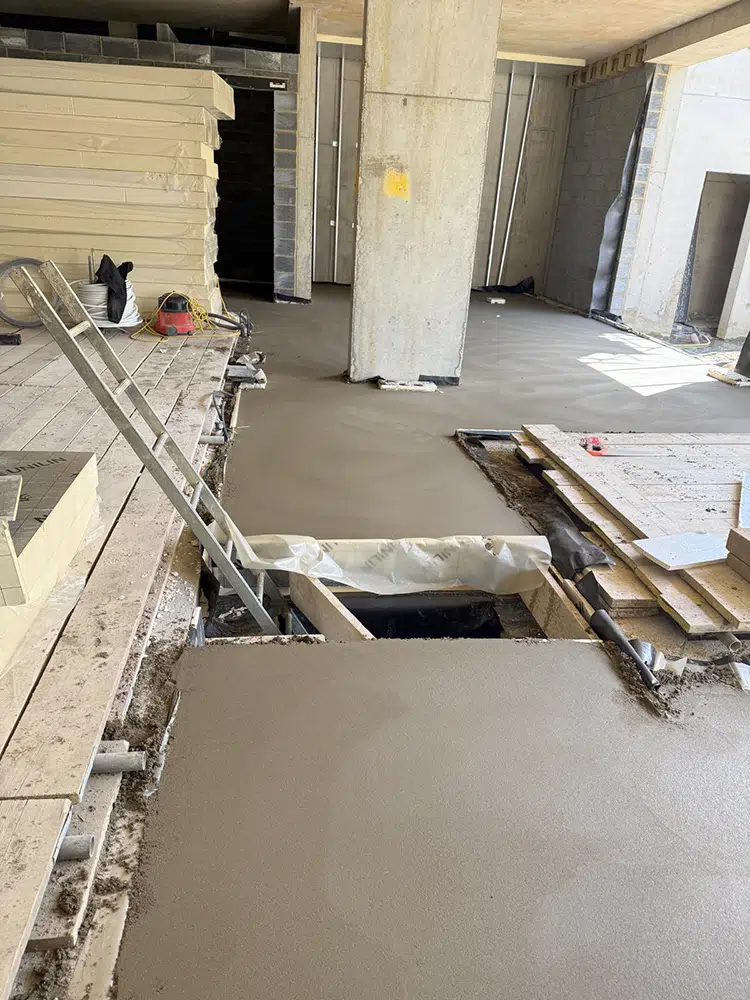
Converting a garage into a room is one of the typical floor jobs on a mid-century estate. On a 1950s or 1960s Corby estate, the old garage slab is normally lower than the hallway and has no insulation beneath it. To bring it up to the hallway, a membrane goes down first, then insulation boards, then the screed. If you are planning one of these conversions, the step by step garage screed guide takes you through each layer in order.
A hand-laid mix fits that job. We batch it on the drive to the depth needed, lay it a bay at a time, tamp it down hard and float it off level. Over insulation in a house, the floating screed is laid 65mm thick. Where the garage slab is solid enough to bond to, 25 to 40mm can do, which saves height under a low garage door opening.
Terraced houses make up 27% of Corby's homes, and a terrace often means one route in, through the front door. A hand-laid screed arrives as sand and cement, and can be barrowed through a hallway without needing a hose run or a pump bay outside.
Porch conversions and small rooms follow the same logic. A pump is hard to justify for a few square metres, and hand-laid screed can be shaped around thresholds and steps. Where an original floor has failed completely, the answer is to break it out and relay it, and preparing the base is covered on the floor preparation service page.
Wet rooms and early loading in Corby homes
There are jobs where a cement screed is not just an option but the requirement. A walk-in shower or wet room in a New Town semi needs its floor sloping down to the drain, and a cement mix can be trowelled to that slope and will put up with water that would damage calcium sulphate. Utility rooms with a washing machine, where a leak is always possible, follow the same reasoning.
Some floors also need to take load early, such as a workshop area or a floor other trades need to use soon. Additives help here: fibres improve resistance to cracking and add £1 to £3 per m² on published 2026 figures, while rapid drying additives shorten the wait before flooring. See fibre reinforced screed for more.
The trade-off against liquid screed is drying speed. Sand and cement dries more slowly, and a heated floor laid in it should not have the heating turned on for at least 21 days. For a like-for-like look at both, the liquid versus traditional screed comparison is worth reading. Homes towards Desborough are covered on the Desborough sand and cement page.
Sand and Cement Screed prices in Corby
Sand and cement screed: £18 to £25 per m² supplied and laid (MyJobQuote, August 2026), so £450 to £630 for 25 m². MyJobQuote does not say whether these figures include VAT. See our floor screeding cost guide or screed calculator.
Who lays your sand and cement screed in Corby
K & B Screeding’s own team, led by director Donatas Bardisevicius. Founded 2019, company 12298780.
See what customers say in our Google reviews and on our testimonials page.
Sand and Cement Screed from Slough to Corby
As the crow flies, our yard in Slough is about 66.1 miles from Corby, which lies to the north. Postcodes here include NN17 and NN18, and Desborough (6 miles), Kettering (6.2 miles), Burton Latimer (8.7 miles) and Market Harborough (9.4 miles) are close by.
More on sand & cement screed, part of our screeding services.
