
Replacing damp floors in Peterborough's older terraces
Terraced houses make up 23% of Peterborough's homes. In the older ones, renovations often mean replacing damp or broken floors, and when a renovation lifts the finishes the slab underneath can be damp, broken or both.
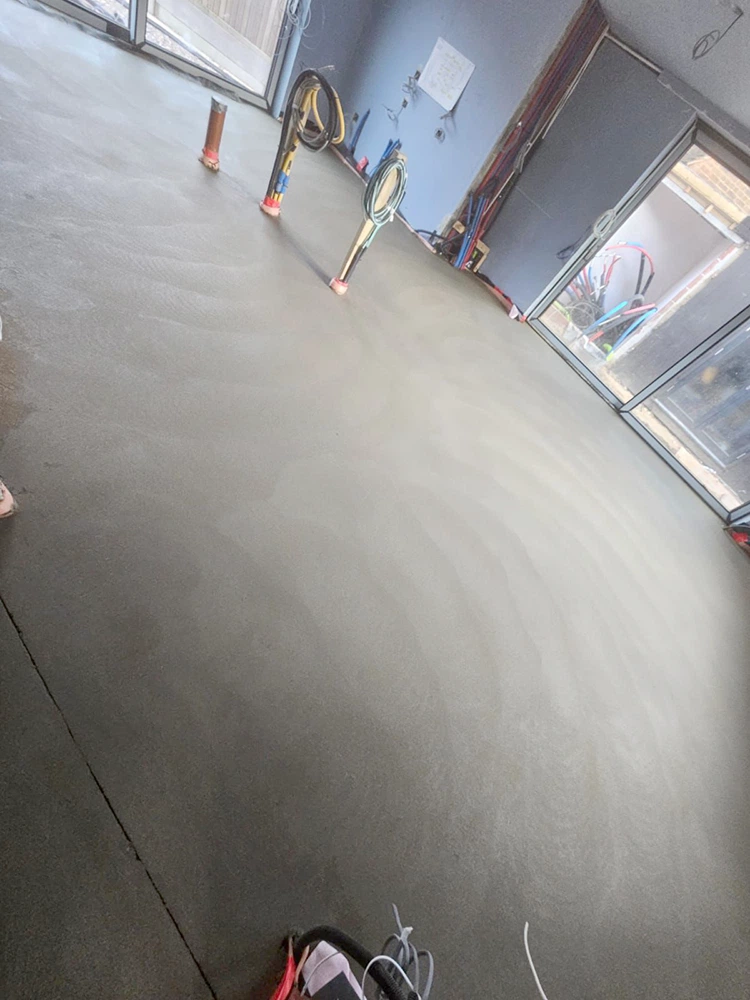
Patching rarely works in that situation. What lasts is digging the slab out, laying insulation with a DPM over it, and screeding on top. Sand and cement suits this because it is mixed on site, can be laid room by room, and copes with short runs, hearths, steps and awkward corners.
How deep it goes comes down to the layers below. A floating screed over insulation in a home is about 65mm; in commercial use, 75mm. A bonded screed on a sound concrete base is typically 25 to 40mm and is laid over a bonding coat.
Finished floor level is often the limiting factor in an older house. The new floor has to meet the hall, the back door and any existing tiles, so we measure the levels before recommending a depth.
Drying is what you give up. Hand-laid cement screed gives up its moisture at something like one millimetre daily until 40mm, slowing beyond it. A 65mm floor can need several weeks before timber or LVT goes down. If time is short, a rapid drying screed is worth considering. Our screed thickness guide covers the depth question in more detail.
Garage conversions in Bretton, Orton and Werrington
In Bretton, Werrington and the Ortons most houses date from the 1970s and 1980s, and a garage conversion there needs a new insulated floor when the garage becomes a bedroom, office or playroom. Garage slabs on those estates normally sit lower than the hall, often by a fair margin.
Insulation boards, polythene and sand and cement close that gap, finished flush with the hall. A single garage with one door in is a small, closed space, and hand laying suits it far better than a pump. Each layer is listed in order in screeding a converted garage.
Wet rooms and level access showers need a cement screed laid to falls, so that water drains correctly. Anywhere the floor could get wet rules calcium sulphate out. The falls are formed by hand with screed rails and a straightedge, and checked before the tanking and tiles go on.
Where a floor must take weight early, such as a workshop, a store or a utility room, the mix can be strengthened. Adding fibres costs around £1 to £3 a square metre; the other route is to specify a stronger screed mix.
Sand and Cement Screed prices in Peterborough
Sand and cement screed: £18 to £25 per m² supplied and laid (MyJobQuote, August 2026), so £450 to £630 for 25 m². MyJobQuote does not say whether these figures include VAT. See our floor screeding cost guide or screed calculator.
Who lays your sand and cement screed in Peterborough
K & B Screeding’s own team, led by director Donatas Bardisevicius. Founded 2019, company 12298780.
See what customers say in our Google reviews and on our testimonials page.
Sand and Cement Screed from Slough to Peterborough
On the map, Peterborough sits north-north-east of Slough, about 73.9 miles from our base in a straight line (postcodes including PE1, PE7, PE3 and PE4), next to Whittlesey (5 miles), Stamford (11.4 miles), March (14 miles) and Chatteris (14.6 miles).
More on sand & cement screed, part of our screeding services.