
Cover over the pipes in Peterborough homes
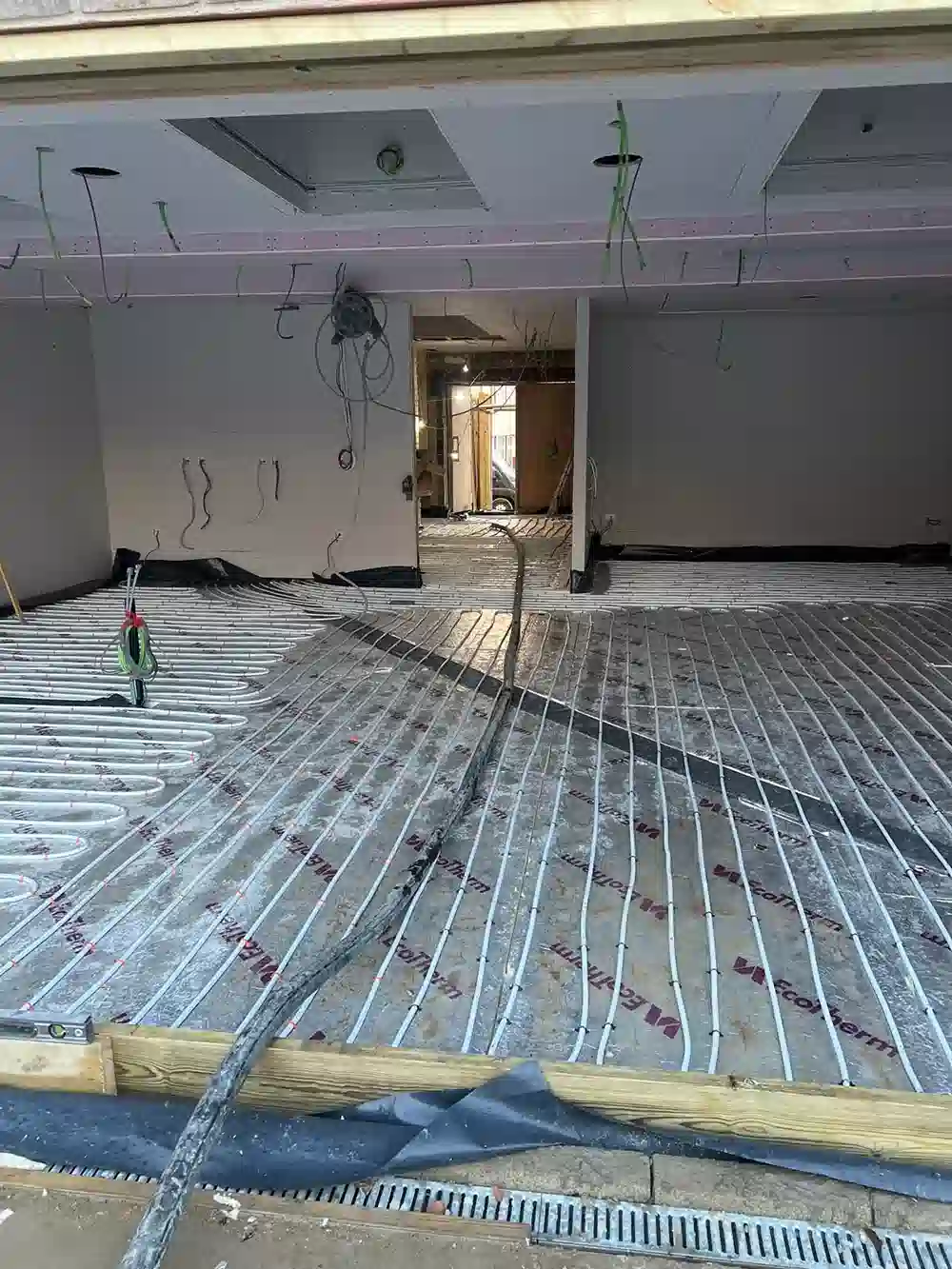
Underfloor heating depends on the screed. The pipes warm the screed, and the screed warms the room. If there is too little cover, the floor can crack along the pipe runs. If there is too much, it responds slowly.
Liquid must cover the pipework by a minimum of 25mm, making the whole layer roughly 45 to 50mm. Because it flows, it surrounds each pipe completely, leaving no voids to slow the heat. Sand and cement is pressed in round the pipes by hand and topped out about 45mm over them.
In new houses the depth is set on the drawings, so the job is to check the insulation, pipes and edge strip match them before the pour. We pour to the figure written, not to a rule of thumb.
Retrofit is where it gets tight. The 1970s and 1980s houses in the Ortons, Bretton and Werrington were not built with room for insulation, pipes and screed in the floor. The existing slab often has to be dug out to create the depth, and door thresholds and the bottom stair limit how far the floor can rise.
A heated extension is simpler, since the floor is built from scratch. Detached houses make up 25% of the city's homes, and where one gains a large heated kitchen extension, pumped liquid screed is the usual pairing.
Heat-up and commissioning in Peterborough
Fresh screed and a hot boiler do not mix. Calcium sulphate will usually take warmth from day 7 or so; sand and cement wants 21 days left alone before anyone touches the thermostat.
Go gently the first time. Flow temperature creeps up in stages across several days, stays at the top a while, then drops back. Running the boiler is the heating engineer's call, and our written notes say what the screed itself needs. Turning the heating straight to full can cause cracks, particularly in a garden room or extension where the owner is keen to move in.
The insulation beneath matters as much as the screed above, and edge strip lets the floor expand as it warms without pushing against the walls. Leave the insulation out and the warmth escapes into the ground below. All three layers get checked by us ahead of the pour, and where one is absent we can fit it as insulation and membrane work.
If the floor is going to be calcium sulphate, remember it needs sanding and a moisture test before flooring. See our anhydrite guide for why.
Underfloor Heating Screed prices in Peterborough
Liquid screed over underfloor heating: £20 to £35 per m² supplied and laid (trade2base, June 2026), so £700 to £1,230 for 35 m². trade2base gives these figures excluding VAT. See our floor screeding cost guide or screed calculator.
Who lays your underfloor heating screed in Peterborough
K & B Screeding’s own team, led by director Donatas Bardisevicius. Founded 2019, company 12298780.
See what customers say in our Google reviews and on our testimonials page.
Underfloor Heating Screed from Slough to Peterborough
On the map, Peterborough sits north-north-east of Slough, about 73.9 miles from our base in a straight line (postcodes including PE1, PE7, PE3 and PE4), next to Whittlesey (5 miles), Stamford (11.4 miles), March (14 miles) and Chatteris (14.6 miles).
More on underfloor heating screed, part of our screeding services.
