
Pipe cover and floor height in St Ives extensions
Detached houses are 29% of the St Ives stock, and many of them date from the 1950s to the 1990s, as most of the semis do. Add a heated extension to a house like that and the new floor must come out flush with the old one, which caps how much depth you have for insulation, pipes and screed together.
That depth decides the screed. Liquid screed has to cover the pipes by at least 25mm, so the whole layer comes to around 45 to 50mm, and it runs right round each pipe without leaving air gaps. Sand and cement needs about 45mm above the pipes, making for a thicker floor. When the levels are tight, pumped liquid screed usually wins. If the room is a wet area or must have a cement base, hand-laid sand and cement over the pipes is the better pick.
Fitting heating into an older room is the trickiest version. Breaking out the old solid floor wins back the depth, but the damp proof membrane then has to be relaid and insulation added, and without that insulation the heat drains into the ground instead of warming the room.
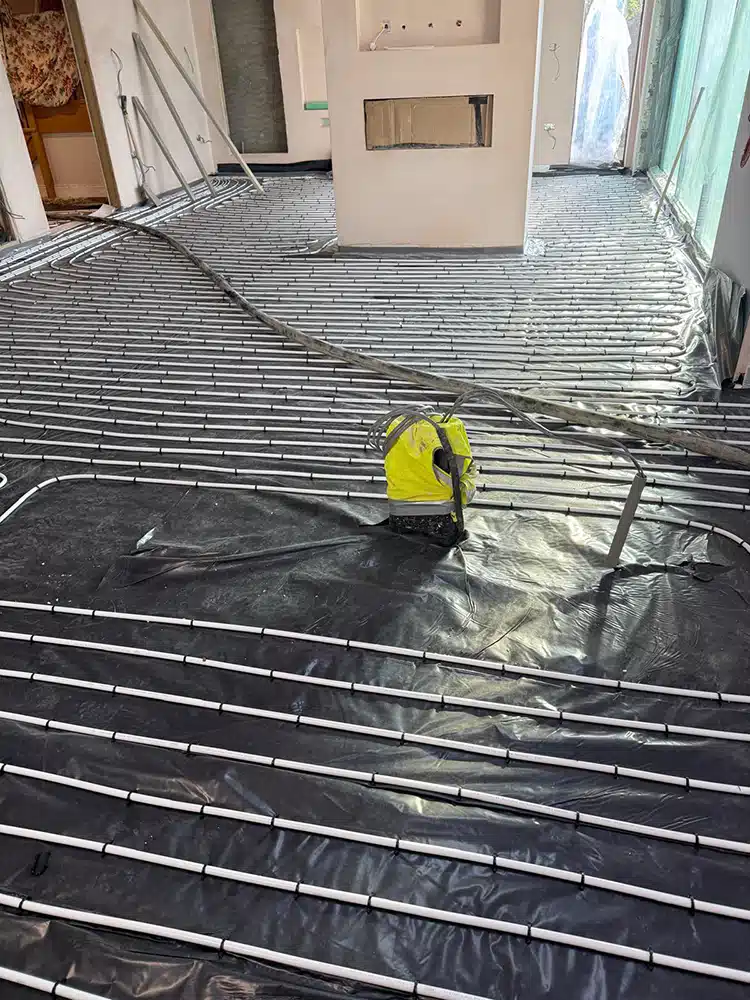
Before any pour we look over the edge strip, insulation and membrane, and we can supply whichever is missing. The pipes have to be fixed and pressure tested already, as K & B does not fit underfloor heating pipes. If you want the two screeds compared point by point, see liquid versus sand and cement screed.
New homes at The Spires and commissioning the heat
Homes from 2015 onwards are just 5% of St Ives so far, though Houghton Grange and The Spires are adding to that and will bring underfloor heating installs with them. On a new house the screed type and depth are normally fixed by the specification, and we lay to that design with every pipe fully encased.
The weeks after the pour count just as much as the day itself. With calcium sulphate, the heating can go on from about 7 days. With sand and cement, give it 21 days at the very least. Either way, the temperature is raised slowly, a few degrees at a step, and held there before any flooring goes down, so the screed dries evenly instead of cracking. We leave you written guidance on that warm-up, and your heating engineer runs the system.
Laid and dried properly, a screed over pipes is flat enough for tiles, LVT or engineered wood. Rushing the warm-up to hit a fitting date is the usual way a heated floor gets spoiled, so it pays to build those weeks into the programme from the start. Building somewhere around St Ives? The same service covers underfloor heating screed in Cambridge.
Underfloor Heating Screed prices in St Ives
Liquid screed over underfloor heating: £20 to £35 per m² supplied and laid (trade2base, June 2026), so £700 to £1,230 for 35 m². trade2base gives these figures excluding VAT. See our floor screeding cost guide or screed calculator.
Who lays your underfloor heating screed in St Ives
K & B Screeding’s own team, led by director Donatas Bardisevicius. Founded 2019, company 12298780.
See what customers say in our Google reviews and on our testimonials page.
Underfloor Heating Screed from Slough to St Ives
On the map, St Ives sits north-north-east of Slough, about 59.9 miles from our base in a straight line (postcodes including PE27), next to Huntingdon (4.7 miles), Chatteris (10.6 miles), St Neots (10.6 miles) and Cambridge (11.6 miles).
More on underfloor heating screed, part of our screeding services.