
Retrofitting heated floors in Romsey Town and older Cambridge homes
In an older Cambridge house, heating pipes usually go in while the ground floor is up for other reasons. In Romsey Town, where Victorian houses often have their old floors dug out before a rear extension, that is the moment to plan for pipes. Across the city, inter-war and post war semis getting a ground floor extension face the same decision.
The challenge is height. The finished floor has to line up with the existing hall and doors, and within that depth it must hold insulation, pipes and screed. Liquid screed must sit 25mm or more above the pipes, for an overall floor of roughly 45 to 50mm, whereas sand and cement needs around 45mm above them and so builds up deeper. In a tight retrofit, that difference can decide which screed fits. Our guide to working out screed depth walks through the sums.
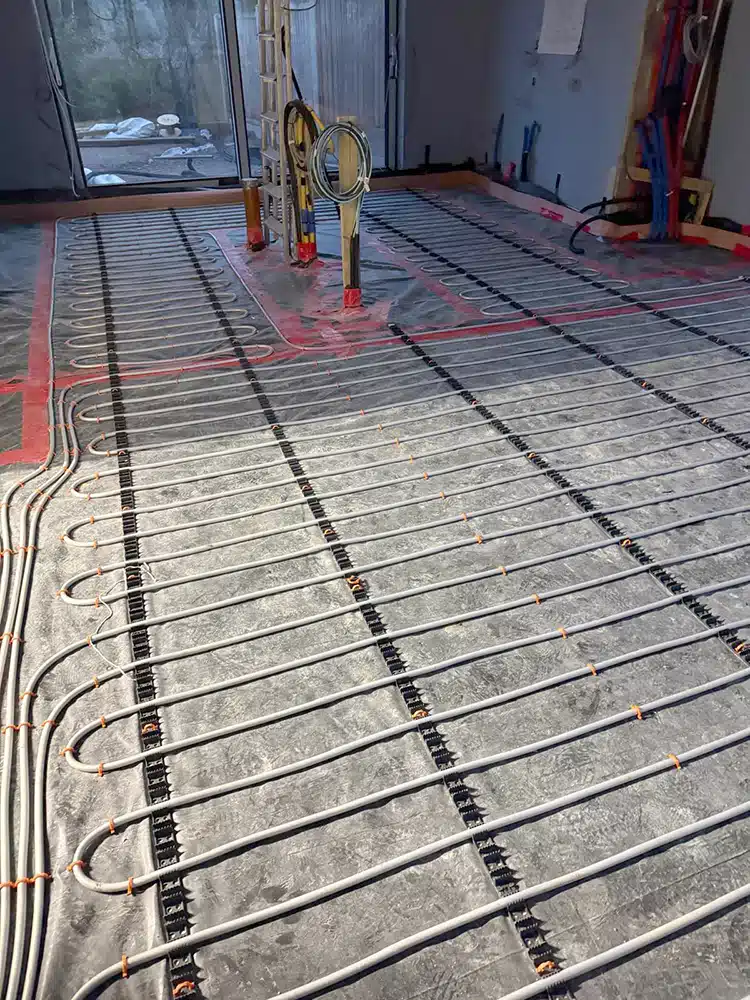
The pipes also need screed tight around them on every side. Air pockets around pipes slow the warm-up and leave cool patches. Pumped liquid screed for heated floors flows under and around each pipe, which is why it is often chosen.
Our checks on pour day start underneath: edge strip, membrane and insulation, and we provide whichever is not there. The edge strip lets the warm screed expand without cracking against the walls, and the membrane keeps ground moisture out of the new floor.
Commissioning a new Cambridge heated floor
The heating must not go straight to full power after the pour. Calcium sulphate can normally take heat after around 7 days, but sand and cement should be left a minimum of 21 days. From that point the flow temperature goes up in steps of a few degrees across several days and is then held, letting the floor dry out evenly without cracking or curling. Rushing this stage can spoil a well laid heated floor, and the damage often shows only once the tiles are down.
Commissioning is your heating engineer's job, done to a written schedule we leave with you. A record of the heat-up is useful to the flooring fitter, who will ask to see it before any tiles, stone or engineered wood go down over the heated screed.
Laid properly, a heated floor in a Romsey Town extension or a newer Cambridge home ends up level enough for LVT, engineered wood or tiles. For the drying side of the programme, see how long screed takes to dry. South of the city, see our page on heated floor screeding in Royston.
Underfloor Heating Screed prices in Cambridge
Liquid screed over underfloor heating: £20 to £35 per m² supplied and laid (trade2base, June 2026), so £700 to £1,230 for 35 m². trade2base gives these figures excluding VAT. See our floor screeding cost guide or screed calculator.
Who lays your underfloor heating screed in Cambridge
K & B Screeding’s own team, led by director Donatas Bardisevicius. Founded 2019, company 12298780.
See what customers say in our Google reviews and on our testimonials page.
Underfloor Heating Screed from Slough to Cambridge
Cambridge is about 56.9 miles north-east of our Slough base as the crow flies, with postcodes including CB2, CB4, CB1 and CB3. The nearest towns to it are St Ives (11.6 miles), Royston (12.4 miles), Newmarket (12.4 miles) and Soham (12.8 miles).
More on underfloor heating screed, part of our screeding services.