
Grinding before refits at Cambridge Science Park
When a laboratory or clinical room on the Science Park or the Biomedical Campus is refitted, lifting the old floor finish leaves adhesive behind, sometimes several generations of it, and older lab floors may carry paint or thin coatings. New sheet vinyl or a levelling compound will only perform on a clean, sound base.
Diamond grinding gives that base. Rotating heads fitted with diamond segments cut a thin layer from the top of the slab or screed with each pass. They remove adhesive residue, floor paint, thin coatings, trowel marks and the weak laitance on a screed, and they take down ridges and the lips between concrete bays. The surface left behind is open and absorbent, ready for primer.
Grinding is precise but local. It brings down high spots; it does not lower a whole room that falls from one side to the other, and grinding a screed too far can leave it thinner than its minimum depth. For a floor that is out over a wide area, we grind the highs and then pour levelling compound to SR1 or SR2, or deal with failed areas through screed repairs.
In a working building, dust control comes first. Concrete, screed and tile contain silica, and grinding releases respirable crystalline silica dust. Our machines run with extraction attached at all times, and we seal off corridors and adjoining rooms before starting.
Extensions, garages and lifted floors in Cambridge homes
At home, grinding tends to be a short, targeted job. Inter-war and post war semis across Cambridge are typical ground floor extension jobs, and where the new slab meets the original floor there is often a small step or ridge. Grinding the high side flush lets a single run of tiles or LVT carry on through the opened-up room.
Houses built between 1973 and 1999 make up 20% of the city's homes, and lifting a tired carpet or vinyl in one of them may expose a slab coated in old adhesive. Loose or soft adhesive has to come off before a levelling coat, and grinding takes it back to bare concrete.
Garage floors being turned into rooms often have oil, paint and a dusty, weak surface. Grinding cleans them before the membrane, insulation and screed go on. The layers that follow are set out in our guide to screeding a converted garage.
We are a contractor, not a hire shop, so our grinders and diamond tooling are not for sale or rent. Nor do we lay resin or polished concrete, though we can prepare a slab for a resin contractor. For thick coatings over large areas, shot blasting and other floor preparation may suit better.
How we price floor grinding in Cambridge
A fixed written price within 24 hours, once we know the area and what has to come off. See our floor screeding cost guide.
Who grinds your concrete floor in Cambridge
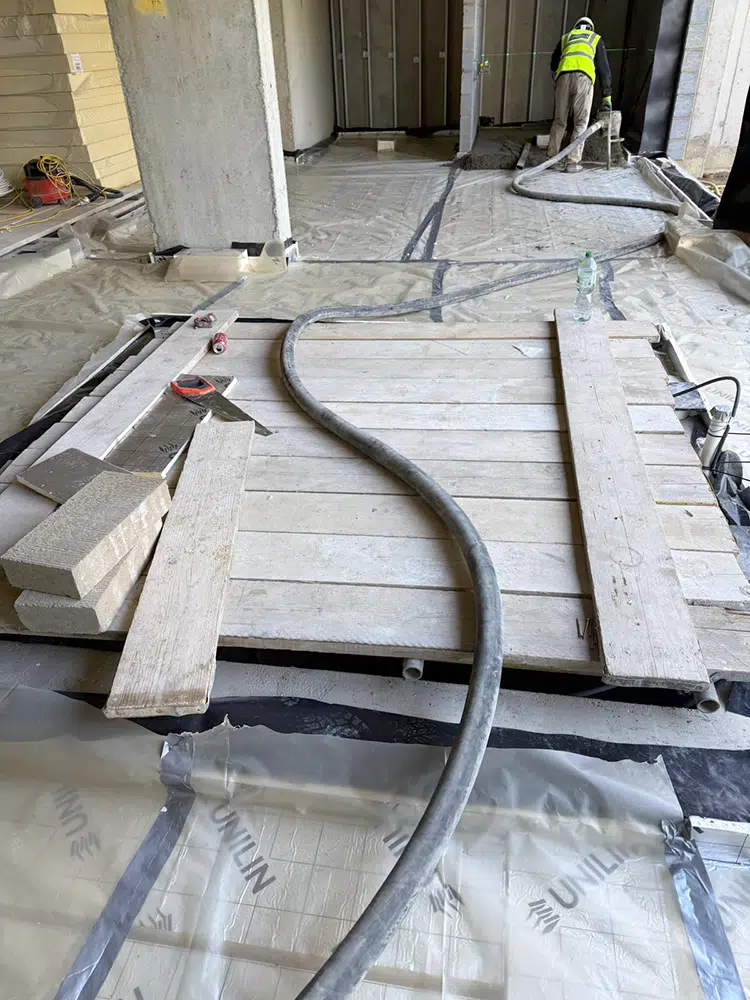
K & B Screeding’s own team, led by director Donatas Bardisevicius. Founded 2019, company 12298780.
See what customers say in our Google reviews and on our testimonials page.
Concrete Floor Grinding from Slough to Cambridge
Cambridge is about 56.9 miles north-east of our Slough base as the crow flies, with postcodes including CB2, CB4, CB1 and CB3. The nearest towns to it are St Ives (11.6 miles), Royston (12.4 miles), Newmarket (12.4 miles) and Soham (12.8 miles).
More on floor grinding, part of our screeding services.