
Heated kitchen extensions on the Haverhill estates
Homes built between 1973 and 1999 are the largest age group in Haverhill, at 34% of the stock, and the estates laid out from the 1950s onwards, such as Clements, Chalkstone, Parkway and Chimswell, take in houses of several decades. Building out the back of one of these houses gives the simplest chance to add underfloor heating, since every layer of the new floor starts from scratch.
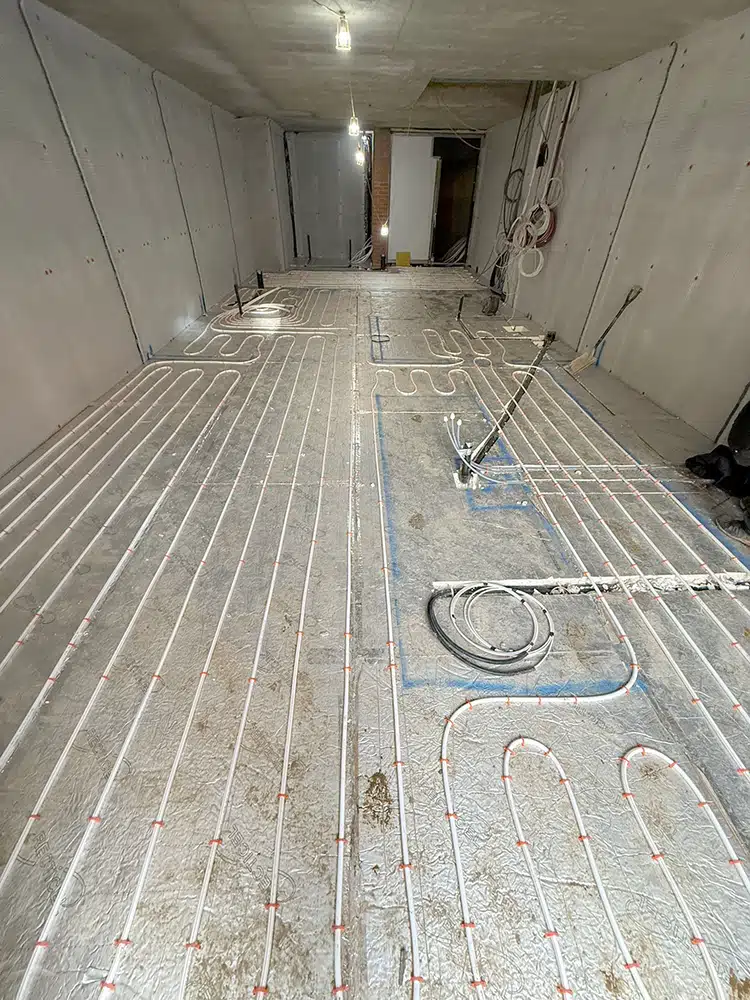
The floor build-up for a heated extension is, from the bottom: slab, insulation, a membrane or pipe fixing layer, the heating pipes, an edge strip around the walls and the screed. Below the pipes, the insulation boards and membrane, plus the edge strip at the walls, are ours to inspect or provide. Pipe laying stays with your heating engineer, who also pressure tests the circuits before our pour; K & B does not fit them.
Pipe cover is what fixes the final floor depth. With liquid screed, 25mm is the least that can sit over them, so the floor comes out at roughly 45 to 50mm. Sand and cement packed by hand needs around 45mm above the pipes, which deepens the build-up. In an extension that must meet the existing floor, that difference usually decides the choice, and the liquid screed page covers that product in more detail.
Liquid screed also wraps the pipes completely with no air pockets, which tends to give a faster warm-up and better heating efficiency. Both types can take tiles, LVT and engineered wood once they are dry and flat enough.
Commissioning underfloor heating in Haverhill homes
A new heated floor has to be warmed gently. Heating a fresh floor too hard or too soon can crack the screed and damage the finish laid over it.
On calcium sulphate the first gentle heat usually comes at about day 7, while sand and cement holds out for 21 days or longer. The first run is at a low water temperature, raised a few degrees at a time over several days, held at working temperature and then lowered. Your heating engineer's schedule governs the detail, and we provide written guidance for the handover.
Putting heating into the existing ground floor of an older Haverhill house is a bigger job than doing it in a new extension. Where the original floor has little or no insulation, the proper approach is often to dig it out and rebuild with insulation, pipes and new screed, rather than lose efficiency heating the ground. That work is described on our floor insulation and membranes page.
If the heated floor ends up slightly uneven for a thin finish, a thin coat of compound can bring it flat, as explained on the Haverhill floor levelling page.
Underfloor Heating Screed prices in Haverhill
Liquid screed over underfloor heating: £20 to £35 per m² supplied and laid (trade2base, June 2026), so £700 to £1,230 for 35 m². trade2base gives these figures excluding VAT. See our floor screeding cost guide or screed calculator.
Who lays your underfloor heating screed in Haverhill
K & B Screeding’s own team, led by director Donatas Bardisevicius. Founded 2019, company 12298780.
See what customers say in our Google reviews and on our testimonials page.
Underfloor Heating Screed from Slough to Haverhill
On the map, Haverhill sits north-east of Slough, about 60 miles from our base in a straight line (postcodes including CB9), next to Saffron Walden (9.3 miles), Newmarket (11.2 miles), Halstead (12.7 miles) and Sudbury (12.9 miles).
More on underfloor heating screed, part of our screeding services.