
Anhydrite grades on Haverhill new build plots
On a Haverhill specification sheet, the screed will carry a code like CA-C25-F5. The letters CA stand for calcium sulphate. The numbers after C and F are the compressive and flexural strength in N/mm2, tested under the British and European screed standard. The three grades in common use each suit a different kind of floor.
Light domestic floors can use CA-C20-F4, the general run of houses, apartments and offices takes CA-C25-F5, and floors with heavier use step up to CA-C30-F6. Alpha hemihydrate products sit beside the three, chosen when speed of drying or a slimmer layer matters; for those, the product's own data sheet sets the rules.
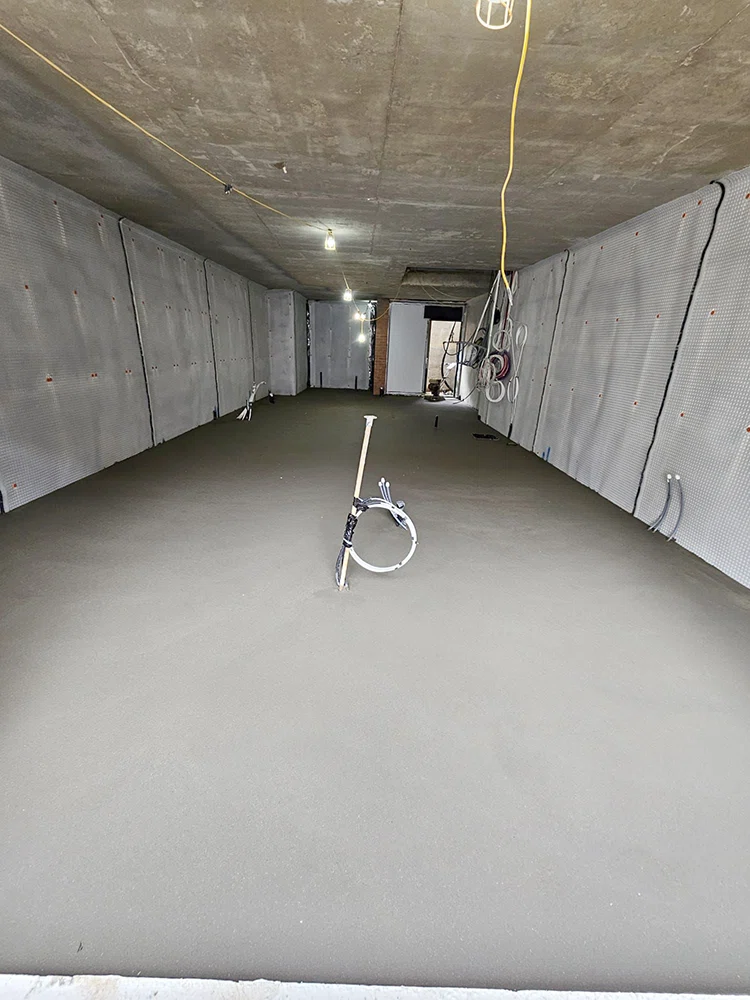
New houses are where these grades most often appear on paper. Between 2000 and 2014, 14% of Haverhill's present homes were built, and building carried on after that. On plots like these, calcium sulphate screed is poured over insulation or heating pipes in large bays, often a whole ground floor at once, because it shrinks so little.
Purpose-built flats account for 10% of the town's homes. Apartment floors suit the material well, with its flatness and low shrinkage, provided the acoustic layer and edge detail are right.
We set out bays and joints on the drawings ahead of pour day. And where a floor may get wet, we switch to a cement based flowing screed instead, since calcium sulphate is not suited to wet areas. For more on the chemistry, see how anhydrite screed works.
Sanding, priming and testing Haverhill anhydrite floors
Three steps separate a poured calcium sulphate screed from a floor ready for its finish.
First, laitance. A fine, weak layer rises to the surface as the screed sets. Once the floor is dry, it has to be sanded off to expose sound material underneath; left in place, it lets adhesives and levelling compound fail.
Second, moisture. Many flooring makers hold calcium sulphate to a stricter moisture figure than cement screed, so a reading fine on sand and cement can still fail here. We check with a hygrometer, which reads relative humidity inside the screed; the target is whatever the flooring product states. Where pipes are buried in it, running the heating on a controlled schedule can usually start force drying from around day 7.
Third, primer. Before tiles, LVT or compound, the sanded floor gets a primer formulated for calcium sulphate. Which one depends on the adhesive or compound going on next.
For where liquid screed of any type is pumped and how fast it goes in, see liquid screed in Haverhill. Written drying and laitance advice comes with every pour.
Anhydrite & Flow Screed prices in Haverhill
Liquid flowing screed (which includes anhydrite): £24 to £31 per m² supplied and laid (MyJobQuote, August 2026), so £960 to £1,240 for 40 m². MyJobQuote does not say whether these figures include VAT. See our floor screeding cost guide or screed calculator.
Who lays your anhydrite and flow screed in Haverhill
K & B Screeding’s own team, led by director Donatas Bardisevicius. Founded 2019, company 12298780.
See what customers say in our Google reviews and on our testimonials page.
Anhydrite & Flow Screed from Slough to Haverhill
On the map, Haverhill sits north-east of Slough, about 60 miles from our base in a straight line (postcodes including CB9), next to Saffron Walden (9.3 miles), Newmarket (11.2 miles), Halstead (12.7 miles) and Sudbury (12.9 miles).
More on anhydrite screed, part of our screeding services.
