
Reading a calcium sulphate specification in Bury St Edmunds
The code on a Bury St Edmunds drawing follows the standard that classifies screed materials. Take the code CA-C25-F5. Its first two letters mean calcium sulphate, and the two numbers give strength in N/mm2: 25 in compression, 5 in bending (flexural). The right grade depends on what the floor has to put up with.
A quiet domestic floor gets by on CA-C20-F4; most homes, flats and offices are poured at CA-C25-F5; heavy use moves up to CA-C30-F6. Alpha hemihydrate products sit outside that scale, picked when drying speed or a slimmer section matters, and each is laid to the maker's sheet.
Apartment blocks are a common home for this material. Blocks of purpose-built flats hold 18% of Bury St Edmunds homes, and with so little shrinkage, their floors go down in broad bays with only a handful of joints. We plan where the bays and joints go before pour day.
New build plots are the other usual setting for this specification, where the screed goes over insulation or heating pipes. Homes built from 2000 to 2014 account for 14% of Bury St Edmunds' stock.
One limit applies everywhere. Water is its weakness, so wet rooms and commercial kitchens should not have it. There a flowing screed bound with cement takes its place, through the same pump. The anhydrite guide explains the chemistry behind that.
Laitance and moisture tests on Bury St Edmunds floors
Laitance, a weak and thin skin, comes up on top of calcium sulphate as it dries. It must be removed. When drying is complete, we sand that skin back to firm material and seal it with a primer compatible with calcium sulphate; only then can adhesive or compound go on. Without that step, tiles and vinyl can lift later.
Moisture is the second check. Calcium sulphate is also judged more strictly for damp: many flooring makers set it a tighter moisture limit than cement, so passing on cement terms is not enough here. A hygrometer test of the relative humidity in the screed is the usual method, but the flooring maker's own limit decides the pass mark.
Drying can be helped. Underfloor heating can speed things up: from about 7 days the pipes can usually be run to force dry the screed, following a set programme. If you want a comparison with standard pumped liquid screed for homes, that page covers speed and access. Our drying and laitance guidance is handed over on paper.
Anhydrite & Flow Screed prices in Bury St Edmunds
Liquid flowing screed (which includes anhydrite): £24 to £31 per m² supplied and laid (MyJobQuote, August 2026), so £960 to £1,240 for 40 m². MyJobQuote does not say whether these figures include VAT. See our floor screeding cost guide or screed calculator.
Who lays your anhydrite and flow screed in Bury St Edmunds
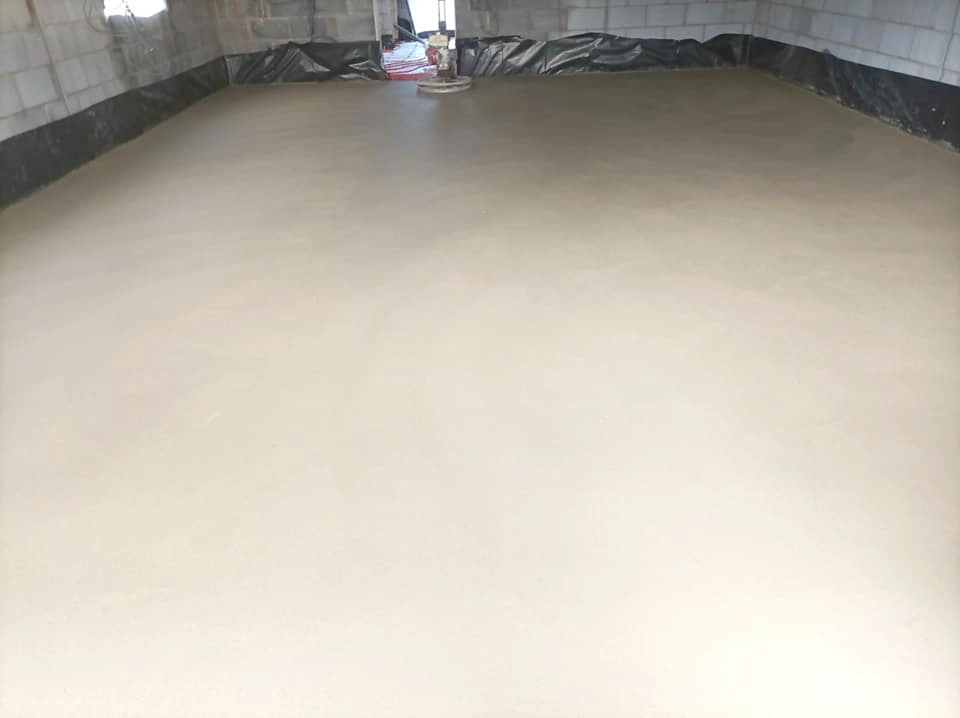
K & B Screeding’s own team, led by director Donatas Bardisevicius. Founded 2019, company 12298780.
See what customers say in our Google reviews and on our testimonials page.
Anhydrite & Flow Screed from Slough to Bury St Edmunds
On the map, Bury St Edmunds sits north-east of Slough, about 76.3 miles from our base in a straight line (postcodes including IP33), next to Newmarket (13.1 miles), Sudbury (14.3 miles), Haverhill (16.3 miles) and Soham (17 miles).
More on anhydrite screed, part of our screeding services.
