
Calcium sulphate grades specified for Sudbury flats
Anhydrite is ordered by a strength code written into the European screed materials standard. In it, C gives the compressive and F the flexural strength, each in N/mm2. Where rooms see only light domestic use, CA-C20-F4 is enough. The middle grade, CA-C25-F5, covers most homes, Sudbury's among them, along with apartments and offices. Floors that take a pounding get CA-C30-F6.
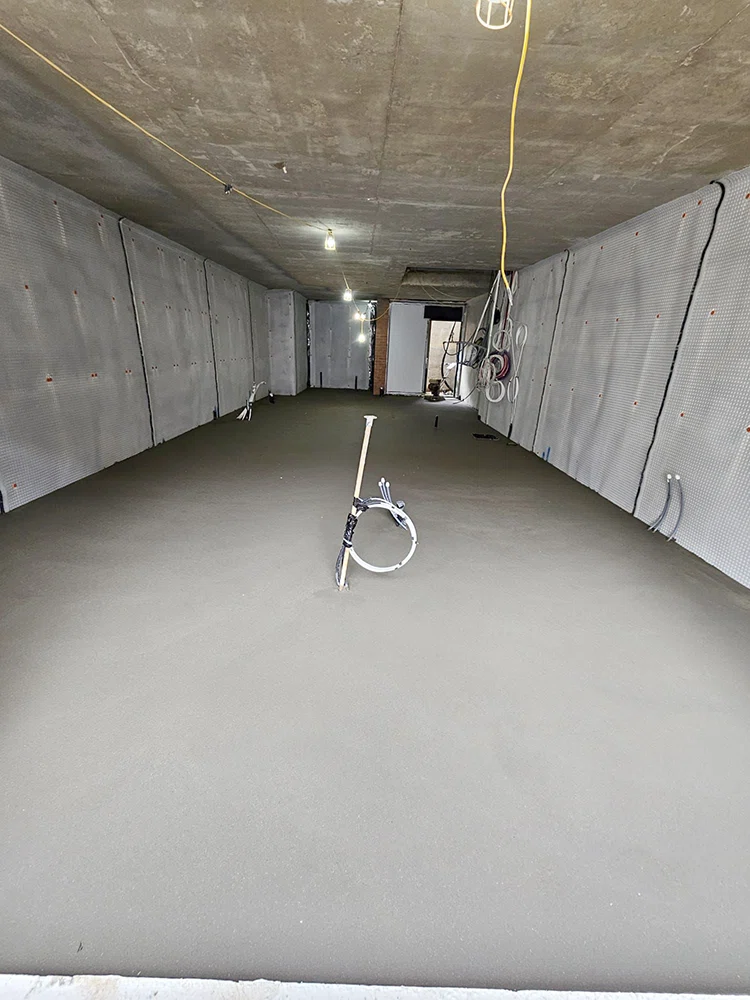
Purpose-built blocks make up 11% of Sudbury's homes. On apartment floors like these, the grade is fixed by the designer, and we pour what the specification says rather than substituting something close. Where a design needs faster drying or a thinner section, an alpha hemihydrate product may be named instead, and that follows its own product sheet for depth and drying.
Because it barely shrinks while curing, wide open bays go down with few joints, which is useful in flats and in the open-plan ground floors of new houses. Where a joint has to go in, say at a doorway or where two heating zones meet, we set out the bays and joints ahead of the pour so nothing is left to the day. Edge strips and any movement joints in the insulation below are checked at the same time, because the screed will follow them.
Calcium sulphate is also a common partner for underfloor heating, because it can usually be force dried with the system from about 7 days. For the broader background, read anhydrite screed explained.
Laitance, testing and primers on Sudbury floors
Calcium sulphate always dries with laitance on top, a thin and weak surface skin. Sand it away before adhesive or levelling compound goes down, or the finish ends up gripping that crust and not the screed. Our sanding waits until the floor is dry enough, and a primer made to work with calcium sulphate follows.
This material is also less forgiving of damp. A wood or vinyl maker will often accept a wetter reading on cement than on calcium sulphate, so the same figure that passes on one base can fail on anhydrite. We test with a hygrometer and give you the result in writing.
The one place anhydrite does not belong is a floor that may stay wet: wet rooms, shower areas or utility rooms at risk of leaks. Those get a cement based flowing screed, and where one specification mixes the two kinds, we can pour the pair. For a hand-laid option in those rooms, see sand and cement screed in Sudbury. Any levelling afterwards is covered on our Sudbury floor levelling page.
Anhydrite & Flow Screed prices in Sudbury
Liquid flowing screed (which includes anhydrite): £24 to £31 per m² supplied and laid (MyJobQuote, August 2026), so £960 to £1,240 for 40 m². MyJobQuote does not say whether these figures include VAT. See our floor screeding cost guide or screed calculator.
Who lays your anhydrite and flow screed in Sudbury
K & B Screeding’s own team, led by director Donatas Bardisevicius. Founded 2019, company 12298780.
See what customers say in our Google reviews and on our testimonials page.
Anhydrite & Flow Screed from Slough to Sudbury
As the crow flies, our yard in Slough is about 68.7 miles from Sudbury, which lies to the east-north-east. Postcodes here include CO10, and Halstead (7.8 miles), Colchester (12.6 miles), Haverhill (12.9 miles) and Braintree (13.5 miles) are close by.
More on anhydrite screed, part of our screeding services.
