
Choosing a CA grade for Colchester apartments
A calcium sulphate screed is specified by a code. CA stands for calcium sulphate, the C number gives the compressive strength and the F number the flexural strength, both in N/mm2, under the European standard for screed materials.
CA-C20-F4 suits domestic floors with light traffic, such as bedrooms and living rooms. CA-C25-F5 is the general choice for most homes, apartments and offices. CA-C30-F6 is used for heavier use, such as communal corridors or busier commercial floors.
Alpha hemihydrate products are chosen where faster drying or reduced depth matter, for example in a conversion where floor to ceiling height is limited. Each follows its own product data sheet for depth and drying.
Because calcium sulphate shrinks very little, it can be laid in large bays with few joints, which suits open apartment floors and new build plots. The bay and joint layout is agreed with the designer before the pour, with particular care at doorways, narrow corridors and where one floor plate changes shape, since those are the points where any movement shows first.
There is one clear limit. Calcium sulphate is not the choice for areas that may get wet. In bathrooms, shower areas and plant rooms, a cement based flowing screed or hand-laid cement screed is used instead. For the pumping method and where liquid screeds fit, see pumped screed in Colchester homes.
Fitting anhydrite into a Mile End or Stanway programme
On the newer Colchester estates and in Garrison conversions, the screed is one line on a long fit-out programme, and calcium sulphate brings its own tasks with it. Building them in from the start stops the flooring contractor arriving to a floor that is not ready.
Drying comes before anything else. The heating can usually be used to force dry the screed from about 7 days, following a gradual heat-up, which is one reason the material is popular on sites with underfloor heating. Even so, the floor is only ready when a hygrometer reading passes. Many flooring manufacturers set a lower moisture limit for calcium sulphate than for cement based screed, so a reading that would suit tiles on sand and cement may still be too high here.
The surface then needs sanding. Calcium sulphate forms a thin laitance as it settles, and that weak skin is sanded off and vacuumed before priming. Priming uses a product compatible with calcium sulphate, chosen alongside the adhesive so the two work as one system.
We hand over drying and laitance advice in writing on the day. For the full sequence, see our anhydrite screed explainer.
Reading the screed specification on a Colchester plot
Some 30% of Colchester's homes have been built since 2000, and on a new plot or a block of flats the screed is usually named on the drawings long before anyone arrives to pour it. Reading that specification properly is the first part of the job.
A specification might name a generic grade such as CA-C25-F5, or a particular manufacturer's product, which may be standard anhydrite or an alpha hemihydrate screed with its own depth and drying rules. In a block of flats it also shows what sits below the screed, whether insulation, an acoustic layer or both, and that build-up has to suit the product named.
When you send the drawings for a quote, include the areas, the depths, the build-up below the screed and the product or grade. We check that the depth and build-up suit that product and flag any conflict before quoting, rather than on the day of the pour. Common examples are a depth thinner than the product sheet allows, a grade too light for a communal corridor, or a calcium sulphate screed shown running into a bathroom or plant room.
If the drawings leave the grade open, we recommend one for each area. The quote comes back within 24 hours with a fixed price, and the specified product is ordered for a date agreed with your programme, after any underfloor heating has been pressure tested.
Anhydrite and flow screed prices in Colchester
Liquid flowing screed (which includes anhydrite): £24 to £31 per m² supplied and laid (MyJobQuote, August 2026), so £960 to £1,240 for 40 m². MyJobQuote does not say whether these figures include VAT. See our liquid screed cost per m² guide or screed calculator.
Who lays your anhydrite and flow screed in Colchester
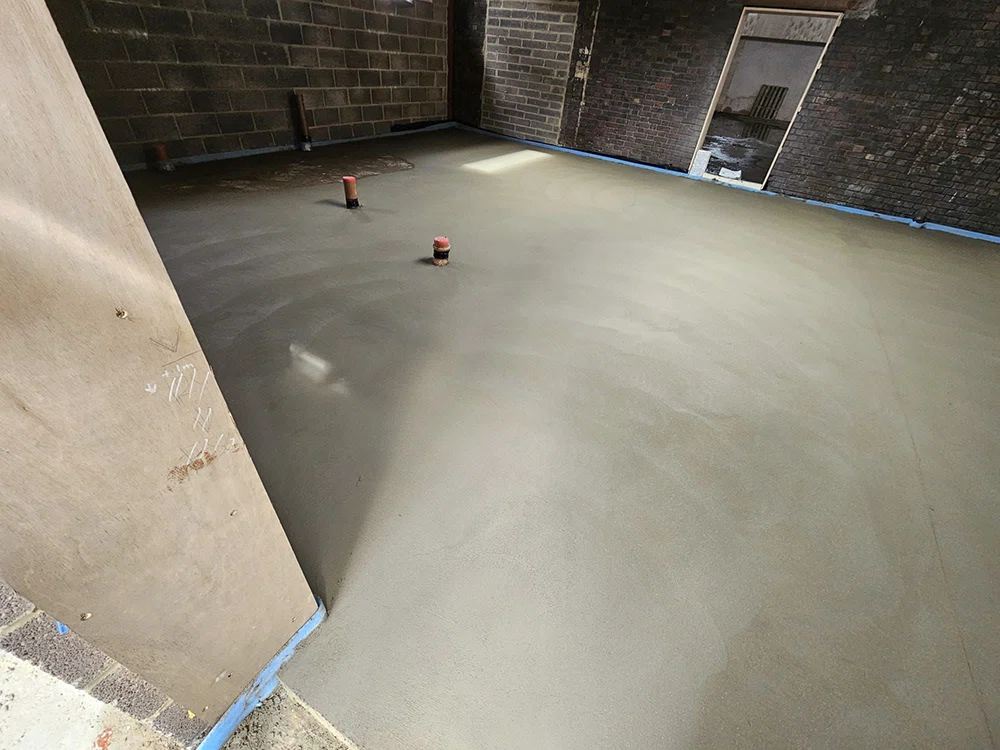
K & B Screeding’s own team, led by director Donatas Bardisevicius. Founded 2019, company 12298780.
See what customers say in our Google reviews and on our testimonials page.
Anhydrite and flow screed from Slough to Colchester
On the map, Colchester sits east-north-east of Slough, about 70.8 miles from our base in a straight line (postcodes including CO1, CO3, CO2 and CO4), next to Halstead (12 miles), Sudbury (12.6 miles), Witham (12.7 miles) and Clacton-on-Sea (12.9 miles).
Where the anhydrite delivery must park in a marked bay in Colchester, a bay suspension from the North Essex Parking Partnership (bay suspension) covers it; the quote tells you if it is needed.
More on anhydrite screed, part of our screeding services. For every screed we lay locally, see floor screeding in Colchester.
Further reading: calcium sulphate screed guide.