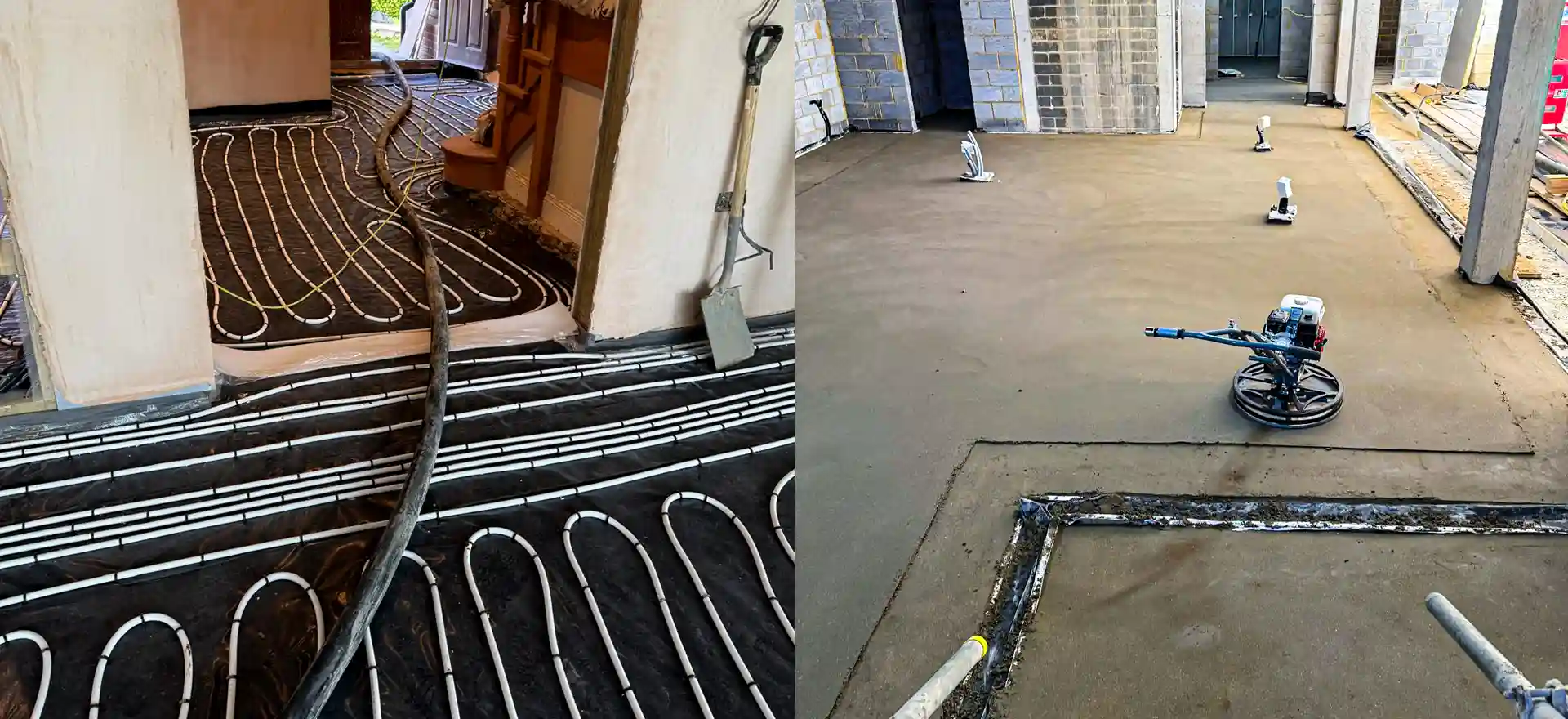
Pipe cover and depth in Colchester heated floors
The screed over underfloor heating does more than cover the pipes. It spreads the heat evenly and gives a strong, flat base for the finish. To do that it needs the right depth and full contact with every pipe.
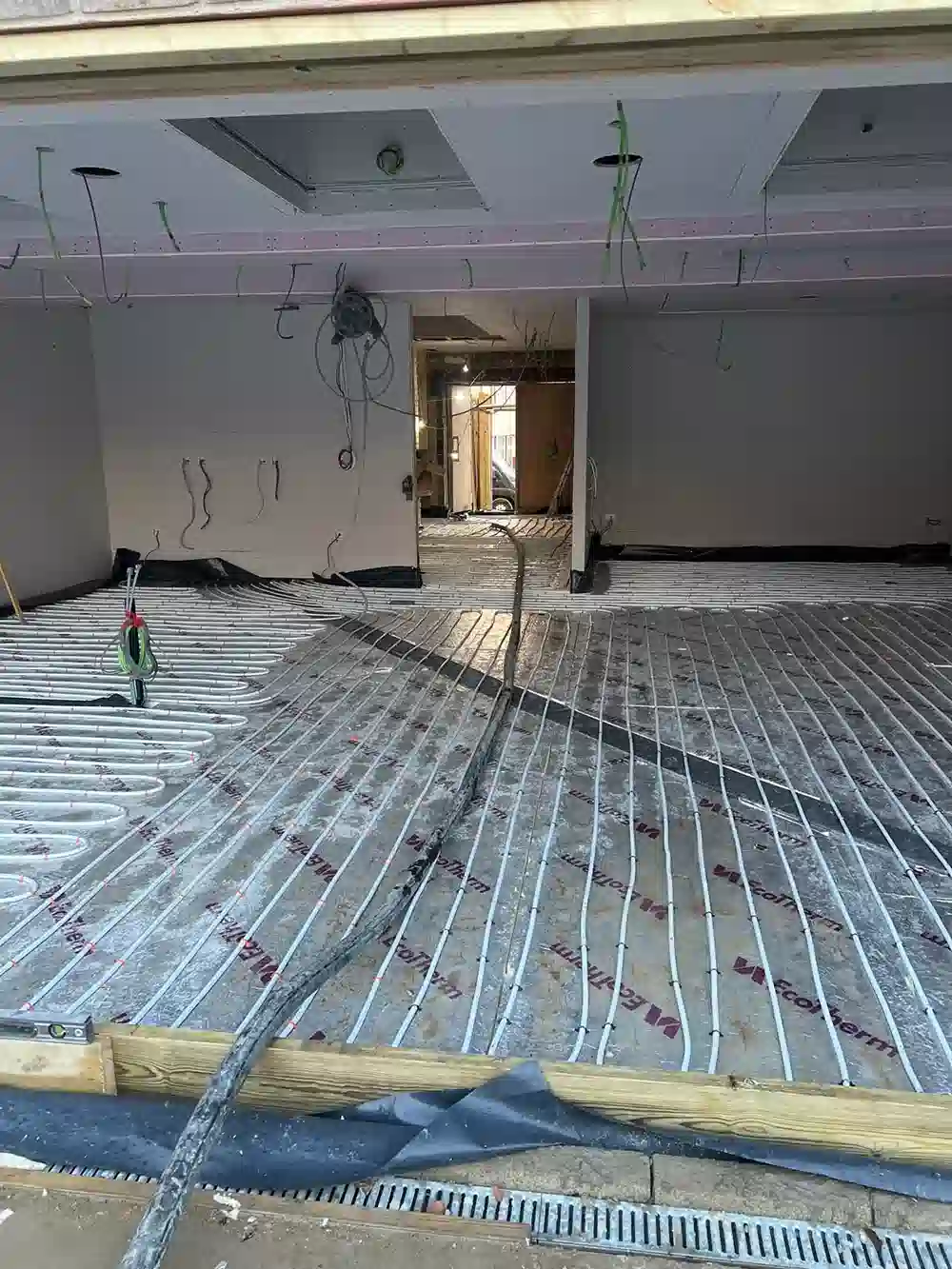
With a pumped liquid screed over heating pipes, cover must be at least 25mm above the top of the pipe, giving 45 to 50mm in total. Liquid screed flows under and around the pipes, leaving no air pockets. With sand and cement, cover is about 45mm, so the finished screed is thicker, heavier and slower to dry.
Newer homes are often built with this in mind, but 26% of Colchester's homes date from 1973 to 1999, and houses of that age were rarely built with heating in the floor. When one of those homes is extended, the new heated floor has to meet the existing one at the same level. Planning the insulation and screed depth before anything is ordered avoids steps and awkward thresholds.
Detached houses account for 23% of the city's homes, and with larger floor areas, the choice between liquid and sand and cement can change the drying time and cost noticeably. Published 2026 rates for liquid screed over underfloor heating run from £20 to £35 a square metre.
K & B does not install the heating pipes. Your heating engineer lays and pressure tests the circuits, and we pour while they are still under pressure.
Commissioning heated floors in Colchester Garrison conversions
After the pour, the heating cannot simply be switched on. The first heat-up follows the material and must be gradual.
Calcium sulphate screed can usually be warmed from about 7 days after pouring. Sand and cement needs at least 21 days. Start at a low water temperature, increase it a little each day, hold at working temperature, then reduce it again before flooring goes down. Moving too quickly can crack the screed or cause flooring to fail later.
In a converted building, the heat-up has a second benefit: it helps dry the screed ready for flooring, which matters on a tight programme. For calcium sulphate floors, the anhydrite drying and laitance advice explains what happens before the finish goes on.
In any room, the screed near an outside wall may dry at a different rate from the middle, so moisture readings should be taken in several places, not just one.
We leave written commissioning guidance on the day, so your heating engineer and flooring fitter work to the same plan. The same service is available for underfloor heating in Witham and other nearby towns.
Joining a heated Greenstead extension to the house
Council-era homes in Greenstead are frequent candidates for extensions, and when the new room has underfloor heating, the floor has to do two things at once: carry the heating and finish exactly level with the existing house.
The height is worked out backwards. Start from the finished floor level of the room you are keeping, take off the thickness of the floor covering, then the screed, then the insulation. Whatever is left is how deep the ground has to be dug. A liquid screed keeps that stack thinner. With sand and cement the screed is thicker, so the dig goes deeper or the insulation gets thinner, which your designer has to approve.
The line where the old house meets the extension needs thought. The heated screed expands and contracts as it warms and cools, while the old floor does not, so edge strip runs along that line and a movement joint is planned where the two floors meet, usually in the opening. That joint is then carried through the tiles above.
If the existing floor is uneven, it rarely matches the new screed perfectly, and a thin compound across both may be the final step before large tiles or long boards. The Colchester floor levelling page explains how that join is finished.
It pays to agree the finish first, because a stone floor and an engineered board need different allowances at that threshold.
Underfloor heating screed prices for Colchester floors
Liquid screed over underfloor heating: £20 to £35 per m² supplied and laid (trade2base, June 2026), so £700 to £1,230 for 35 m². trade2base gives these figures excluding VAT. See our liquid screed cost per m² guide, the floor screeding cost guide or the screed calculator.
Who lays your underfloor heating screed in Colchester
K & B Screeding, led by director Donatas Bardisevicius. Founded 2019, company 12298780.
See what customers say in our Google reviews and on our testimonials page.
Underfloor heating screed from Slough to Colchester
On the map, Colchester sits east-north-east of Slough, about 70.8 miles from our base in a straight line (postcodes including CO1, CO2, CO3 and CO4), next to Halstead (12 miles), Sudbury (12.6 miles), Witham (12.7 miles) and Clacton-on-Sea (12.9 miles).
On Colchester streets where the screed lorry cannot park off the road, a bay suspension comes from the North Essex Parking Partnership (bay suspension). We confirm on the quote whether it is needed. For an extension in Colchester, the floor usually needs building regulations approval, including Part L insulation in England. Local building control is Colchester City Council Building Control.
More on underfloor heating screed, part of our floor screeding service. For every screed we lay locally, see floor screeding in Colchester.
Further reading: screed depth for underfloor heating and underfloor heating on a concrete floor.