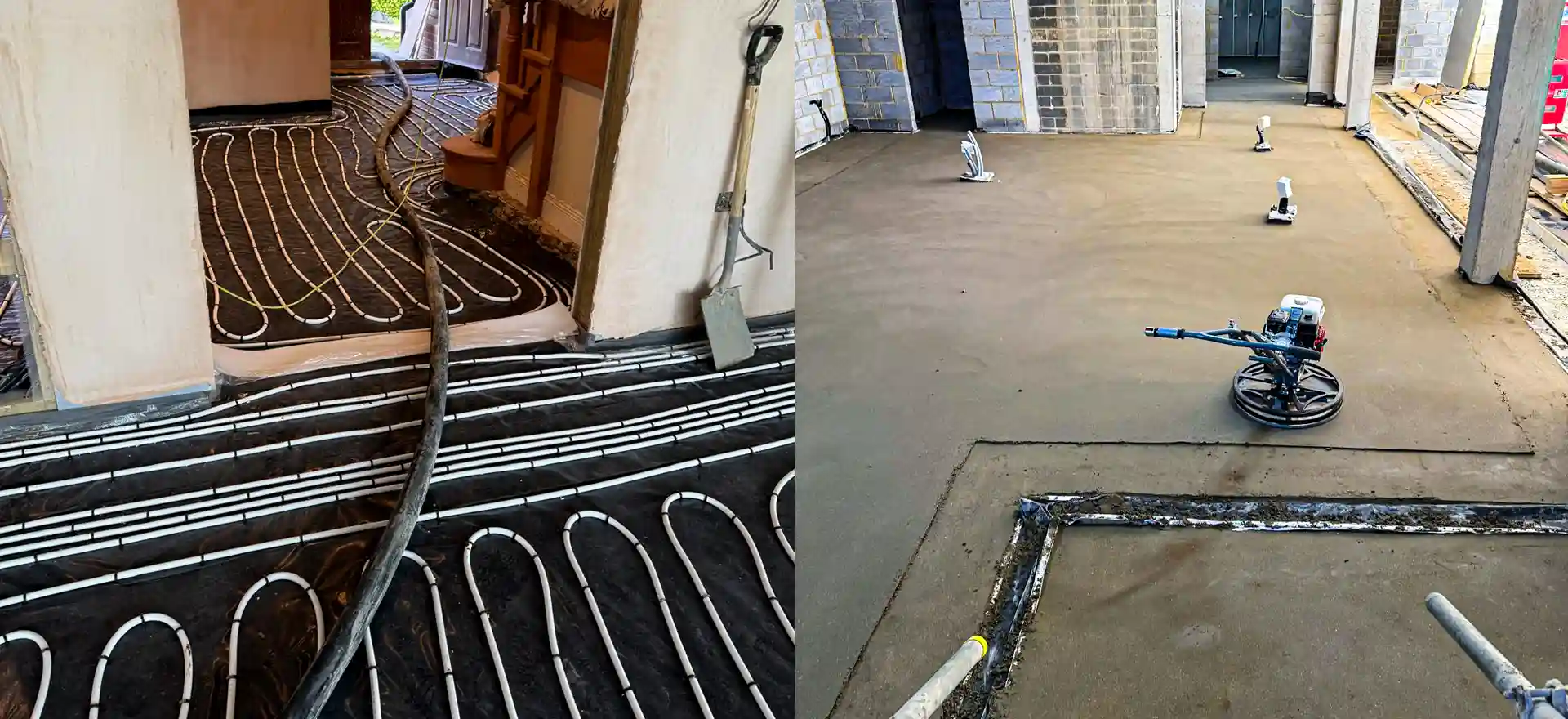
Keeping the build-up thin in South Woodham Ferrers
Height is the problem with retrofit heating. The new floor has to finish at the level of the rooms around it, the front door and the kitchen units, and it has to hold insulation, pipes and screed within that depth. Where the existing floor is a sand and cement screed on a slab, the old screed is often taken up to create the room needed.
Liquid screed earns its place here by going down thinner. With 25mm minimum over the pipes, the whole layer comes to about 45 to 50mm, whereas sand and cement wants about 45mm over the pipes alone and ends up deeper overall. Being runny, it also wraps each pipe completely, leaving no air gaps, so heat spreads evenly and the room warms up sooner.
In an extension the numbers are easier, because the build-up is designed from the start and set to meet the old floor. Garage conversions sit between the two: the slab is low, so there is usually room for insulation and pipes, but the finished level must still line up with the hallway. On semi-detached houses, which make up 23% of the town, the join between the new heated room and the old kitchen is the key level to match. Our screed thickness guide sets out typical build-ups, and where the old floor has to come up first, floor preparation covers removal and making good.
Switching the heating on in South Woodham Ferrers
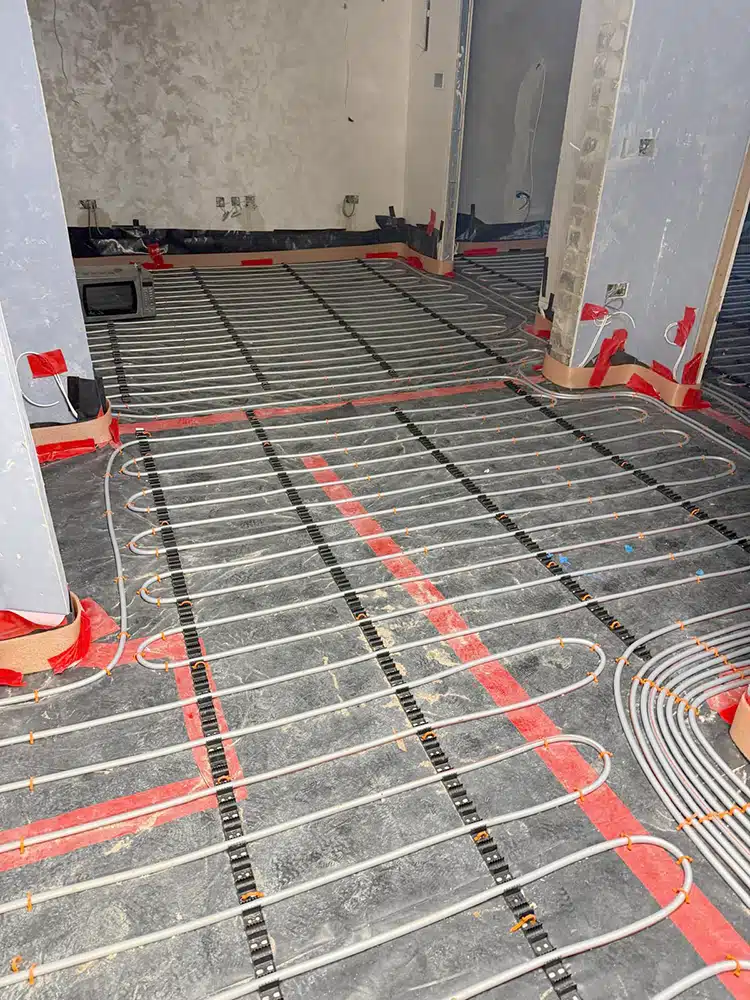
The pipes come first, and they are not ours. Laying the pipes and pressure testing them is your heating engineer's work. We come after that, look over the insulation, the membrane and the edge strip, and then pour or lay the screed on top.
After the pour, the timing depends on the material. Calcium sulphate will usually take gentle heat from around 7 days. With sand and cement, keep the heating off for 21 days at least. From there the flow temperature begins low and climbs a little each day over several days. Turn it straight up to full and the top dries ahead of the layer underneath, which can crack the floor.
Heated floors also affect the finish. The screed has to be dry, and in the case of calcium sulphate sanded, before tiles, LVT or engineered wood go down, and the flooring maker's moisture limits apply. Our drying guide explains the numbers. The published price range for a heated liquid screed floor is £20 to £35 per m². For the pumped option in detail, see liquid screed in South Woodham Ferrers, or look at underfloor heating screed in Maldon.
Large tiles over heated floors in South Woodham Ferrers
Nearly every house in South Woodham Ferrers belongs to the same forty year window, with 78% built between 1973 and 1999, so many original floors and kitchens are now due for renewal. Levelling floors for large format tiles is typical work, and when an extension or a renewed kitchen gets underfloor heating as well, the tiles and the heated screed should be planned together.
Start with the old floor. Relaying cracked or hollow sand and cement screeds is common work here, and a floor like that is no base for heating or for big tiles. If the existing screed is coming up to make room for insulation and pipes, it is replaced in full. If part of it is staying in an unheated room next to the new floor, any hollow sections there are repaired so the tiles can run through on a sound base.
Flatness comes next. Large tiles need a flat base, or they rock and leave lips at the joints. A liquid screed over heating reaches a good flatness class readily, and where it falls short, a thin levelling coat goes on once the screed is dry.
Movement is the last point. Any joints in the screed, such as at a doorway, between heating zones or where the heated floor meets an unheated one, need a matching movement joint in the tiling above, and the tiler should use an adhesive suited to heated floors. The tiler can confirm what their tile and adhesive need.
Underfloor heating screed prices for South Woodham Ferrers floors
Liquid screed over underfloor heating: £20 to £35 per m² supplied and laid (trade2base, June 2026), so £700 to £1,230 for 35 m². trade2base gives these figures excluding VAT. See our liquid screed cost per m² guide, the floor screeding cost guide or the screed calculator.
Who lays your underfloor heating screed in South Woodham Ferrers
K & B Screeding, led by director Donatas Bardisevicius. Founded 2019, company 12298780.
See what customers say in our Google reviews and on our testimonials page.
Underfloor heating screed from Slough to South Woodham Ferrers
On the map, South Woodham Ferrers sits east of Slough, about 55.1 miles from our base in a straight line (postcodes including CM3), next to Rayleigh (4.1 miles), Wickford (4.9 miles), Rochford (5.7 miles) and Maldon (6.5 miles).
Where the screed lorry must park in a marked bay in South Woodham Ferrers, a bay suspension from Chelmsford City Council (suspension of parking restrictions) covers it; the quote tells you if it is needed. An extension floor usually needs building regulations approval (Part L sets the insulation standard in England); the council building control service for South Woodham Ferrers is Chelmsford City Council Building Control.
More on underfloor heating screed, part of our floor screeding service. For every screed we lay locally, see floor screeding in South Woodham Ferrers.
Further reading: underfloor heating on a concrete floor.