
Heating the whole ground floor of a Billericay house
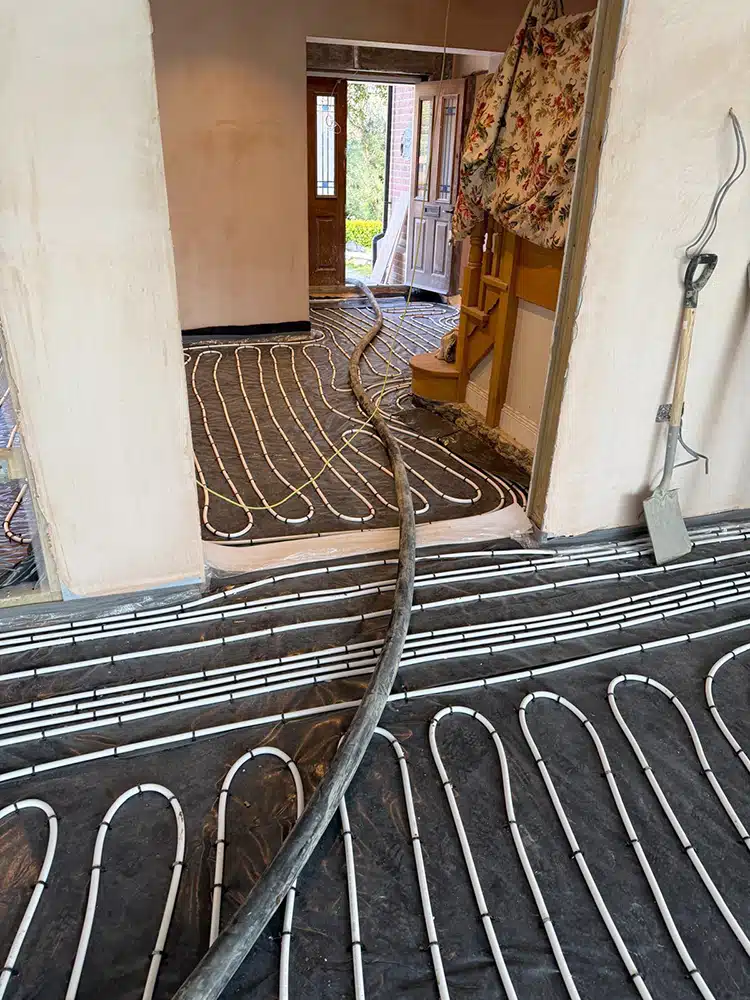
When a Billericay semi or detached house is extended, the owner often decides to heat the whole ground floor, not just the new room. That changes the job. The extension gets a fresh build-up, but the existing rooms have their old floor lifted, insulation laid, the heating pipes fitted by your installer and a new screed poured to meet the extension at one level.
The depth available decides a lot. Pumped screed has to sit at least 25mm above the pipes, so it normally ends up 45 to 50mm thick. Hand-laid wants about 45mm above them, which adds depth overall. Add the insulation beneath, and the dig in the existing rooms has to go down far enough that the finished floor still meets doors, stairs and the front threshold. Where height is tight, the thinner liquid option often decides it, and the liquid screed page for Billericay covers that product in more detail.
Liquid screed flows fully round every pipe, leaving no voids, so heat spreads evenly and the floor responds faster. Sand and cement also works over heating and suits smaller or more awkward rooms, but it has to be compacted carefully around the pipes.
Your installer should have the pipes clipped and pressure tested before our day, and the insulation, membrane and edge strip should already be down. We go over each layer when we arrive, and the boards and sheeting can come from us through our insulation and membrane supply.
Commissioning heated floors in Billericay homes
The first warm-up is when a heated screed is most at risk, so it follows a set schedule. Over calcium sulphate, the system can normally be started around a week after the pour; over sand and cement, wait 21 days as a minimum. Then the water is warmed in small steps of a few degrees across several days, and held there before the floor goes up to full temperature. Rushing it can crack the floor.
We give you that schedule in writing at handover, so the heating engineer, the flooring fitter and anyone else on the job work from the same plan. If flooring has to go down by a set date, force drying with the heating can help a calcium sulphate screed along, and our screed drying guide explains how.
For a heated floor in liquid screed, the published 2026 UK range is £20 to £35 per m². A whole ground floor plus extension is a larger area than an extension alone, so the pump set-up is spread across more square metres. If you are comparing prices from nearby, underfloor heating screed in Chelmsford is priced on the same basis.
Underfloor Heating Screed prices in Billericay
Liquid screed over underfloor heating: £20 to £35 per m² supplied and laid (trade2base, June 2026), so £700 to £1,230 for 35 m². trade2base gives these figures excluding VAT. See our floor screeding cost guide or screed calculator.
Who lays your underfloor heating screed in Billericay
K & B Screeding’s own team, led by director Donatas Bardisevicius. Founded 2019, company 12298780.
See what customers say in our Google reviews and on our testimonials page.
Underfloor Heating Screed from Slough to Billericay
On the map, Billericay sits east of Slough, about 46.2 miles from our base in a straight line (postcodes including CM12 and CM11), next to Basildon (4 miles), Wickford (4.5 miles), Brentwood (4.8 miles) and Stanford-le-Hope (7 miles).
More on underfloor heating screed, part of our screeding services.
