
Retrofitting heated floors in post-war Stanford-le-Hope houses
The hard part of adding underfloor heating to an existing house is height. A post-war semi was built with a concrete slab and doors, skirting and stair nosings set to that level. Lifting the old floor frees depth, but the new build-up has to fit insulation, pipes and screed back into roughly the same space.
That is why liquid screed is usually chosen on these retrofits. With 25mm minimum above the pipes, the whole screed comes out at roughly 45 to 50mm deep. Trowelling sand and cement over the same pipes takes roughly 45mm above them, and that lifts the new floor closer to those fixed door heights. Liquid also flows fully around the pipes, leaving no air pockets to block the heat, and the denser layer warms up faster.
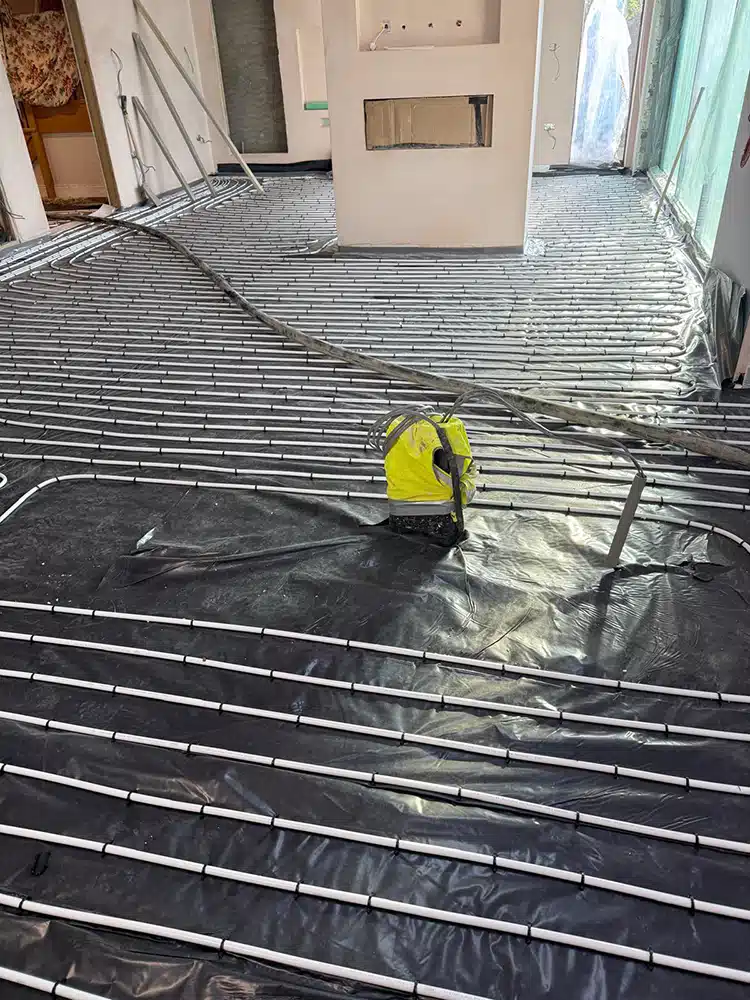
Your heating installer should have the pipes in and tested under pressure before we turn up. We check that the insulation is flat and continuous, that a membrane is in place and that an edge strip runs round every wall so the screed can expand. A gap in any of those shows up later as cracking or cold patches.
The same approach suits a heated extension or a garden room, where the floor is built from scratch. New homes follow it too: 8% of the town's homes were built since 2015, and recent houses are often planned with heated floors from the start. For depth figures in more detail, see the screed thickness guide.
Switching the heating on in Stanford-le-Hope homes
Once the screed is down, the heating becomes part of the drying plan, but only on a schedule. With calcium sulphate, gentle warming can normally begin about 7 days after pouring. Sand and cement needs longer, with no heat at all until day 21 has passed.
Commissioning should be gradual. Begin with the water running cool, nudge it higher a little at a time across several days, then keep it steady for a spell before flooring goes on. Jumping straight to maximum dries the top too quickly, which can crack the floor or lift its edges. Your heating engineer sets the exact steps for the system, and we hand over clear guidance on how the screed needs to be treated.
Even then, a moisture reading has to clear the floor before any tiles, LVT or engineered boards. If you are planning the whole ground floor, compare pumped liquid screed for open rooms with traditional screed where a wet area joins. Budget-wise, pumping screed over heating pipework is priced at £20 to £35 for each m² in the 2026 published figures.
Underfloor Heating Screed prices in Stanford-le-Hope
Liquid screed over underfloor heating: £20 to £35 per m² supplied and laid (trade2base, June 2026), so £700 to £1,230 for 35 m². trade2base gives these figures excluding VAT. See our floor screeding cost guide or screed calculator.
Who lays your underfloor heating screed in Stanford-le-Hope
K & B Screeding’s own team, led by director Donatas Bardisevicius. Founded 2019, company 12298780.
See what customers say in our Google reviews and on our testimonials page.
Underfloor Heating Screed from Slough to Stanford-le-Hope
Stanford-le-Hope is about 47.2 miles east of our Slough base as the crow flies, with postcodes including SS17. The nearest towns to it are Basildon (3.1 miles), Tilbury (5.7 miles), Grays (6.2 miles) and Gravesend (6.7 miles).
More on underfloor heating screed, part of our screeding services.
