
Heated extensions in King's Farm and Riverview Park
Kitchen and garden room extensions are a good fit for the inter-war streets of King's Farm and the post-war houses of Riverview Park, and a new room like that is the easiest place to add heating in the floor. The screed is the working part of the system. It surrounds the pipes, holds and spreads the heat, and gives the flooring a stable base.
Cover over the pipes sets the thickness. With liquid, cover over the pipes starts at 25mm, so the floor typically reaches 45 to 50mm. Sand and cement placed by hand needs nearer 45mm above them, which deepens the floor. Because liquid fills every gap round the pipes and traps no air, the room warms evenly and fast. Heated liquid floors are listed at £20 to £35 per m² in the 2026 published figures.
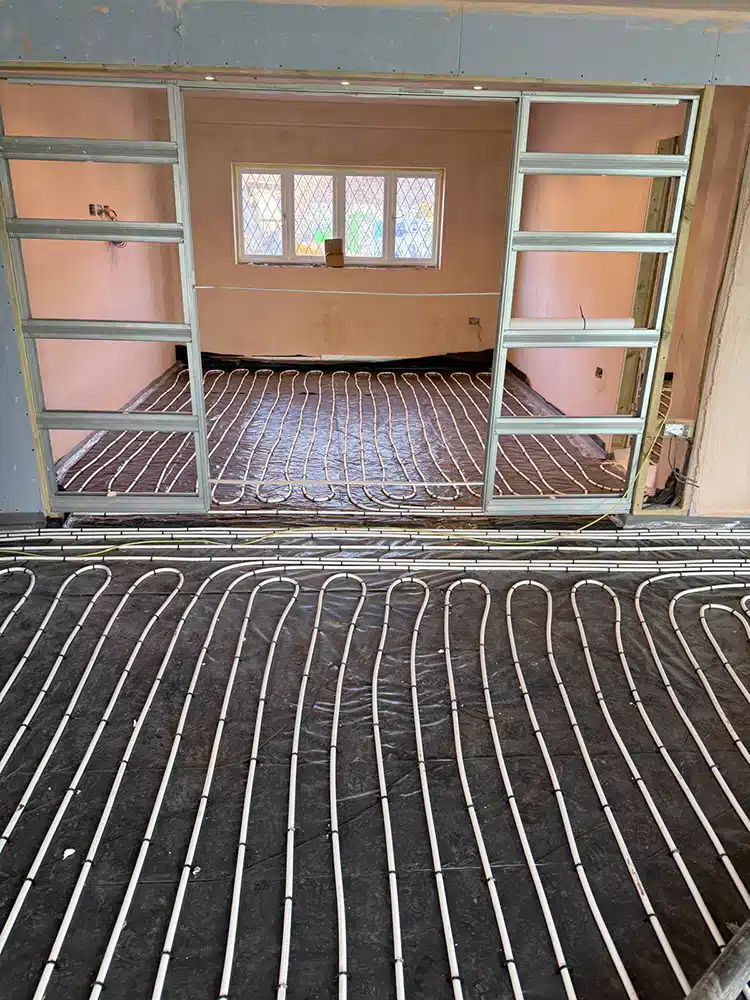
On a King's Farm or Riverview Park extension, the heated floor has to end up level with the original slab. That means working back from the finished floor level: flooring, screed, pipes, insulation and then the depth to dig. We check that the insulation is continuous, the membrane is lapped and taped, and the edge strip runs around every wall before the pour.
Homes built from 1973 to 1999 make up 15% of the town, and extensions to them face the same height question at the doorway. For the pumping and access side, our page on liquid screed in Gravesend covers the method.
Commissioning heated screed floors in Gravesend homes
The first weeks after the pour decide how long a heated floor lasts. Warmth can normally reach calcium sulphate from around day 7, but sand and cement has to sit unheated for three weeks, 21 days, at least. Begin the flow temperature low and lift it bit by bit across several days. Turning it straight up to maximum can crack the floor.
Running the system also helps the floor dry. Once commissioning has started, running the system gently draws moisture out of the screed, which our screed drying guide explains. Even so, flooring only goes down after a moisture test.
Retrofitting heating into an older Gravesend terrace is harder than into an extension, because floor height is usually tight. If the old solid floor is being broken out anyway, the dig can be taken deep enough for insulation, pipes and screed; otherwise a thin liquid screed may be the only way to fit a system without raising the floor. Hand-laid sand and cement over pipes needs more depth but suits wet areas.
For the rest of a renovation, the main Gravesend floor screeding page shows how the different screeds fit together.
Underfloor Heating Screed prices in Gravesend
Liquid screed over underfloor heating: £20 to £35 per m² supplied and laid (trade2base, June 2026), so £700 to £1,230 for 35 m². trade2base gives these figures excluding VAT. See our floor screeding cost guide or screed calculator.
Who lays your underfloor heating screed in Gravesend
K & B Screeding’s own team, led by director Donatas Bardisevicius. Founded 2019, company 12298780.
See what customers say in our Google reviews and on our testimonials page.
Underfloor Heating Screed from Slough to Gravesend
Gravesend is about 44.2 miles east of our Slough base as the crow flies, with postcodes including DA11 and DA12. The nearest towns to it are Northfleet (1 miles), Tilbury (1.3 miles), Grays (3.2 miles) and Swanscombe (3.7 miles).
More on underfloor heating screed, part of our screeding services.
