
Screeding heated floors in Swanscombe extensions
A heated floor works because the screed spreads the warmth evenly and protects the pipes. Too little screed and you may see cracks tracing the pipe runs, or warm and cold bands across the room.
The rule depends on the screed. Pumped liquid has to clear the pipes by 25mm or more, so it ends up 45 to 50mm deep above the insulation. It flows around every pipe with no voids, and its thinner section responds faster when the heating comes on. Hand-laid sand and cement wants about 45mm above the pipework, which makes the floor thicker and slower to heat, though it is the better fit for wet rooms and certain tile systems.
In a new extension, the slab can be set low enough for insulation, pipes and screed from the start, and the finished level matched to the existing house at the doorway. That is the easiest heated floor to build. Pumping that floor is covered under Swanscombe liquid screed.
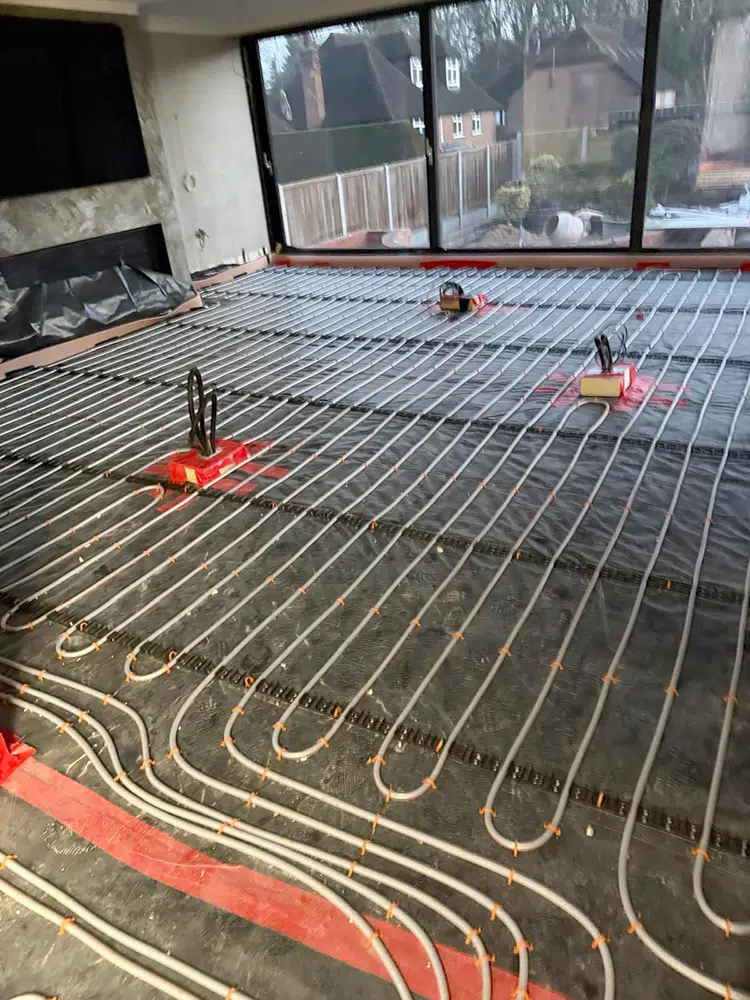
By pour day we need the insulation, membrane and perimeter strip down, and every pipe clipped and through its pressure test. Our crew looks over those layers on arrival. If insulation and membrane are not in the heating package, we can supply them through our insulation and membranes service.
Detached houses are only 7% of Swanscombe's homes, so a heated floor here usually goes into a semi, terrace or flat, where the depth available between the slab and the door thresholds needs checking early.
Swanscombe retrofits and the first heat-up
Retrofitting heating into an older Swanscombe terrace is harder than building it into an extension. The old floor has to come up, and insulation, pipes and screed have to fit into a height set by doors, stairs and kitchen units. Liquid screed eases things, as the pipes need a thinner layer of it. Where there is still not enough room, the old slab may need lowering, which has to be decided before the heating is ordered. See how the depths add up in our screed thickness figures.
The first heat-up is the other critical stage. On calcium sulphate the heating can normally come on at around 7 days, set low and nudged up a little at a time. Sand and cement stays cold for 21 days minimum. We hand over the schedule with the job, and your heating engineer commissions the system to it.
Flooring goes down only once the screed tests dry. Timber and vinyl makers often set their own limits for surface temperature and moisture, so check the chosen finish before the heating schedule is agreed. The same underfloor heating screed service covers nearby Northfleet.
Underfloor Heating Screed prices in Swanscombe
Liquid screed over underfloor heating: £20 to £35 per m² supplied and laid (trade2base, June 2026), so £700 to £1,230 for 35 m². trade2base gives these figures excluding VAT. See our floor screeding cost guide or screed calculator.
Who lays your underfloor heating screed in Swanscombe
K & B Screeding’s own team, led by director Donatas Bardisevicius. Founded 2019, company 12298780.
See what customers say in our Google reviews and on our testimonials page.
Underfloor Heating Screed from Slough to Swanscombe
As the crow flies, our yard in Slough is about 40.5 miles from Swanscombe, which lies to the east. Postcodes here include DA9, and Dartford (1.6 miles), Grays (2.6 miles), Northfleet (2.8 miles) and Tilbury (3.5 miles) are close by.
More on underfloor heating screed, part of our screeding services.
