
Specifying anhydrite at Ebbsfleet and Swanscombe apartments
Anhydrite is ordered by a code drawn from the European standard for screeds. Take CA-C25-F5: 25 is its compressive strength and 5 its flexural strength, both stated in N/mm2.
Housing nearly always uses one of three. CA-C20-F4 is enough for a home with light foot traffic. Most houses, flats and offices sit at CA-C25-F5, the middle grade. The toughest of the three, CA-C30-F6, goes where use is heavier. On new plots at Castle Hill, Springhead or Eastern Quarry, or any apartment block, the grade comes from the engineer's specification, and we pour that grade rather than swap it.
A specification may skip the CA grades and name an alpha hemihydrate screed. Designers reach for these when the floor must dry sooner or sit shallower, and each comes with its own data sheet, which is what we follow.
Flats suit calcium sulphate because it hardly shrinks. That lets a long corridor or an open-plan flat go down in wide bays with only a handful of joints. The few joints required, usually at doorways or between heating zones, are mapped out before any screed is pumped.
With 37% of Swanscombe homes built since 2000, a large share of the town's floors are recent. When any floor is refitted, knowing whether it is calcium sulphate matters for the primer and adhesive, because the wrong product can fail on it. Our plain guide to anhydrite covers the chemistry.
Laitance and moisture checks on Swanscombe floors
As it dries, anhydrite throws up a fragile top skin called laitance. Adhesive or compound laid over that skin grips the crust, not the screed, so we sand it off first. A primer made for calcium sulphate goes on next, since a primer designed only for cement screed may not hold on this material.
Moisture is then tested with a hygrometer. Calcium sulphate often gets a stricter moisture ceiling from flooring makers than cement does, and the hygrometer figure has to clear the one set for your chosen covering. Over heating pipes, the system can normally be used to dry the screed faster from around day 7.
The material is not for wet areas. Anywhere in a Swanscombe home that could end up under water, a shower room, wet room or leak-prone utility, belongs on a cement based flowing screed or sand and cement laid by hand.
If a recent anhydrite floor has been finished without sanding and is now failing, it usually needs stripping, sanding and levelling before the new floor. The same calcium sulphate specification work is offered in Grays.
Anhydrite & Flow Screed prices in Swanscombe
Liquid flowing screed (which includes anhydrite): £24 to £31 per m² supplied and laid (MyJobQuote, August 2026), so £960 to £1,240 for 40 m². MyJobQuote does not say whether these figures include VAT. See our floor screeding cost guide or screed calculator.
Who lays your anhydrite and flow screed in Swanscombe
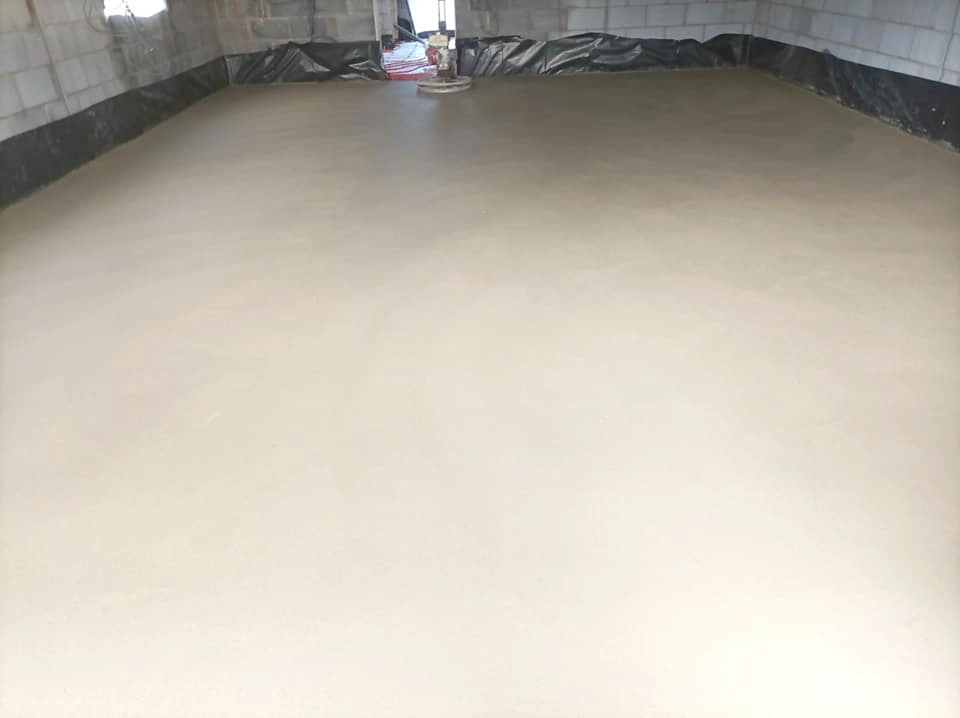
K & B Screeding’s own team, led by director Donatas Bardisevicius. Founded 2019, company 12298780.
See what customers say in our Google reviews and on our testimonials page.
Anhydrite & Flow Screed from Slough to Swanscombe
As the crow flies, our yard in Slough is about 40.5 miles from Swanscombe, which lies to the east. Postcodes here include DA9, and Dartford (1.6 miles), Grays (2.6 miles), Northfleet (2.8 miles) and Tilbury (3.5 miles) are close by.
More on anhydrite screed, part of our screeding services.