
Specifying calcium sulphate for Dartford apartments and plots
Calcium sulphate screeds take their grades from the European screed materials standard. Take CA-C25-F5: C is compressive strength and F flexural strength, each in N/mm2. Domestic rooms with little foot traffic can use CA-C20-F4. Most homes, apartment schemes and offices are specified at CA-C25-F5. Floors that work harder get CA-C30-F6.
The engineer or architect decides the grade, and we pour exactly what is on the drawings. A specification can also swap in an alpha hemihydrate product when the floor must dry faster or be thinner. Its own data sheet then sets the depth and drying times, overriding the usual rules of thumb. If the drawings leave the choice open, we explain the trade-off between a standard grade and an alpha product before the order is placed.
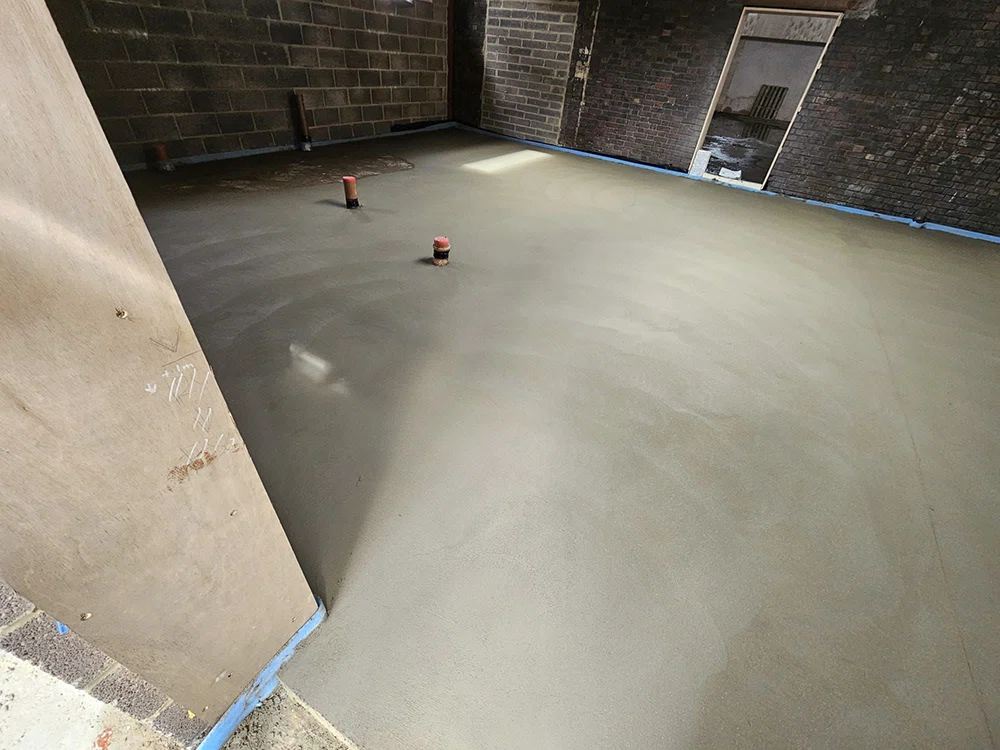
Dartford's apartment schemes, such as Langley Square and Brewery Square, combine flowing screed with acoustic layers and underfloor heating. A calcium sulphate screed suits that kind of floor because it shrinks very little, so an apartment can be poured in large bays with few joints. Where joints cannot be avoided, at doorways or where two heating zones meet for example, we plan their layout before pouring.
To read more about the material, see our guide to anhydrite screed. Larger schemes, and warehouse or retail floors where a different material may be the better fit, are covered by commercial screeding.
Laitance and moisture checks on Dartford anhydrite floors
Once a calcium sulphate floor has dried enough, the laitance comes off. It is a fragile crust that builds up on top while the screed dries, and adhesive cannot be relied on to hold to it. We sand it away, then prime the floor with a product made for calcium sulphate, not a cement primer.
Moisture is checked next, with a hygrometer. The moisture limit many flooring makers set for calcium sulphate is tighter than for cement, which is how a floor that looks dry can still fail. Force drying with the heating can usually begin from about 7 days, which helps apartment programmes where other trades are waiting. Without heating, the floor dries naturally and the programme needs to allow for it.
Wet areas are the exception. Any floor that might get wet is off limits for calcium sulphate, so level-access shower rooms, wet rooms and some utility floors take a cement based flowing screed or a hand-laid one. Our page on sand and cement screed in Dartford covers those rooms, and underfloor heating screed in Dartford covers the heat-up in detail.
Anhydrite & Flow Screed prices in Dartford
Liquid flowing screed (which includes anhydrite): £24 to £31 per m² supplied and laid (MyJobQuote, August 2026), so £960 to £1,240 for 40 m². MyJobQuote does not say whether these figures include VAT. See our floor screeding cost guide or screed calculator.
Who lays your anhydrite and flow screed in Dartford
K & B Screeding’s own team, led by director Donatas Bardisevicius. Founded 2019, company 12298780.
See what customers say in our Google reviews and on our testimonials page.
Anhydrite & Flow Screed from Slough to Dartford
As the crow flies, our yard in Slough is about 38.8 miles from Dartford, which lies to the east. Postcodes here include DA2, DA1 and DA9, and Swanscombe (1.6 miles), Grays (3.8 miles), Northfleet (4.5 miles) and Bexley (4.5 miles) are close by.
More on anhydrite screed, part of our screeding services.
