
Calcium sulphate for Tilbury flats and new-build plots
Anhydrite screed uses a calcium sulphate binder mixed with sand and water, pumped in as a fluid. Its main advantage is very low shrinkage. It barely moves as it sets, so bays can be large with few joints, which is why housebuilders specify it for open-plan floors and apartment blocks.
The code on a specification pairs a C figure for compressive strength with an F figure for flexural strength, each in N/mm2. A lightly used house floor can take CA-C20-F4. A Tilbury terrace, a flat or an office would normally take CA-C25-F5, with CA-C30-F6 poured where a floor faces heavier use. We pour the grade that is written down and do not substitute. The drawings may name an alpha hemihydrate product when the designer wants a quicker dry or less depth, and we then follow that product's data sheet.
New building in Tilbury has come in modest steps. Homes from 2000 to 2014 make up 6% of the stock. Beaconsfield Place brought 35 flats for people over 55, and council-led schemes like it are the kind of build where insulation and a flowing screed go down together. An individual plot or a flat refurbishment in the town may call for the same material on a smaller scale.
Joints are planned before the pour, usually at door thresholds and between heating zones, so the layout suits the rooms rather than the other way round. Read the anhydrite screed guide for a fuller account of the material.
Sanding, testing and priming Tilbury anhydrite floors
Drying leaves a fragile film on top of the screed, known as laitance. Glue and compound will not grip that film dependably, so once the floor has dried far enough, we sand the film away and apply a primer suited to calcium sulphate. Using the wrong primer, or skipping the sanding, is a common reason for tiles and LVT failing later.
Then comes the moisture reading, which catches out plenty of owners. Flooring makers often accept less moisture in calcium sulphate than in cement, so the hygrometer, not a count of weeks, decides when your flooring goes down. In a Tilbury flat with heating pipes in the floor, the heating can normally start drying the screed from about day 7.
Water is its weak point. Long contact with moisture softens it, so bathrooms, showers and utility rooms likely to see leaks should have a flowing screed made with cement or a trowelled sand and cement floor for Tilbury wet rooms. For anhydrite laid over heating pipes, the underfloor heating screed page for Tilbury covers commissioning.
Anhydrite & Flow Screed prices in Tilbury
Liquid flowing screed (which includes anhydrite): £24 to £31 per m² supplied and laid (MyJobQuote, August 2026), so £960 to £1,240 for 40 m². MyJobQuote does not say whether these figures include VAT. See our floor screeding cost guide or screed calculator.
Who lays your anhydrite and flow screed in Tilbury
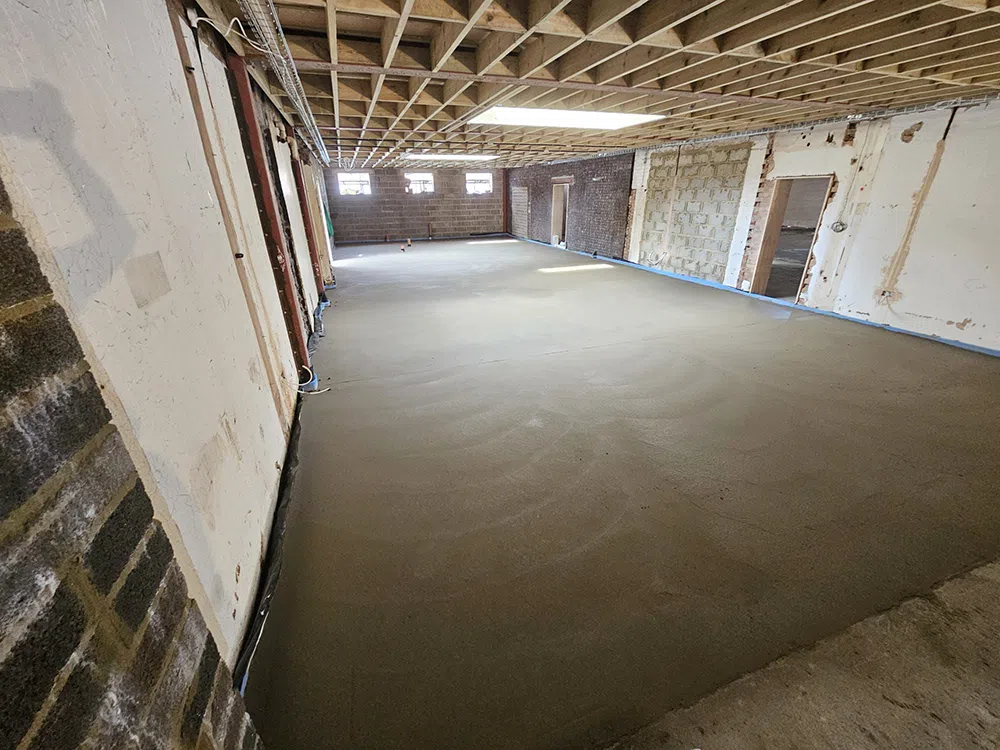
K & B Screeding’s own team, led by director Donatas Bardisevicius. Founded 2019, company 12298780.
See what customers say in our Google reviews and on our testimonials page.
Anhydrite & Flow Screed from Slough to Tilbury
Tilbury is about 43.8 miles east of our Slough base as the crow flies, with postcodes including RM18. The nearest towns to it are Gravesend (1.3 miles), Northfleet (1.7 miles), Grays (2 miles) and Swanscombe (3.5 miles).
More on anhydrite screed, part of our screeding services.