
Chatham specifications: CA grades and alpha products
The European screed standard gives every calcium sulphate screed a code, CA-C25-F5 for example. CA stands for calcium sulphate, the C figure for compressive strength and the F figure for flexural strength, measured in N/mm2. CA-C20-F4 covers domestic rooms with light traffic. Homes, apartment blocks and offices mostly use CA-C25-F5. CA-C30-F6 is kept for floors under heavier use.
We pour the grade that the engineer or architect has named. An alpha hemihydrate product may be written in instead where quicker drying or a thinner section is wanted, and its manufacturer's sheet then governs depth and drying.
On former dockyard land at St Mary's Island, Chatham Maritime has brought a marina and new housing estates. Wherever new plots are built in the town, the drawings may name a calcium sulphate grade, and that grade is what we pour. With purpose-built flats at 13% of Chatham's homes, apartment floors are a good match for this material: it hardly shrinks, so a whole flat can go down in large bays with few joints.
Doorways and the boundaries between heating zones are where joints have to go; we draw up the bay layout before pouring so each one lands where the floor finish can cope with it. The material itself is explained in our anhydrite screed guide, and sites with difficult access are covered by our screed pumping service.
Sanding, testing and priming Chatham anhydrite floors
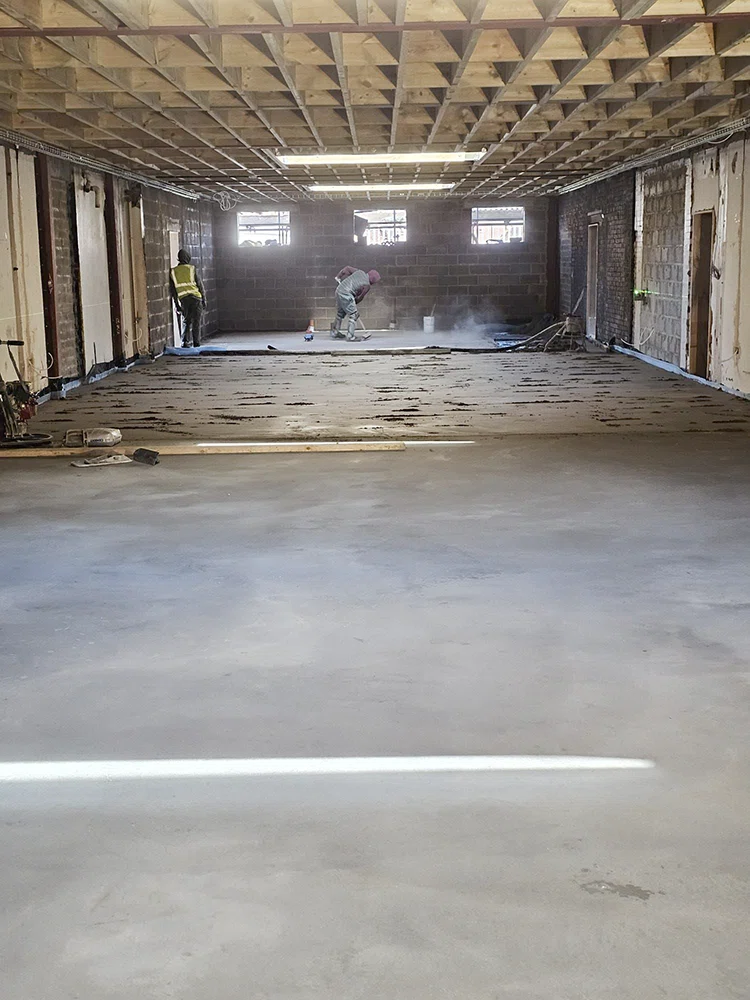
Three steps come between a poured calcium sulphate floor and the finished flooring. The first is removing the laitance, a thin weak layer that forms on top as the screed dries. It is sanded off, because adhesive bonded to laitance can fail and lift the finish.
The second is a moisture test. Because flooring makers often allow calcium sulphate less moisture than cement, a hygrometer reading against their limit decides when it is ready, not the calendar. With underfloor heating fitted, force drying can normally start at around day 7.
The third is priming with a product that is compatible with calcium sulphate, ready for adhesive or a levelling coat.
Above any specification sits one rule: keep calcium sulphate out of rooms where the floor could get wet. Walk-in shower rooms, wet rooms and utility rooms take a cement based flowing screed or a hand-laid option. Our page on hand-laid screed for Chatham wet rooms covers them. If the finish needs a smoother base after priming, floor levelling in Chatham covers compound work.
Anhydrite & Flow Screed prices in Chatham
Liquid flowing screed (which includes anhydrite): £24 to £31 per m² supplied and laid (MyJobQuote, August 2026), so £960 to £1,240 for 40 m². MyJobQuote does not say whether these figures include VAT. See our floor screeding cost guide or screed calculator.
Who lays your anhydrite and flow screed in Chatham
K & B Screeding’s own team, led by director Donatas Bardisevicius. Founded 2019, company 12298780.
See what customers say in our Google reviews and on our testimonials page.
Anhydrite & Flow Screed from Slough to Chatham
On the map, Chatham sits east of Slough, about 51.6 miles from our base in a straight line (postcodes including ME4 and ME5), next to Rochester (1 miles), Gillingham (2.5 miles), Snodland (5.2 miles) and Maidstone (7.7 miles).
More on anhydrite screed, part of our screeding services.
