
Specified CA grades on Ashford new build schemes
On a house builder's drawings, the screed appears as a CA code from the European screed standard. After the C comes the compressive strength, and after the F the flexural strength, in N/mm2. Lightly used domestic floors can take CA-C20-F4, the bulk of houses, apartments and offices are poured in CA-C25-F5, and CA-C30-F6 is saved for floors that see heavier use. If the drawings name no grade, we explain the three options and recommend one to suit each floor's use, so the specification is settled before materials are ordered.
Alongside these sit alpha hemihydrate products, chosen when the floor has to dry quicker or go in thinner. Depth, drying and heat-up for each are set by its own product sheet. On a plot-by-plot programme with a fixed handover date, the drying time can be the deciding factor.
The appeal of calcium sulphate on large schemes is its low shrinkage. It can be laid in large bays with few joints, it flows completely around heating pipes, and it gives a flat, dense floor. We plan bay layout and joint positions before the pour, placing joints at doorways where the flooring can hide them.
Our own team can put in everything under the screed as well: insulation, membrane, edge strip and the dams across doorways. Background on how calcium sulphate behaves is in our anhydrite screed explained guide.
Laitance, moisture limits and wet rooms in Ashford
Calcium sulphate screed forms laitance as it sets: a thin, weak surface layer that must come off before flooring. When the plot floor has dried, it gets sanded and vacuumed, then coated with a calcium sulphate compatible primer. Using the right primer is what lets adhesive or compound bond to the sanded surface. Our floor preparation service includes sanding.
Moisture testing follows. Many flooring brands want calcium sulphate drier than cement screed, so the hygrometer result is checked against the figure for the actual product going down. Switching the heating on from about day 7 brings a plot down to that figure faster. Drying and laitance advice is handed over in writing, which helps site managers sign off each plot.
Anywhere that might get wet is off limits for calcium sulphate. Wet rooms and plant rooms with drains take a cement based flowing mix, so on a mixed plot each room is checked before the pour. For access, depth and the pumping process for flowing screeds in general, see liquid screed in Ashford.
Anhydrite & Flow Screed prices in Ashford
Liquid flowing screed (which includes anhydrite): £24 to £31 per m² supplied and laid (MyJobQuote, August 2026), so £960 to £1,240 for 40 m². MyJobQuote does not say whether these figures include VAT. See our floor screeding cost guide or screed calculator.
Who lays your anhydrite and flow screed in Ashford
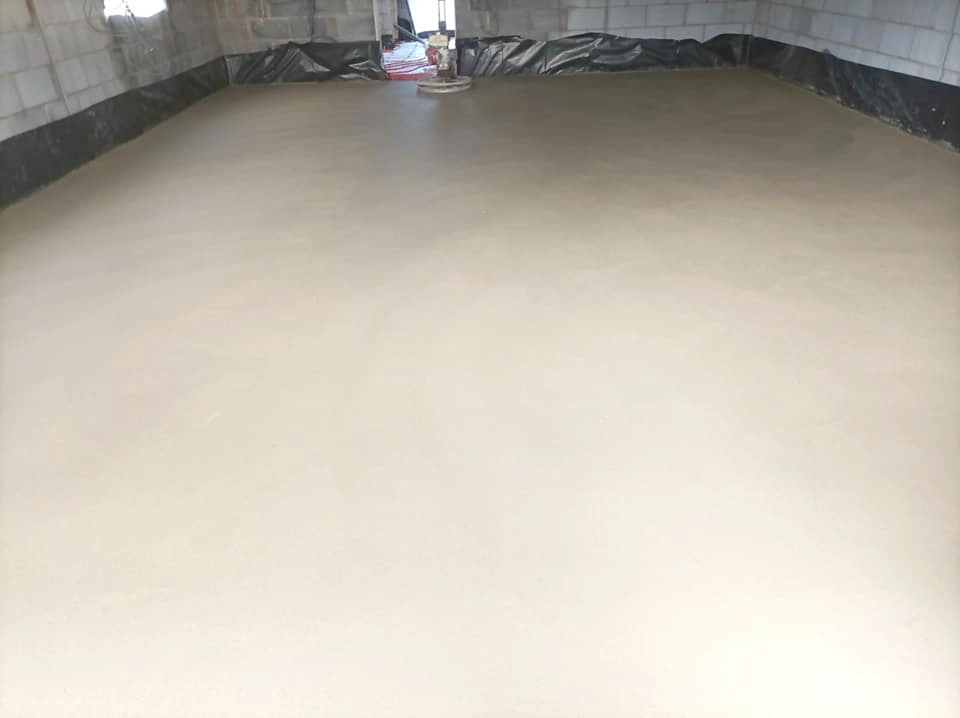
K & B Screeding’s own team, led by director Donatas Bardisevicius. Founded 2019, company 12298780.
See what customers say in our Google reviews and on our testimonials page.
Anhydrite & Flow Screed from Slough to Ashford
On the map, Ashford sits east-south-east of Slough, about 70.8 miles from our base in a straight line (postcodes including TN23, TN24 and TN25), next to Faversham (11.6 miles), Canterbury (12.8 miles), Sittingbourne (14.5 miles) and Whitstable (16 miles).
More on anhydrite screed, part of our screeding services.
