
Reading the CA grade on a Herne Bay specification
Each anhydrite screed carries a code under the BS EN screed standard, and once you can read it you know what load the floor is built for. Take CA-C25-F5: the CA stands for calcium sulphate, the 25 gives the compressive strength and the 5 the flexural, each in N/mm2.
Three grades cover most work. For lightly used rooms in a house, CA-C20-F4 is enough. CA-C25-F5 covers the bulk of homes, flats and offices. Floors that take more wear get CA-C30-F6. On a retirement scheme or apartment block near the seafront, the designer will usually set the grade in the specification, and we lay to that.
Alpha hemihydrate products are a separate group, not a stronger version of the same thing. Specifiers pick them when a floor must dry sooner or be laid thinner, say where there is little height to play with, and every product has its own data sheet setting depth and drying.
The material's big practical advantage is low shrinkage. That allows larger bays with fewer joints than sand and cement, which is useful across open-plan apartment floors and on a run of identical new build plots at Strode Farm or Greenhill. We still draw up where the bays and joints go well ahead of pour day. For more on how this material behaves, see our guide to anhydrite screed.
Laitance, moisture and wet rooms in Herne Bay flats
As calcium sulphate cures, a fragile surface film called laitance forms on top. That film has to come off, normally with a sander, when the floor has dried. Adhesives and levelling compounds bond poorly to it, and a floor laid over it can fail.
Moisture is the second check. Many flooring makers are stricter about moisture on a calcium sulphate base than on cement, so a reading that clears a cement screed can fail on this one. A hygrometer reading comes before any flooring. Running the heating from about day 7 can usually speed drying when time is short, and the heat-up itself is covered under warming up a heated Herne Bay floor.
The primer matters too. It has to be one made for calcium sulphate, and if a thin compound goes on next, as it often does under vinyl, see our levelling service for Herne Bay floors.
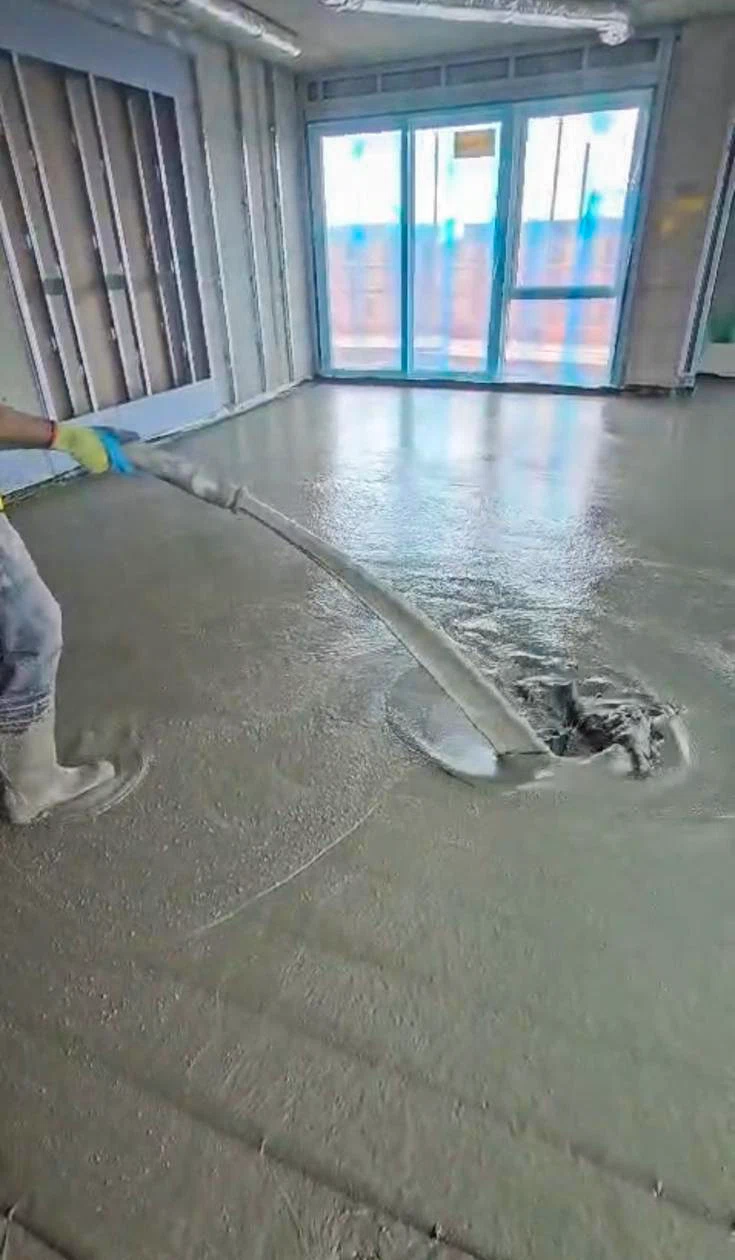
Areas that may get wet are the exception. Keep calcium sulphate out of wet rooms and anywhere water can reach the floor. In those spots we pour a flowing screed made with cement instead, which gives much the same finish and copes with water.
Anhydrite & Flow Screed prices in Herne Bay
Liquid flowing screed (which includes anhydrite): £24 to £31 per m² supplied and laid (MyJobQuote, August 2026), so £960 to £1,240 for 40 m². MyJobQuote does not say whether these figures include VAT. See our floor screeding cost guide or screed calculator.
Who lays your anhydrite and flow screed in Herne Bay
K & B Screeding’s own team, led by director Donatas Bardisevicius. Founded 2019, company 12298780.
See what customers say in our Google reviews and on our testimonials page.
Anhydrite & Flow Screed from Slough to Herne Bay
As the crow flies, our yard in Slough is about 77.3 miles from Herne Bay, which lies to the east. Postcodes here include CT6, and Whitstable (4.5 miles), Canterbury (6.7 miles), Faversham (10.9 miles) and Sittingbourne (17 miles) are close by.
More on anhydrite screed, part of our screeding services.
