
Specification grades for Whitstable new build plots
On the plot drawings you will see the screed written as a code. CA tells you the binder, calcium sulphate; the figure after C is crushing strength and the figure after F is bending strength, both in N/mm2. The lightest, CA-C20-F4, is meant for house floors that see little traffic. The middle grade, CA-C25-F5, covers most houses, flats and offices, and CA-C30-F6 is kept for harder wear.
On a house plot the specification will often name CA-C25-F5, and occasionally CA-C20-F4 for lightly used rooms. Areas expected to take heavier use may call for the stronger grade. We pump to the grade on the drawings; where none is given, we recommend one from the use of each area.
Outside that scale sit alpha hemihydrate screeds. A specifier reaches for one when a plot has to dry sooner or the floor must be thinner, and the depth and drying of each are set by the maker's sheet, not the general rules.
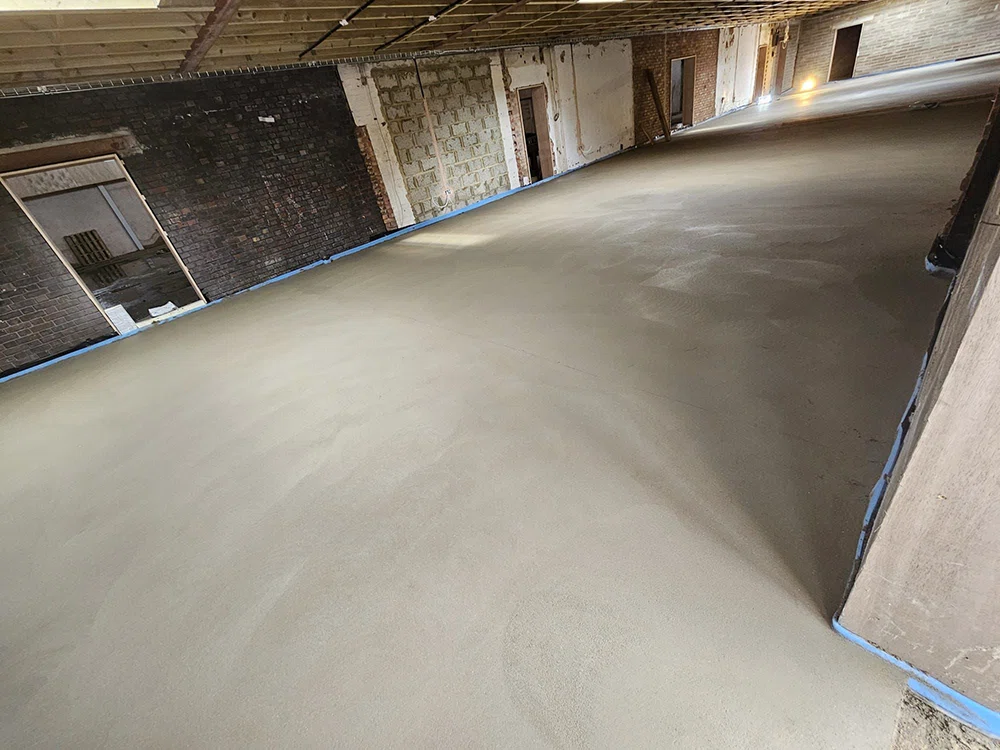
Because calcium sulphate hardly shrinks, a whole open-plan ground floor on the Thanet Way or Ridgeway sites can go down in big bays with very few joints. Those bays and joints are still drawn up before each pour, with doorways checked most closely.
Only 6% of Whitstable's homes were built from 2015 onwards, so the new sites are a real change for the town. Purpose-built flats make up 10% of homes, and apartment floors are another typical use. The anhydrite screed explainer covers the material's chemistry.
Preparing anhydrite floors for Whitstable finishes
Three steps stand between a dry calcium sulphate screed and a finished floor.
First, the laitance. Curing leaves a soft, thin crust on top, and when the floor has dried that crust is sanded away. Adhesive stuck to laitance fails with it.
Second, moisture testing. Plenty of flooring makers accept less moisture in calcium sulphate than in cement, so the bar is set lower. Running the heating from around day 7 to force dry the floor gets it there sooner.
Third, priming. Once sanded, the floor takes a primer made for calcium sulphate; one designed purely for cement bases will not do. Where a very flat base is needed for thin sheet flooring, a skim of levelling compound over the primed screed can follow.
There is one rule we do not bend: if water may reach the floor, anhydrite stays out. Bathrooms with walk-in showers, utility rooms and anything near the harbour that is washed down are better in a cement based flowing screed or a hand-laid cement screed.
Anhydrite & Flow Screed prices in Whitstable
Liquid flowing screed (which includes anhydrite): £24 to £31 per m² supplied and laid (MyJobQuote, August 2026), so £960 to £1,240 for 40 m². MyJobQuote does not say whether these figures include VAT. See our floor screeding cost guide or screed calculator.
Who lays your anhydrite and flow screed in Whitstable
K & B Screeding’s own team, led by director Donatas Bardisevicius. Founded 2019, company 12298780.
See what customers say in our Google reviews and on our testimonials page.
Anhydrite & Flow Screed from Slough to Whitstable
As the crow flies, our yard in Slough is about 73.1 miles from Whitstable, which lies to the east. Postcodes here include CT5, and Herne Bay (4.5 miles), Canterbury (5.9 miles), Faversham (6.5 miles) and Sittingbourne (12.6 miles) are close by.
More on anhydrite screed, part of our screeding services.
