
Rebuilding floors in Whitstable's low-lying centre
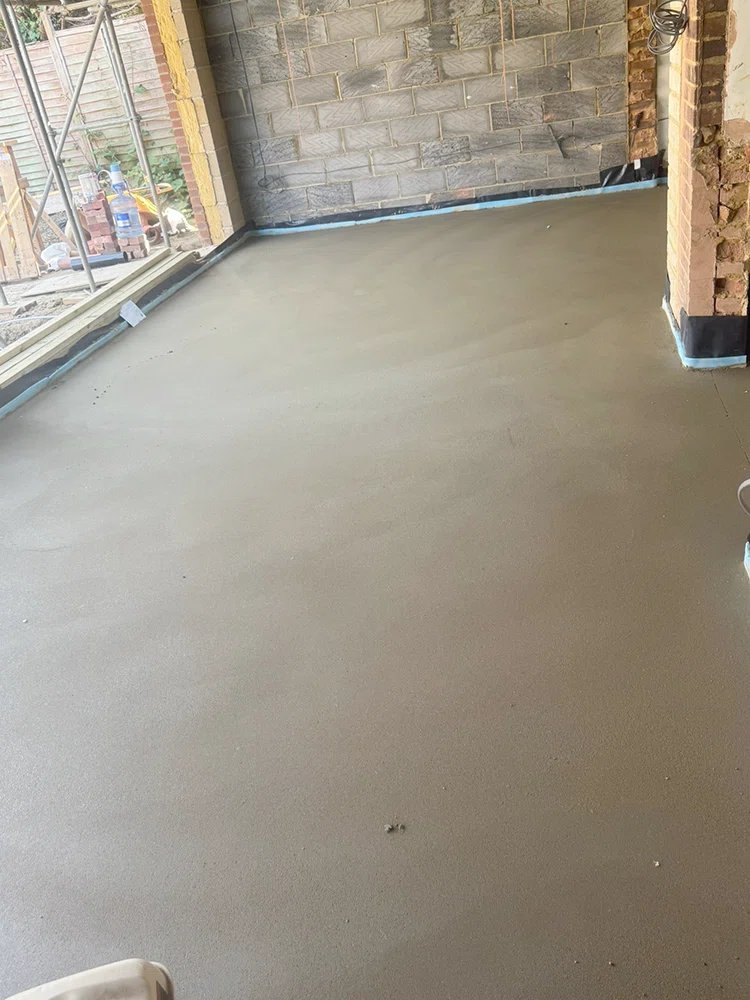
Replacing an old solid floor is a sequence, and the order is what makes it last. First the existing floor comes up, and we excavate until there is room for every layer going back in. A damp proof membrane goes down next, lapped and sealed at every joint and turned up the walls to meet the wall damp course. Insulation follows, then a separating layer, then the screed.
For a home, the floating screed on top is usually 65mm. That extra thickness, compared with a liquid screed, is worth planning for, because in an older building the finished level usually has to match an existing threshold or step. Our screed thickness guide sets out the depth for each method.
Some 14% of Whitstable's houses predate 1919, and a house that old may have poky rooms, a slim hallway and a step or two between floors. A hand-laid screed can be adjusted as it goes, compacted into corners and taken through a doorway in a way that a pumped floor cannot easily match.
Where the existing concrete is sound, dry and well bonded, and only a thin layer is possible because of a fixed threshold, a bonded screed of 25 to 40mm laid directly onto the prepared slab is an option. Getting the old floor out and the base ready is handled through our floor preparation service.
Wet rooms, garages and falls in Whitstable
Sand and cement is the screed for areas that will get wet. In a walk-in shower the screed is shaped by hand to fall towards the drain, and it has to be a cement base that takes water in its stride. Calcium sulphate screed is not suitable for that, so even when the rest of the floor is poured, the wet room is often laid traditionally.
Terraced homes make up 15% of the town's housing, and a ground floor bathroom or utility room in one of them is a typical place where this matters.
Converting a garage is the other place it earns its keep. A garage slab usually slopes and finishes below the house floor, so it gets insulation and a membrane, then screed deep enough to come level with the hall. See our guide to screeding a garage conversion for the layers.
Fibres can be mixed in to help control cracking, adding £1 to £3 per m², and quick drying additives shorten the wait before flooring. The trade-off with any sand and cement floor is drying: about a day per millimetre for the first 40mm, then slower.
Sand and Cement Screed prices in Whitstable
Sand and cement screed: £18 to £25 per m² supplied and laid (MyJobQuote, August 2026), so £450 to £630 for 25 m². MyJobQuote does not say whether these figures include VAT. See our floor screeding cost guide or screed calculator.
Who lays your sand and cement screed in Whitstable
K & B Screeding’s own team, led by director Donatas Bardisevicius. Founded 2019, company 12298780.
See what customers say in our Google reviews and on our testimonials page.
Sand and Cement Screed from Slough to Whitstable
As the crow flies, our yard in Slough is about 73.1 miles from Whitstable, which lies to the east. Postcodes here include CT5, and Herne Bay (4.5 miles), Canterbury (5.9 miles), Faversham (6.5 miles) and Sittingbourne (12.6 miles) are close by.
More on sand & cement screed, part of our screeding services.
