
Rebuilding solid floors in Wincheap's older houses
Wincheap has been a conservation area since 1996, and its streets mix 18th-century brick houses with Victorian terraces. Many of those terraces have no damp proof membrane under the ground floor, so a floor that has cracked, sunk or stayed damp is a familiar problem. Patching it rarely lasts.
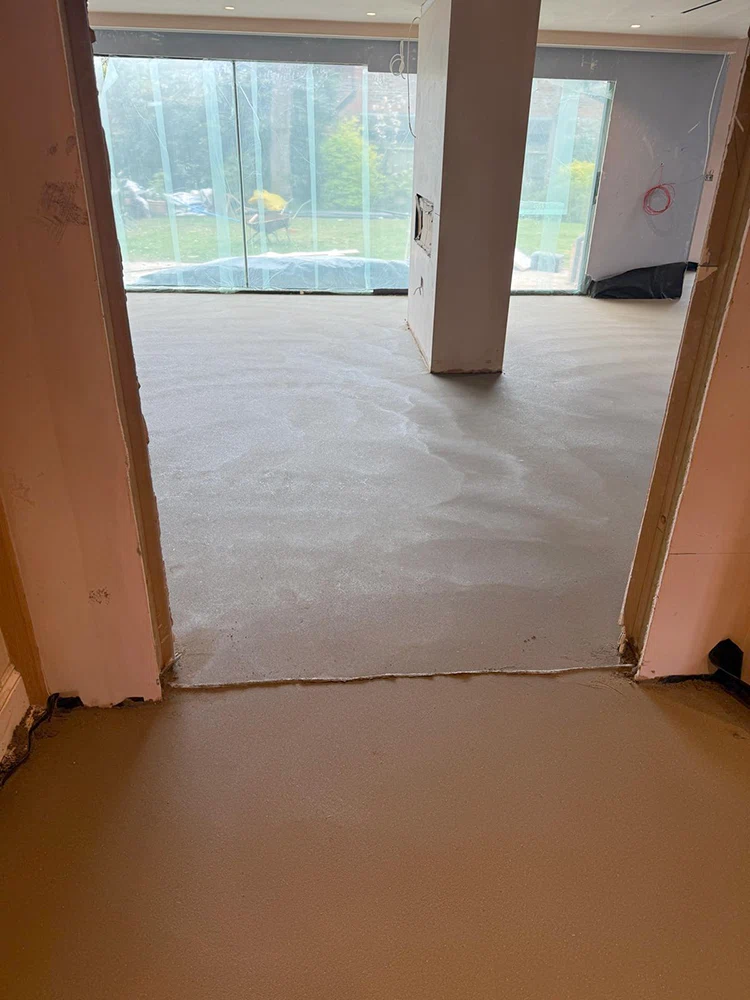
Doing it properly means lifting the old floor, excavating to depth, laying a membrane and insulation, and screeding over them. Over that insulation, a house floor gets 65mm of sand and cement and a commercial one 75mm. We mix it on site, compact it by hand and finish it level, which suits small rooms, narrow passages and doorways that a pump hose would struggle to serve.
Sand and cement also handles wet areas where calcium sulphate cannot go. A shower room or wet room can be laid to falls so water runs to the drain, and a utility floor sits on a cement base from the start. Where the floor cannot be built that high, a thinner screed bonded to the slab, 25 to 40mm, is the fallback.
Before any Canterbury floor is broken out, check whether the house is listed. Listed and conservation area properties inside and just outside the walls often need breathable build-ups rather than thick cement screeds, and the approach must be agreed first. We can put in the new damp barrier and boards as well, through our membrane and insulation work.
Garages, small rooms and drying times in Canterbury
Hand-laid screed is often the practical choice for smaller jobs around Canterbury: a single back room, a porch, a cloakroom or a garage being turned into a bedroom. On floors like these the cost of bringing in a pump outweighs the speed it offers, and a crew with a mixer and barrows can work through a narrow side passage.
A garage conversion needs its floor raised to meet the house, insulated and protected from damp. Our garage floor screed guide shows how that build-up is planned.
Drying is where sand and cement asks for patience. A 65mm floor needs weeks, not days: around 40 days just for the first 40mm, then a slower rate for the remaining 25mm, before any moisture-sensitive covering goes on. Fibres added to the mix to resist cracking put roughly £1 to £3 on each m², and an additive for rapid drying cuts the wait. More on that under faster drying screed mixes.
The mix can also be made stronger for floors that must take early load, such as trade counters and stores. For a large, open floor where speed matters more than access, compare liquid screed for Canterbury floors before deciding.
Sand and Cement Screed prices in Canterbury
Sand and cement screed: £18 to £25 per m² supplied and laid (MyJobQuote, August 2026), so £450 to £630 for 25 m². MyJobQuote does not say whether these figures include VAT. See our floor screeding cost guide or screed calculator.
Who lays your sand and cement screed in Canterbury
K & B Screeding’s own team, led by director Donatas Bardisevicius. Founded 2019, company 12298780.
See what customers say in our Google reviews and on our testimonials page.
Sand and Cement Screed from Slough to Canterbury
On the map, Canterbury sits east-south-east of Slough, about 76.5 miles from our base in a straight line (postcodes including CT1, CT2 and CT3), next to Whitstable (5.9 miles), Herne Bay (6.7 miles), Faversham (8.5 miles) and Ashford (12.8 miles).
More on sand & cement screed, part of our screeding services.