
Rebuilding old ground floors on Abbey Street and The Mall
Historic houses in Faversham are where sand and cement screed does its most careful work. The terraces and timber-framed houses along Abbey Street, and the Georgian and Victorian houses on The Mall, often have ground floors of failed concrete or brick. Putting a new finish over a floor like that only covers the problem up.
On Abbey Street or The Mall that normally means breaking up the old floor, excavating to suit the new build-up, putting in a compacted sub-base and slab if needed, then the membrane and insulation, and only after that the screed. The demolition and clearing out can be handled by our floor preparation team. On top of insulation a house screed goes down at around 65mm, so the insulation has to be sized to suit old thresholds and door heights that are staying where they are.
Hand-laid screed also adapts to what an old building throws at it. Walls are rarely square, rooms step up or down, and an old hearth or chimney breast can interrupt the floor. The mix is made on site, so a small back room, a hallway and a scullery can each be laid to their own level in one visit, then compacted and finished flat.
For a listed building, check what the conservation officer expects before the old floor comes up. We lay the screed to the agreed specification, and we will tell you plainly if a detail looks likely to cause trouble later.
Wet rooms, garages and falls in Faversham houses
Sand and cement is the screed to use wherever water is part of the room. Calcium sulphate screeds do not suit floors that may get wet, so a wet room, a shower area laid to a fall, a utility room with a floor drain or a covered yard needs a cement base. We form the falls by hand towards the drain, so water runs away from the walls rather than pooling in a corner.
It is also the usual screed when a garage becomes a room. The floor is raised to meet the house level, insulated, given a membrane and then screeded. We list each layer in our garage conversion floor guide.
Where a floor must resist cracking or take knocks, the mix can be adapted, with fibres added at about £1 to £3 per m² extra, or a fibre reinforced screed specified from the start.
Where it loses out is drying. A 65mm sand and cement screed takes far longer to dry than its liquid equivalent, and it should not be heated for at least 21 days. For depth choices on each kind of floor, see our screed thickness guide.
Sand and Cement Screed prices in Faversham
Sand and cement screed: £18 to £25 per m² supplied and laid (MyJobQuote, August 2026), so £450 to £630 for 25 m². MyJobQuote does not say whether these figures include VAT. See our floor screeding cost guide or screed calculator.
Who lays your sand and cement screed in Faversham
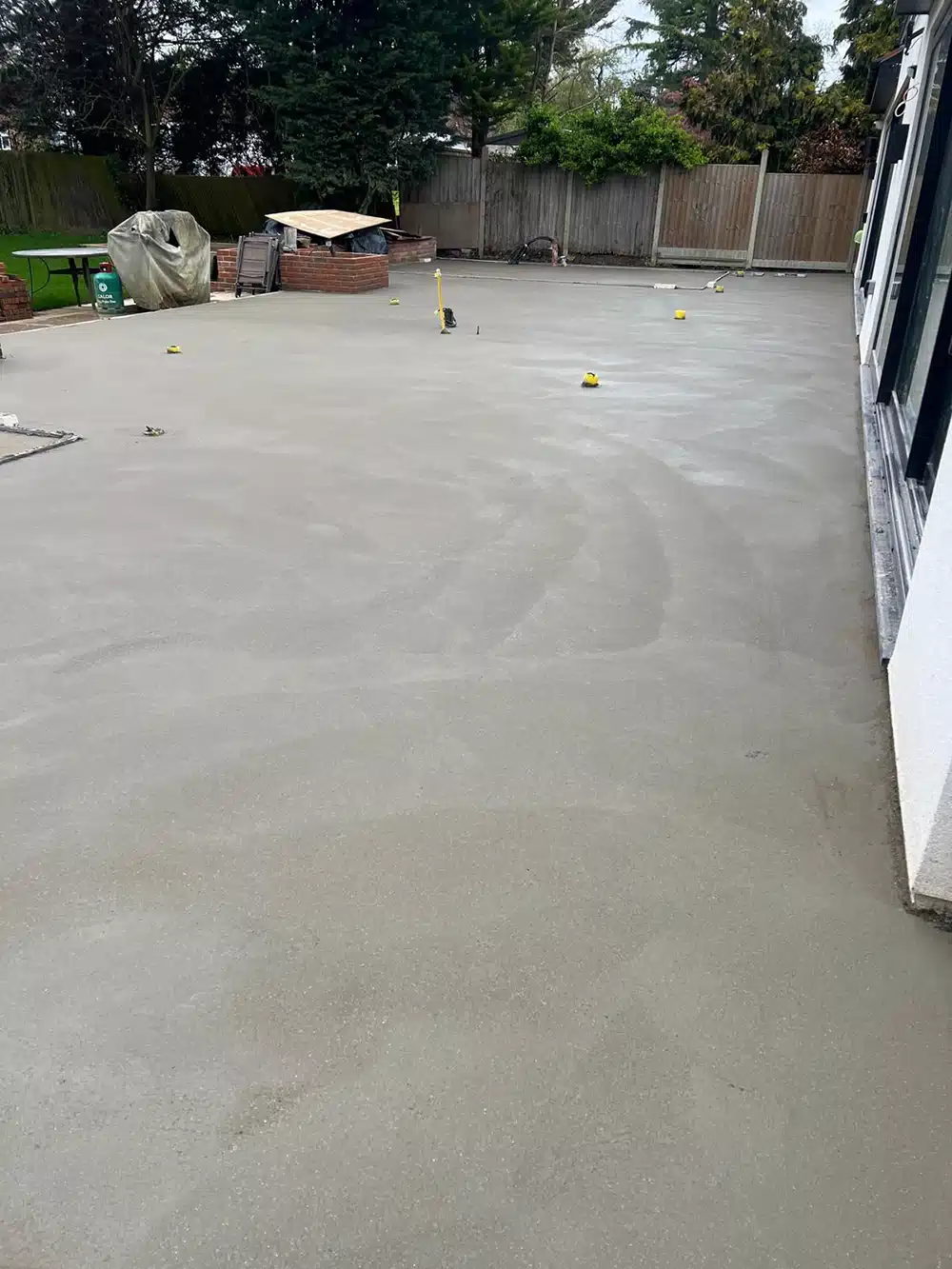
K & B Screeding’s own team, led by director Donatas Bardisevicius. Founded 2019, company 12298780.
See what customers say in our Google reviews and on our testimonials page.
Sand and Cement Screed from Slough to Faversham
As the crow flies, our yard in Slough is about 68.1 miles from Faversham, which lies to the east. Postcodes here include ME13, and Whitstable (6.5 miles), Sittingbourne (7 miles), Canterbury (8.5 miles) and Herne Bay (10.9 miles) are close by.
More on sand & cement screed, part of our screeding services.