Fibre reinforcement is one of the simplest and most cost effective ways to improve a traditional sand and cement screed. Millions of fine polypropylene fibres are mixed evenly through the material, so there is reinforcement in every part of the floor, including the corners, doorways and edges that are hardest to protect. K & B Screeding lays it across London and the Home Counties.
We recommend fibre reinforced screed on floating floors, over underfloor heating and on new build housing, where the risk of shrinkage cracking is highest.
How fibres stop screed cracking
As a screed cures it loses water, and as it loses water it wants to shrink. In the first hours and days, while the screed is still weak, that shrinkage concentrates into fine cracks. They tend to appear at doorways, bay windows, around columns and at internal corners, where the floor changes shape.
Polypropylene fibres work in three dimensions to resist that early movement. They bridge the micro-cracks as they try to form and hold them closed until the screed has gained enough strength to resist cracking on its own. The result is a denser, more cohesive screed with far fewer visible cracks under the floor finish.
What fibres do and do not do
It is worth being clear about this, because fibres are sometimes oversold.
- They do control plastic shrinkage cracking, reduce curling at edges, and improve toughness and resistance to damage during the build.
- They do not replace good workmanship. A screed that is badly compacted, laid too thin, or missing its movement joints can still crack.
- They are not structural reinforcement. Fibres are not a substitute for steel reinforcement where a structural engineer has specified it.
That is why we pair fibre reinforcement with correct depth, proper compaction and well placed joints. Together they give a floor that stays sound for decades.
Where we recommend fibre reinforced screed
- Floating screeds over insulation, where the screed is not bonded to anything and relies on its own integrity.
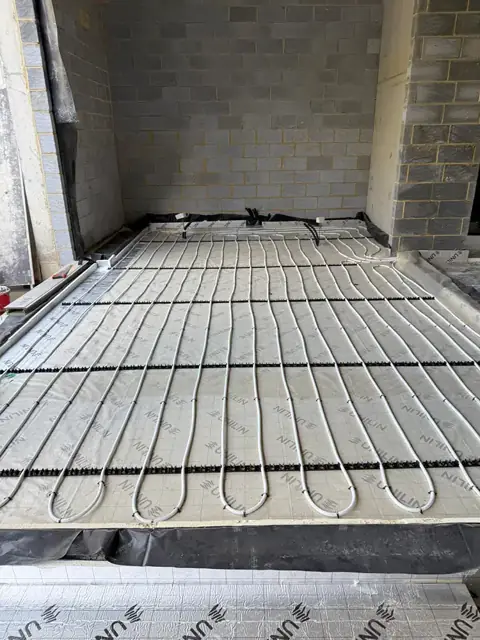
- Heated floors, where the screed expands and contracts with every heating cycle. See underfloor heating screed.
- Irregular floor plans with lots of corners, bays and openings that concentrate stress.
- New builds and extensions, where the programme often puts early demands on the floor.
- Floors with steel mesh omitted, where fibres give useful crack control as an alternative for non-structural screeds.
Laying and finishing
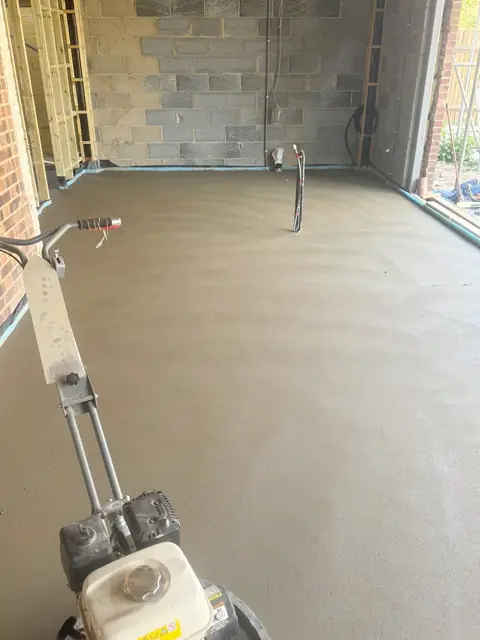
Fibre reinforced screed is laid, compacted, ruled off and finished exactly like a traditional sand and cement screed. On larger areas we power float it to a close, dense surface. The fibres are dispersed evenly during mixing, so they do not clump or show on the finished surface once it has been floated.
It is fully compatible with the usual floor finishes, including tiles, stone, vinyl, LVT, laminate, engineered wood and carpet, once it has dried to the level the flooring manufacturer requires.
Depth and drying
Adding fibres does not change the thickness rules. Floating screeds over insulation are typically 65mm in homes and 75mm in commercial buildings, and bonded screeds are thinner. See our screed thickness guide for the detail.
Fibres also do not change drying time. If the programme is tight, fibres can be combined with a rapid drying additive, as in our quick drying screed.
Fibre reinforcement or steel mesh?
Before fibres became common, screeds were sometimes reinforced with light steel mesh laid mid-depth. Mesh still has a place, but for most non-structural floor screeds fibres are the more practical choice.
| Polypropylene fibres | Light steel mesh | |
|---|---|---|
| Where it sits | Throughout the full depth | One level, usually mid-depth |
| Controls early shrinkage cracking | Yes, very effectively | Limited |
| Holds cracks together after they form | Limited | Yes |
| Affects compaction | No | Can make compaction harder |
| Risk of being laid in the wrong place | None | Mesh often ends up at the bottom |
| Speed on site | No extra work | Extra handling and positioning |
Swipe the table sideways to see every column.
Where a designer has specified mesh, we lay it. Where the choice is ours, fibres usually give the better result for a floating or heated floor.
Fibre reinforced screed near you
We lay fibre reinforced screed across London and the Home Counties from our base in Slough, including sand screed in Slough, High Wycombe, Northampton and throughout London.
“From start to finish, K & B Screeding Ltd demonstrated exceptional expertise and a commitment to customer satisfaction. I am extremely impressed with the service that they provide.”
Part of our screeding and floor screeding services, laid by our own team across London and the Home Counties.