
Calcium sulphate grades on Canterbury specifications
Calcium sulphate screeds are labelled with a code from the European standard covering screed materials. The C figure tells you its compressive strength, while F gives flexural strength, each in N/mm2. For housing, three grades cover most floors. CA-C20-F4 suits domestic rooms with light traffic. Most houses, flats and offices end up with CA-C25-F5. Floors facing harder wear move up to CA-C30-F6.
On Canterbury's newer housing and flats the grade is set in the engineer's specification, and we pour that grade and no other. Now and then the specification names an alpha hemihydrate product, picked because it dries faster or can go down thinner. In that case the manufacturer's own sheet, not a general rule, sets the depth and the drying time.
What makes calcium sulphate useful on site is how little it shrinks. That lets big areas go down in single bays with much less jointing than cement would need, handy across an open-plan ground floor or a full storey of apartments. Doorways and the line between two heating zones still need joints, and we set out where every bay and joint will go before the screed arrives.
University buildings in Canterbury also need screeds matched to their loads, which may point to a higher grade or to a different material altogether, and those are priced under commercial screeding for larger buildings. There is more on the material in our anhydrite screed guide.
Laitance, moisture and wet rooms in Canterbury flats
As it dries, calcium sulphate leaves a fragile film on top known as laitance. It has to be sanded off once the floor is dry, or the adhesive for tiles or LVT bonds to that crust instead of the screed. Once sanded, it takes a primer made to work on calcium sulphate. One meant for cement screeds should not be used instead.
Moisture is the second check. Flooring makers often want calcium sulphate drier than a cement screed before they will cover it, so a reading that would satisfy a tiler on sand and cement can still be too wet on anhydrite. The only reliable answer comes from a hygrometer test on the floor itself. Where heating is installed, it can usually be used to force dry the screed from around day 7, which takes time off the wait.
Anywhere that may stay damp is the wrong place for calcium sulphate. In a Canterbury flat with an en-suite or a wet room, those rooms need a cement based flowing screed or a sand and cement screed for wet rooms, even when the rest of the flat is poured in anhydrite. Where the specification leaves the material open, compare the pumped liquid screed options first.
Anhydrite & Flow Screed prices in Canterbury
Liquid flowing screed (which includes anhydrite): £24 to £31 per m² supplied and laid (MyJobQuote, August 2026), so £960 to £1,240 for 40 m². MyJobQuote does not say whether these figures include VAT. See our floor screeding cost guide or screed calculator.
Who lays your anhydrite and flow screed in Canterbury
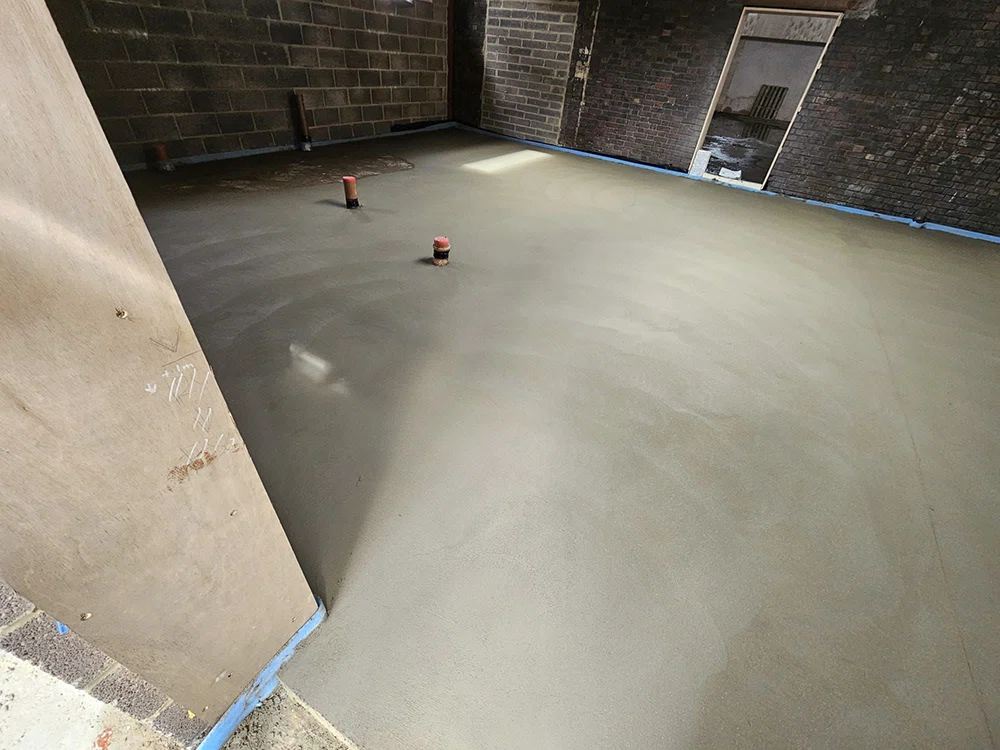
K & B Screeding’s own team, led by director Donatas Bardisevicius. Founded 2019, company 12298780.
See what customers say in our Google reviews and on our testimonials page.
Anhydrite & Flow Screed from Slough to Canterbury
On the map, Canterbury sits east-south-east of Slough, about 76.5 miles from our base in a straight line (postcodes including CT1, CT2 and CT3), next to Whitstable (5.9 miles), Herne Bay (6.7 miles), Faversham (8.5 miles) and Ashford (12.8 miles).
More on anhydrite screed, part of our screeding services.