
CA grades and products for Maidstone flats and new homes
Every calcium sulphate screed has a code, CA-C25-F5 being one. The letters CA give the material type, the number after C its compressive strength and the number after F its flexural strength, in N/mm2 under the BS EN screed standard.
The three common grades line up with use. Light domestic traffic calls for no more than CA-C20-F4. The middle grade, CA-C25-F5, suits the bulk of houses, flats and offices and turns up in many specifications. Heavier wear means CA-C30-F6. On a new development or a block of flats, the architect or developer normally names the grade, and we lay to it.
Then come alpha hemihydrate products, used when the programme needs a quicker dry or the floor can only take a slim layer, and each is governed by its own product sheet instead of the general rules.
Low shrinkage is why calcium sulphate is used on so many new floors. It allows larger bays and fewer joints than sand and cement, which keeps open-plan apartments and new houses tidy under tiles and LVT. We still plan the bays and joints before the pour, so the layout is settled with the specification rather than decided on the day. For the background, see our explainer on anhydrite screed.
We prepare the whole build-up ourselves, from insulation and membrane to edge strip, so the base is right for the grade.
Before flooring goes down in a Maidstone apartment
Two checks come before any floor covering on calcium sulphate, and skipping either is a common cause of failed floors in new flats.
Check one is laitance, the weak crust left on top as the screed cures. When the floor is dry it gets sanded away, and the bare surface is primed with something compatible with calcium sulphate. Adhesives and compounds laid straight onto laitance can let go.
The second is moisture. Flooring makers often hold a calcium sulphate base to a stricter moisture reading than a cement one, so a flat at Wallis Fields or Langley Park may need its floor drier than the buyer would guess. We test with a hygrometer. Using the heating to speed drying is usually possible from about 7 days, and the warm-up steps are on our Maidstone page for heated screed floors.
Keep it away from water. Bathrooms with walk-in showers, and any floor that may get wet, take a flowing screed made with cement instead. If a thin sheet finish needs extra flatness after sanding, our floor levelling work in Maidstone follows on. We hand over the sanding, priming and drying advice in writing, so the flooring contractor knows exactly what state the floor is in.
Anhydrite & Flow Screed prices in Maidstone
Liquid flowing screed (which includes anhydrite): £24 to £31 per m² supplied and laid (MyJobQuote, August 2026), so £960 to £1,240 for 40 m². MyJobQuote does not say whether these figures include VAT. See our floor screeding cost guide or screed calculator.
Who lays your anhydrite and flow screed in Maidstone
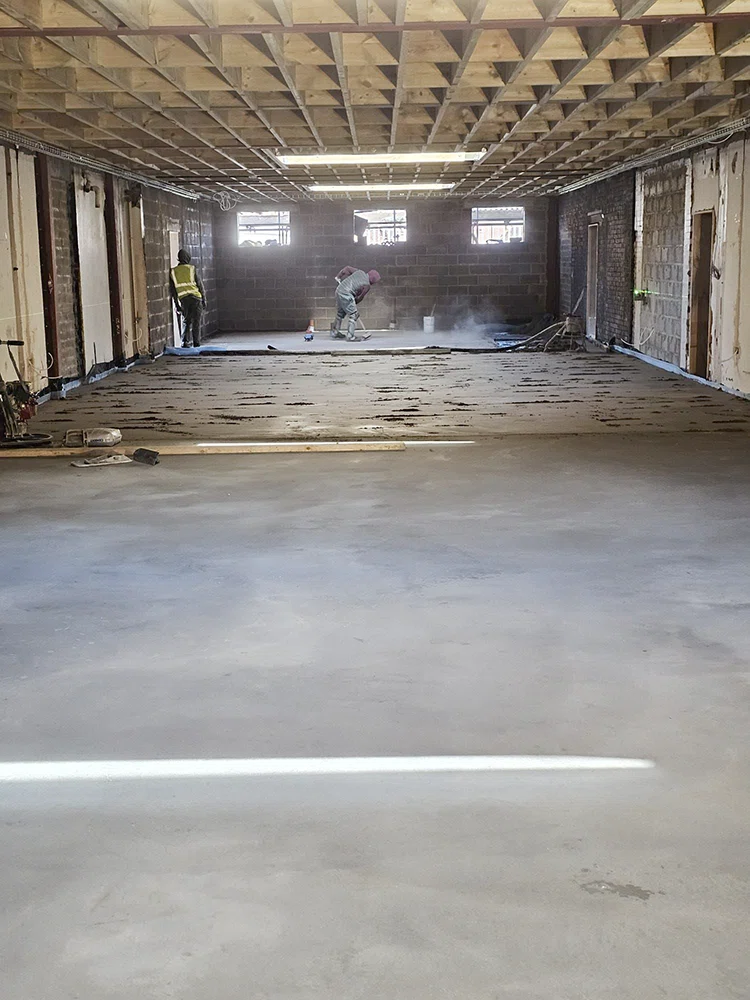
K & B Screeding’s own team, led by director Donatas Bardisevicius. Founded 2019, company 12298780.
See what customers say in our Google reviews and on our testimonials page.
Anhydrite & Flow Screed from Slough to Maidstone
On the map, Maidstone sits east-south-east of Slough, about 53.5 miles from our base in a straight line (postcodes including ME14, ME16, ME17 and ME15), next to Snodland (5.2 miles), Gillingham (7.1 miles), Chatham (7.7 miles) and Rochester (8.1 miles).
More on anhydrite screed, part of our screeding services.
