
Heated extensions on Shepway and Ringlestone semis
The typical project is a single storey extension on a post-war semi, opening into the kitchen to make one family room, with wet underfloor heating throughout. Post-war building accounts for a large part of the town, with 25% of Maidstone's homes dating from 1945 to 1972. Extending one of these houses usually means joining a new heated floor to an older solid one, and the two have to finish at the same height.
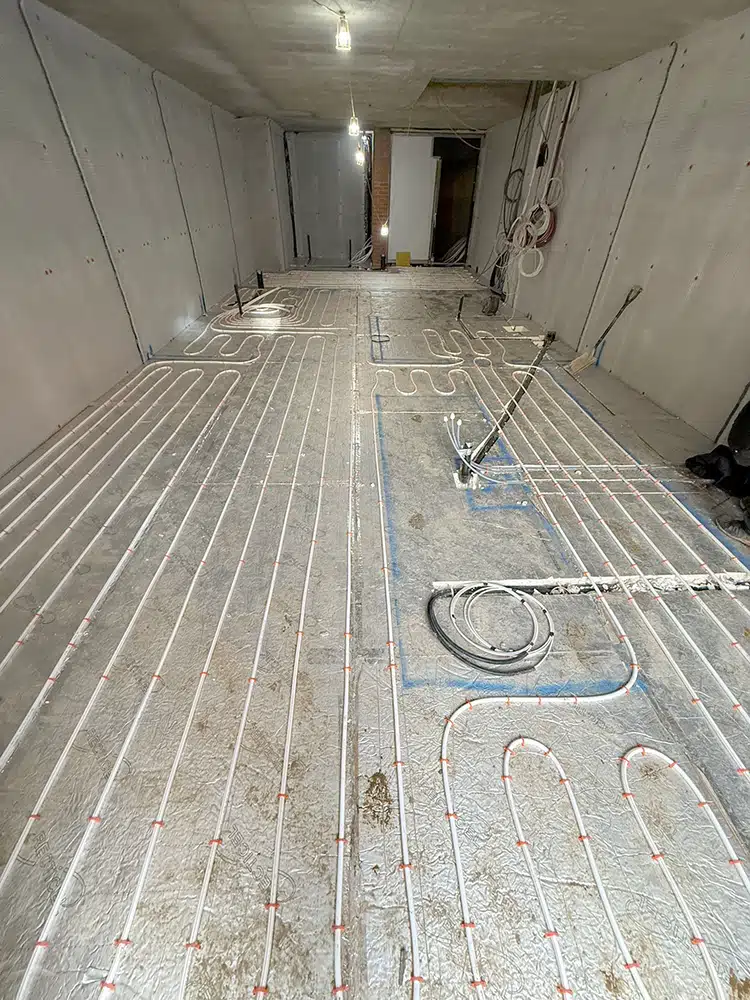
The screed has three jobs over the pipes. It must surround them without air pockets, carry enough depth to spread heat evenly and resist cracking, and finish flat enough for tiles, LVT or engineered wood. Pour a flowing screed and you need 25mm or more above the pipes, around 45 to 50mm overall. Lay sand and cement and that cover rises to about 45mm, so the whole floor is thicker.
On a Shepway or Ringlestone semi, the heated extension floor must run into the old kitchen with no step. That sets the total depth of insulation, pipes and screed, and it is often the reason a liquid screed for the extension is chosen over sand and cement. Minimum depths are listed in our screed depth guide.
Ahead of the pour we go over the edge strip, membrane and insulation, and we want the pipework pressure tested first. We can supply and fit the insulation and membrane if they are not already down.
Maidstone retrofits and the first heat-up
Putting underfloor heating into an older Maidstone house, rather than a new extension, is harder because the floor height is already fixed by doors, stairs and the rooms around it. Sometimes the old solid floor has to be dug out so that insulation, pipes and screed fit within the same height. That dig-out is where a new sand and cement floor often comes in, because it can be laid by hand to exactly the depth left over, room by room, and it copes with the thresholds and small spaces of an older house.
Whatever the screed, the heating must not go on at full power straight away. With calcium sulphate, warming can normally begin about 7 days in; sand and cement needs 21 days or longer. Commissioning then goes step by step, a few degrees at a time, and our written heat-up notes keep you and your heating engineer on one schedule.
Liquid screed over heating pipes is published at £20 to £35 per m². We include the insulation and membrane in the same written price where they are needed. If the finish is thin LVT or vinyl, a light skim of compound after drying may also be worth pricing, and we flag that at the quote stage rather than on the day.
Underfloor Heating Screed prices in Maidstone
Liquid screed over underfloor heating: £20 to £35 per m² supplied and laid (trade2base, June 2026), so £700 to £1,230 for 35 m². trade2base gives these figures excluding VAT. See our floor screeding cost guide or screed calculator.
Who lays your underfloor heating screed in Maidstone
K & B Screeding’s own team, led by director Donatas Bardisevicius. Founded 2019, company 12298780.
See what customers say in our Google reviews and on our testimonials page.
Underfloor Heating Screed from Slough to Maidstone
On the map, Maidstone sits east-south-east of Slough, about 53.5 miles from our base in a straight line (postcodes including ME14, ME16, ME17 and ME15), next to Snodland (5.2 miles), Gillingham (7.1 miles), Chatham (7.7 miles) and Rochester (8.1 miles).
More on underfloor heating screed, part of our screeding services.