
Heated floors in Twydall, Wigmore and Hempstead extensions
Underfloor heating and extensions go together. When a semi or terrace on an estate such as Twydall, Wigmore or Hempstead gains a new kitchen and family room, or an old conservatory is replaced with a solid room, the floor is built from scratch. That is the easiest point to add wet underfloor heating, and the screed is what makes it perform.
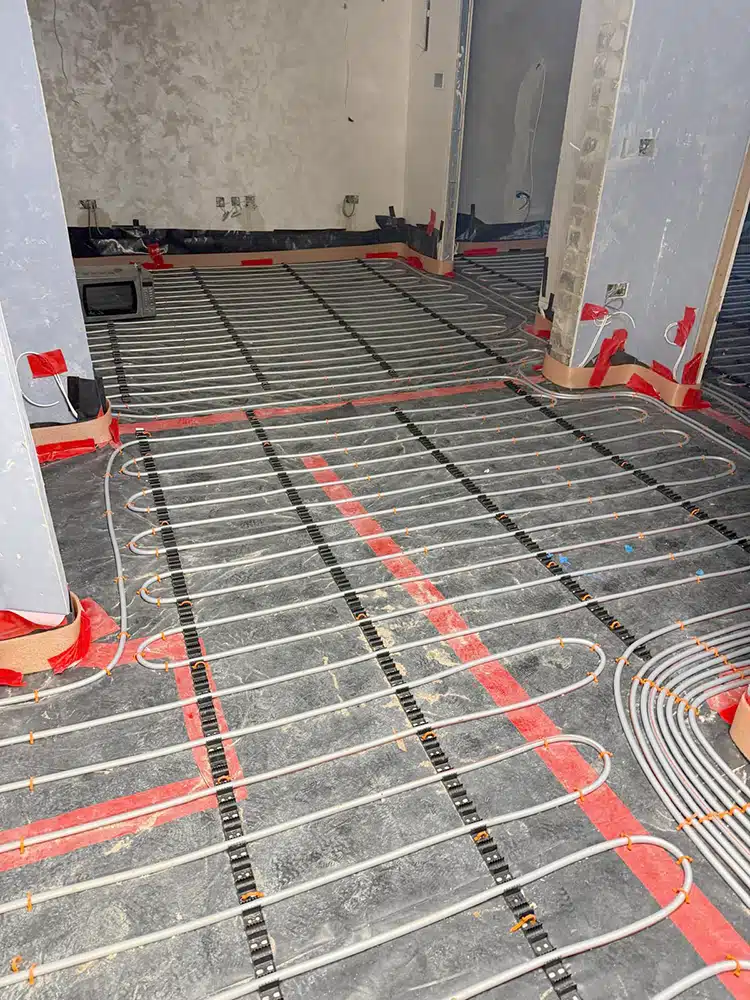
How deep the floor ends up depends on what sits over the pipes. With liquid the pipes must be buried by 25mm or more, for a floor around 45 to 50mm deep. Choose sand and cement and that cover grows to around 45mm, raising the total. Liquid also wraps each pipe completely, leaving no air gaps, which spreads heat evenly and warms the room more quickly. Our liquid screed page for Gillingham covers that method, and published 2026 figures for liquid screed over heating run from £20 to £35 per m².
Homes from 1973 to 1999 make up 18% of the town, and extensions to them face the same question at the doorway: the full build-up of insulation, pipes and screed has to fit between the ground and the existing floor level.
Insulation below the pipes stops heat escaping into the ground. We check that it is continuous, that the membrane and edge strip are in place, and that the pipes are secured before we pour.
Retrofit heating in older Gillingham terraces
Older terraces make it a tougher job. Floors in older houses rarely have spare depth, and a New Brompton kitchen floor that has to be dug out for a membrane anyway is often the natural moment to fit pipes. The dig must be deep enough for insulation, pipes and screed while the finished floor still matches the hall and the back door. A thinner liquid screed often makes the difference, while sand and cement over pipes needs more room.
After the pour, patience protects the floor. Heating has to wait: roughly 7 days for calcium sulphate, a minimum of 21 for sand and cement. Then, following the commissioning schedule, bring the temperature up from low in stages across several days instead of turning it straight to maximum. A controlled heat-up also helps the screed dry before flooring goes down.
For planning the whole build-up, see our screed thickness guide. If the heating is part of a wider renovation, the main Gillingham floor screeding page explains how the different screeds fit together.
Underfloor Heating Screed prices in Gillingham
Liquid screed over underfloor heating: £20 to £35 per m² supplied and laid (trade2base, June 2026), so £700 to £1,230 for 35 m². trade2base gives these figures excluding VAT. See our floor screeding cost guide or screed calculator.
Who lays your underfloor heating screed in Gillingham
K & B Screeding’s own team, led by director Donatas Bardisevicius. Founded 2019, company 12298780.
See what customers say in our Google reviews and on our testimonials page.
Underfloor Heating Screed from Slough to Gillingham
As the crow flies, our yard in Slough is about 54 miles from Gillingham, which lies to the east. Postcodes here include ME8 and ME7, and Chatham (2.5 miles), Rochester (3.5 miles), Snodland (6.5 miles) and Sittingbourne (7.1 miles) are close by.
More on underfloor heating screed, part of our screeding services.