
Pipe cover and depth in Snodland extensions
Pipes on their own do not make a warm floor; the screed around them does that job. It spreads warmth across the room and protects the pipes from load, so the depth above them is set by the screed type, not by preference.
Pour liquid screed and you need no less than 25mm above the pipes, so the floor normally measures 45 to 50mm from the insulation up. Because it flows, liquid screed wraps fully around each pipe with no voids, and the thinner section warms up faster. That combination is why it suits the rectangular extensions added to Snodland's semis and terraces.
Sand and cement needs more over the pipework, about 45mm, so the finished floor is thicker and heavier. It is still the right choice where the heated floor is a wet room, or where the builder prefers a cement base under a particular tile system. The sand and cement screed page for Snodland covers that route.
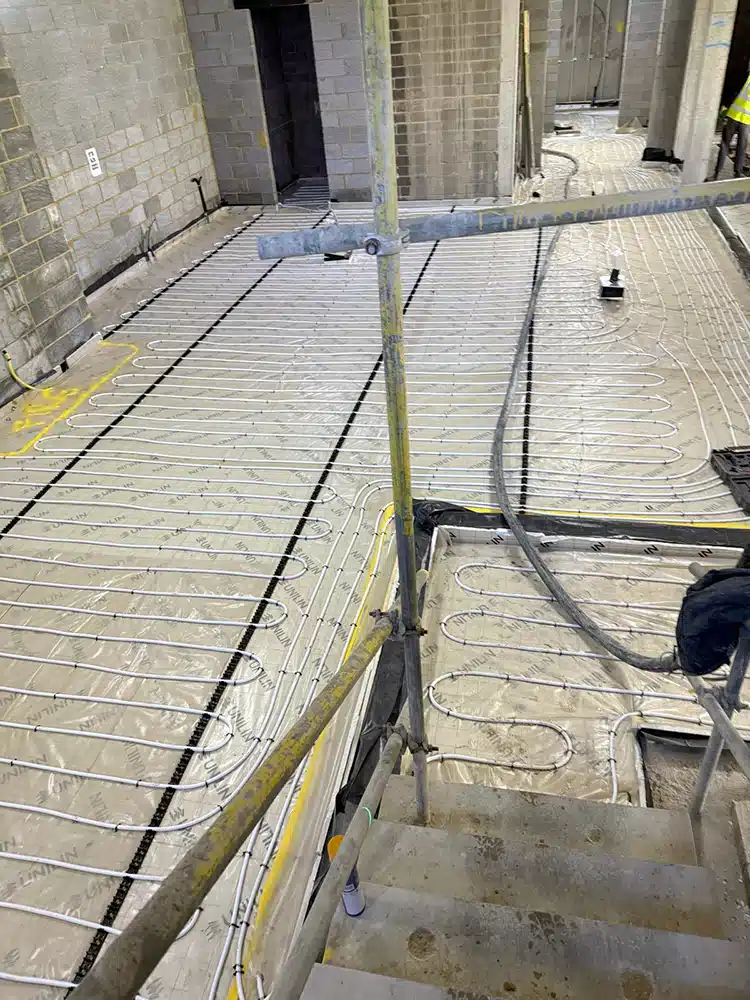
On pour day the insulation boards, membrane and perimeter edge strip need to be down already, with every pipe clipped in place and pressure tested. We look over those layers when we arrive, and if your heating kit came without them we can provide the insulation boards, membrane and edge strip.
Homes built since 2000 make up 24% of Snodland's stock, so a heated floor here is more often added to an older house. Retrofits in those homes are harder, and the next section explains why.
Retrofits and heat-up in older Snodland homes
Putting underfloor heating into an existing Snodland house usually means lifting the old floor. The difficulty is height. Insulation, pipes and screed together take up more depth than a thin old floor, and the finished level still has to meet the doors, the stairs and the kitchen units.
Liquid screed earns its place here, since the pipes need a thinner layer on top. Where the depth is very tight, the old slab may have to be broken out and lowered, which is a decision to make before the heating is ordered. To see how insulation, pipes and screed stack up, look at our guide to screed depths.
Commissioning is the other stage people rush. Calcium sulphate can take heat from around day 7, kept low to begin with and raised gradually. Leave sand and cement unheated for 21 days at the very least. Turning the system up fast to dry a floor quickly can crack it, so the heat-up schedule is handed over with the job.
Flooring goes down once the screed has been tested dry, not when the calendar says so. For a pumped option over pipes, see liquid screed in Snodland, and for the same work nearby, underfloor heating screed in Chatham.
Underfloor Heating Screed prices in Snodland
Liquid screed over underfloor heating: £20 to £35 per m² supplied and laid (trade2base, June 2026), so £700 to £1,230 for 35 m². trade2base gives these figures excluding VAT. See our floor screeding cost guide or screed calculator.
Who lays your underfloor heating screed in Snodland
K & B Screeding’s own team, led by director Donatas Bardisevicius. Founded 2019, company 12298780.
See what customers say in our Google reviews and on our testimonials page.
Underfloor Heating Screed from Slough to Snodland
As the crow flies, our yard in Slough is about 49 miles from Snodland, which lies to the east-south-east. Postcodes here include ME6, ME19 and ME20, and Rochester (4.9 miles), Maidstone (5.2 miles), Chatham (5.2 miles) and Gillingham (6.5 miles) are close by.
More on underfloor heating screed, part of our screeding services.
