
Awkward bases under Snodland kitchen and bathroom refits
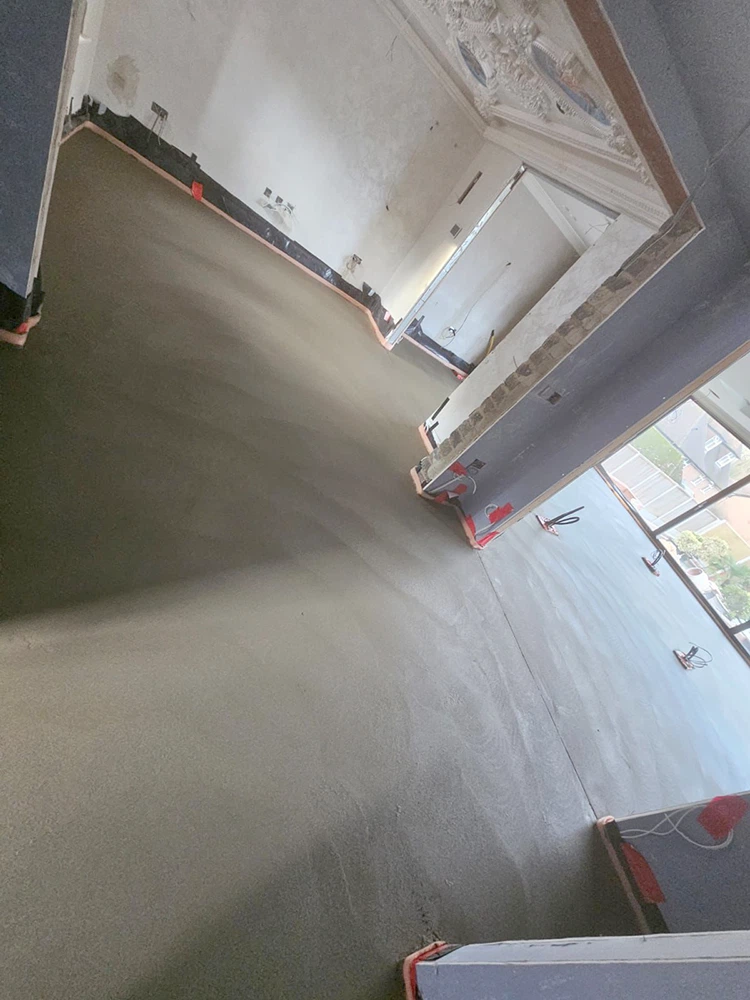
The name comes from the liquid half of the pack. A plain levelling compound is mixed with water; a latex screed swaps that water for a latex emulsion, which helps the mix grip the base and tolerate slight movement. It goes on thin, usually a few millimetres, and its whole job is to hide what lies underneath.
In a town that grew on lime quarrying and paper making and is still adding houses, what lies underneath varies from one street to the next. Strip out a Snodland kitchen or bathroom and the base could be timber boards, quarry or ceramic tiles, an old concrete floor, or a skin of adhesive left by a previous covering.
Each of those can take latex, on conditions. Timber is overboarded first with flooring grade plywood, screwed down at close centres, because latex spread straight onto bare boards cracks along the joints as they move. Old tiles have to be firmly bonded: we tap across the floor, lift any that ring hollow and fill the holes. Concrete must be sound and dry. Old adhesive can stay only if it is thin, hard and well stuck; anything soft or flaking is taken off, and our floor preparation service covers that stripping.
Priming is matched to the base, because porous concrete, glazed tile and plywood each need a different product. A calcium sulphate screed always has its laitance removed and a suitable primer applied before latex goes on.
The finishes that call for this care are the thin ones that copy every flaw beneath them: sheet vinyl, LVT, lino, rubber and safety flooring. Carpet benefits too where the base is rough.
When latex will not fix a Snodland floor
Latex smooths a surface. It does not repair a floor, and three conditions stop us before any bag is opened.
Damp comes first. An older solid floor, or one in a house built before damp proof membranes were usual, may let moisture through. Latex laid over a wet base can blister or lose its bond, and it does nothing to hold the damp back. We test first, and a damp floor goes back to a membrane and a new screed, often a hand-laid sand and cement rebuild.
Movement is second. If the boards bounce underfoot, a thin compound will crack whatever plywood sits on top. That calls for joinery: refixing or replacing boards and checking the joists, then overboarding.
Third is a floor that is badly out of level. A smoothing coat a few millimetres thick cannot take out a slope across a room or a deep hollow. For those floors, the Snodland page on deeper levelling compound and flatness classes explains the next step, and a new screed is sometimes the honest answer.
When the base passes those checks, latex is a quick way to a finish that lies flat. Each product has its own data sheet for drying before flooring, and we give you that timing with the quote. Only 9% of Snodland homes are detached, so in most houses the work happens beside lived-in rooms, and we keep the mixing outside. The same service runs in Maidstone.
How we price latex screed in Snodland
A fixed written price within 24 hours, once we know the area and the base. See our floor screeding cost guide.
Who lays your latex screed in Snodland
K & B Screeding’s own team, led by director Donatas Bardisevicius. Founded 2019, company 12298780.
See what customers say in our Google reviews and on our testimonials page.
Latex Screed from Slough to Snodland
As the crow flies, our yard in Slough is about 49 miles from Snodland, which lies to the east-south-east. Postcodes here include ME6, ME19 and ME20, and Rochester (4.9 miles), Maidstone (5.2 miles), Chatham (5.2 miles) and Gillingham (6.5 miles) are close by.
More on latex screed, part of our screeding services.
