
Anhydrite grades on Snodland plots and flats
Every anhydrite screed is labelled with a code set by the European standard that governs screed materials. The C figure gives compressive strength, the F figure flexural strength, both in N/mm2. Three grades cover most housing. A house floor that only sees light traffic can take CA-C20-F4. Step up to CA-C25-F5 for the majority of homes, apartments and offices. Heavier loads call for CA-C30-F6.
On a housing plot, the engineer or developer picks the grade, and we pour exactly that product without substitutes. Snodland has seen a lot of new building since the Holborough Quarry site was started by Berkeley Homes in 2005, and that kind of development is where a written specification usually arrives with the enquiry.
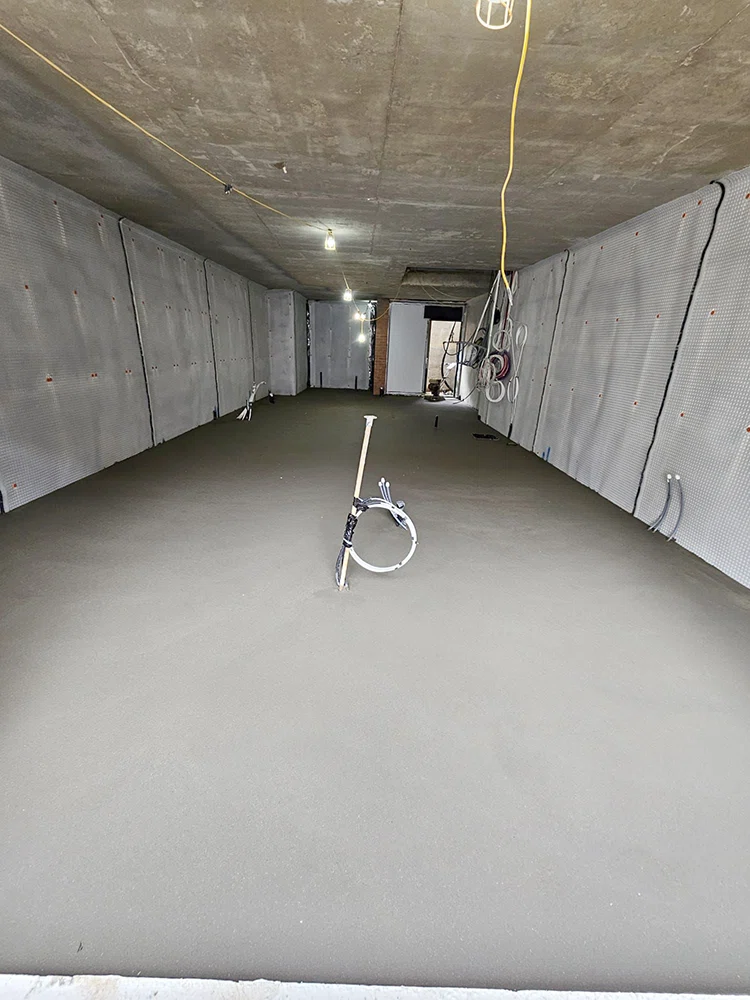
Snodland has 14% of its homes in purpose-built blocks of flats, and calcium sulphate suits apartment floors like theirs. Because it barely shrinks while setting, a big open bay needs only a handful of joints. Those few joints, usually at doorways or where one heating zone meets the next, are marked out before pumping starts.
Then there are the alpha hemihydrate screeds. A specifier picks one when the programme needs quicker drying or the floor has to be thinner, and each comes with a maker's data sheet setting its depth and drying time, which we follow. For the chemistry behind it, see how anhydrite screed works.
Laitance, moisture and wet areas in Snodland
As an anhydrite floor dries, a thin, weak crust known as laitance comes to the top. Leave it on and adhesive or compound grips that crust rather than the screed beneath, so it must be sanded away first. We sand once the floor has dried, then prime with a product made for calcium sulphate, since not every primer designed for cement screeds is suitable.
Moisture is the second check. Because flooring makers commonly set a tighter moisture limit on calcium sulphate than on cement, a surface that seems dry may not be. Our hygrometer gives a relative humidity reading, which we hold against the limit printed by the maker of your floor covering. Where the floor is heated, running the system from about 7 days helps force the drying along.
Anhydrite is the wrong choice anywhere water may sit on the floor. So a Snodland wet room, a tray-free shower or a utility room with leak risk goes on a cement based flowing screed, or on sand and cement laid by hand.
If an existing anhydrite floor has been tiled without sanding and the finish is lifting, the answer is usually removal, sanding and levelling before new flooring. We pour to the same specifications for anhydrite flow screed in Gillingham.
Anhydrite & Flow Screed prices in Snodland
Liquid flowing screed (which includes anhydrite): £24 to £31 per m² supplied and laid (MyJobQuote, August 2026), so £960 to £1,240 for 40 m². MyJobQuote does not say whether these figures include VAT. See our floor screeding cost guide or screed calculator.
Who lays your anhydrite and flow screed in Snodland
K & B Screeding’s own team, led by director Donatas Bardisevicius. Founded 2019, company 12298780.
See what customers say in our Google reviews and on our testimonials page.
Anhydrite & Flow Screed from Slough to Snodland
As the crow flies, our yard in Slough is about 49 miles from Snodland, which lies to the east-south-east. Postcodes here include ME6, ME19 and ME20, and Rochester (4.9 miles), Maidstone (5.2 miles), Chatham (5.2 miles) and Gillingham (6.5 miles) are close by.
More on anhydrite screed, part of our screeding services.
