
Calcium sulphate grades for Rochester apartment specifications
An engineer specifying calcium sulphate screed writes a code such as CA-C25-F5. CA means calcium sulphate. Under the European standard for screeds, C is followed by the compressive strength and F by the flexural strength, with both figures in N/mm2.
Three grades between them cover nearly every building. CA-C20-F4 sits at the bottom, meant for homes where foot traffic is light. CA-C25-F5, one step up, is what most houses, apartments and offices take. Heavier wear, on a commercial ground floor for instance, means CA-C30-F6. The higher numbers mean a stronger screed, not a thicker one, so the depth is still set by the build-up and the product sheet.
An alpha hemihydrate product turns up on some specifications. Designers choose one when the floor needs to dry faster or be thinner, and its own data sheet then sets the minimum depth and drying, which is what we follow.
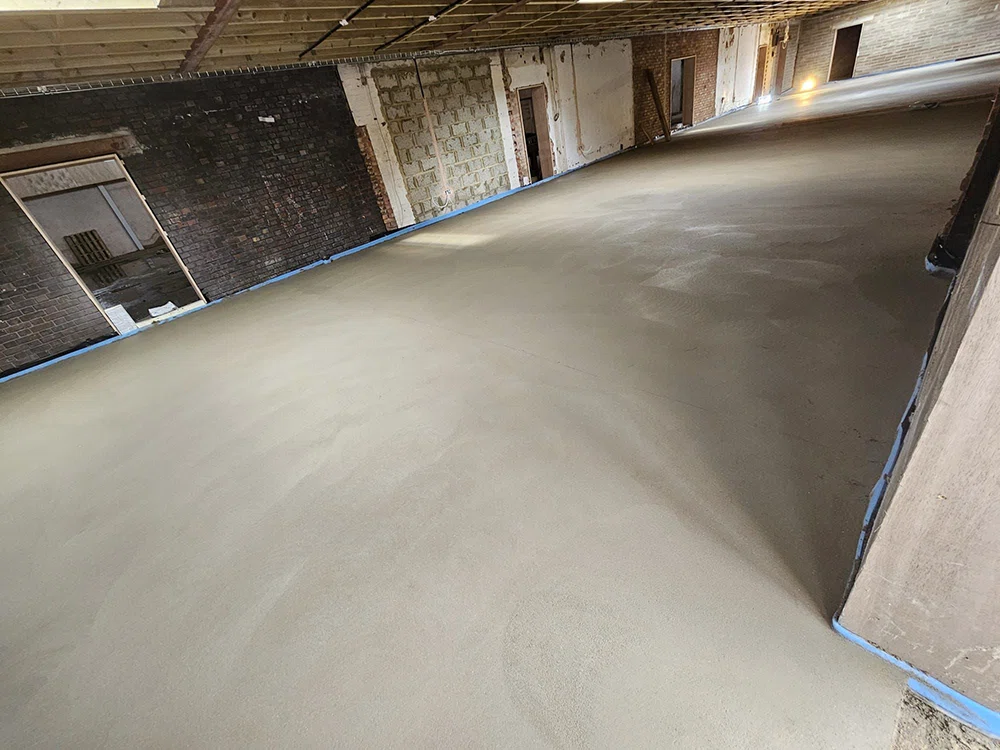
The practical strength of the material is how little it shrinks. Large bays can be poured with few joints, so an entire apartment floor goes down in one pour, over insulation, an acoustic layer or heating pipes. Bays and joints are drawn up ahead of pour day, with movement joints placed at doorways and where one heating zone meets the next.
On a site with dozens of plots, consistency matters. Every plot is poured to the same grade and depth, so the flooring contractor knows what they are working on. Our anhydrite screed explainer goes into how the material behaves.
Sanding, priming and testing floors in The Delce and Strood
Drying calcium sulphate leaves a fragile film on its surface, known as laitance. Glue a floor straight onto that and the bond can be no stronger than the skin. So when drying has progressed far enough, the laitance is sanded off and a primer that suits calcium sulphate goes on. This applies just as much to a single extension in The Delce as to a block of flats.
Moisture comes next. Flooring manufacturers frequently allow calcium sulphate less moisture than a cement screed, so no finish goes down in Strood or The Delce until a hygrometer says so. If there is heating in the floor, it can normally be used to force dry the screed once about 7 days have passed.
The material does have limits. Long exposure to water weakens it, which is why wet rooms, utility floors that could see a leak and anything outdoors are poured in a flowing screed with a cement base. In a Strood house where most rooms are on anhydrite, the bathroom may still be better on a hand-laid sand and cement screed. If a floor needs grinding or cleaning before any new layer, our concrete floor grinding service prepares it. We pour calcium sulphate in Snodland too.
Anhydrite & Flow Screed prices in Rochester
Liquid flowing screed (which includes anhydrite): £24 to £31 per m² supplied and laid (MyJobQuote, August 2026), so £960 to £1,240 for 40 m². MyJobQuote does not say whether these figures include VAT. See our floor screeding cost guide or screed calculator.
Who lays your anhydrite and flow screed in Rochester
K & B Screeding’s own team, led by director Donatas Bardisevicius. Founded 2019, company 12298780.
See what customers say in our Google reviews and on our testimonials page.
Anhydrite & Flow Screed from Slough to Rochester
As the crow flies, our yard in Slough is about 50.6 miles from Rochester, which lies to the east. Postcodes here include ME1, ME2 and ME3, and Chatham (1 miles), Gillingham (3.5 miles), Snodland (4.9 miles) and Gravesend (6.9 miles) are close by.
More on anhydrite screed, part of our screeding services.