
Anhydrite grades for Sittingbourne plots and apartments
Calcium sulphate screed designations follow a European standard. Take CA-C25-F5 on a Sittingbourne drawing: the CA is calcium sulphate, 25 is its compressive strength and 5 its flexural strength, both in N/mm2. The lighter duty CA-C20-F4 is meant for domestic floors with little traffic and CA-C30-F6 is kept for heavier use, leaving CA-C25-F5 in between as what most homes, apartments and offices get. On a housing plot or apartment floor, CA-C25-F5 is the usual grade, but the specification decides, and we lay what it names.
Sittingbourne's purpose-built blocks of flats hold 12% of its homes. Homes built between 2000 and 2014 account for 15%. These are the kinds of building where a flowing screed over insulation or heating is often specified, and where a developer expects the same grade from plot to plot.
A developer wanting plots handed over sooner, or a shallower floor, may name an alpha hemihydrate product instead. Those screeds are laid and dried by their own product sheet, not by the general rules.
Because calcium sulphate shrinks so little, bays can be large and joints few, and an open-plan Sittingbourne apartment can often go down as a single bay. Bay and joint positions are drawn up ahead of pour day. On a phased development, the same layout can be repeated plot after plot, which keeps drying times and handover dates predictable. For how the screed is delivered and pumped, see liquid screed in Sittingbourne.
Laitance, moisture and primer on Sittingbourne floors
Calcium sulphate needs more care after the pour than cement. Drying leaves a thin, weak laitance across the top. Since adhesive will not hold well on that layer, we sand it away once the floor is dry and vacuum up the dust. Our written handover covers laitance and drying so the flooring contractor knows the state of the floor.
Moisture limits are stricter. A hygrometer reading that a cement floor would pass can fail on calcium sulphate, because many flooring makers set the bar lower for it. On a busy Sittingbourne site with underfloor heating, running the system to its heat-up schedule from about 7 days usually lets the screed be force dried and keeps the programme on track.
Next, a primer that suits calcium sulphate as well as the adhesive and covering above goes on the sanded floor.
Wet floors are where calcium sulphate stops being an option. In bathrooms, wet rooms and anywhere that could flood, the screed should be a cement based flowing one or sand and cement laid for wet areas. Laboratory floors, such as those at Kent Science Park, follow their own specification; our commercial screeding page covers that work. For a fuller look at what anhydrite is, read anhydrite screed in plain terms.
Anhydrite & Flow Screed prices in Sittingbourne
Liquid flowing screed (which includes anhydrite): £24 to £31 per m² supplied and laid (MyJobQuote, August 2026), so £960 to £1,240 for 40 m². MyJobQuote does not say whether these figures include VAT. See our floor screeding cost guide or screed calculator.
Who lays your anhydrite and flow screed in Sittingbourne
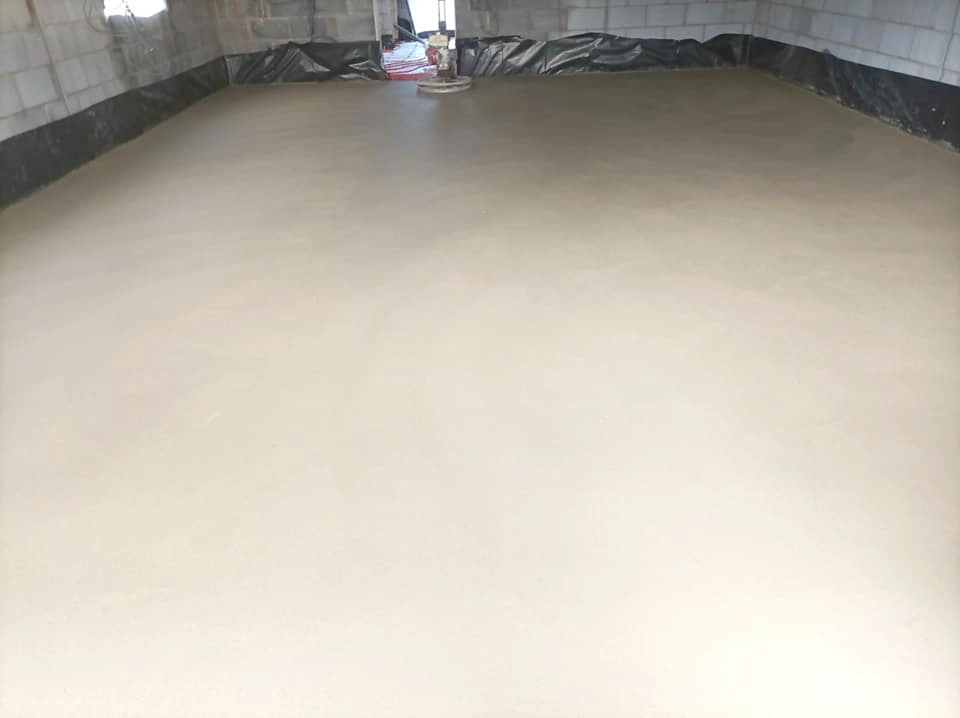
K & B Screeding’s own team, led by director Donatas Bardisevicius. Founded 2019, company 12298780.
See what customers say in our Google reviews and on our testimonials page.
Anhydrite & Flow Screed from Slough to Sittingbourne
Sittingbourne is about 61.1 miles east of our Slough base as the crow flies, with postcodes including ME10 and ME9. The nearest towns to it are Faversham (7 miles), Gillingham (7.1 miles), Chatham (9.6 miles) and Maidstone (10.4 miles).
More on anhydrite screed, part of our screeding services.
